The Last Mile Is the Offer. The Build Was Never the Hard Part.
Most AI projects don't die because the model is wrong. They die in the last mile — the part after the demo, where the thing has to be hosted, handed off, and kept alive in production. I run five companies where that last mile is exactly where a normal project would die, and doesn't. This is the playbook for crossing it.
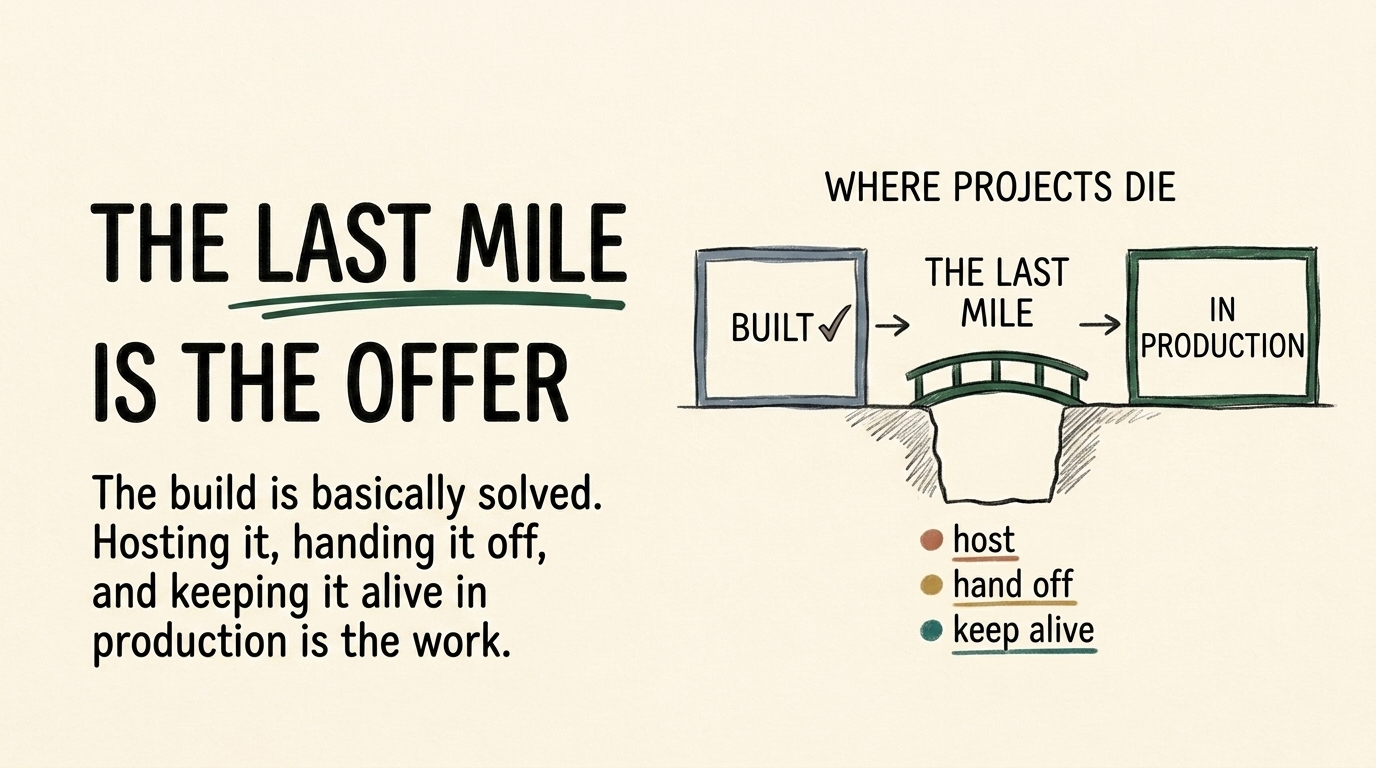
Table of Contents
There's a moment in almost every AI project where the demo works. The agent answers correctly, the workflow runs end to end, everyone in the room nods. And then nothing ships. Three months later the pilot is still a pilot, the champion has moved on, and the "AI initiative" quietly becomes a story about how AI didn't pan out. That gap — between a demo that works and a system that runs — is the single biggest thing standing between mid-market companies and AI that pays.
I run five companies — Sena, Precis, Gavel, TrueStandard, and GameTape — with co-founders, AI agents, and zero hired employees. Every one of them is a service that has to run in production every day, not a demo I show and walk away from. So the last mile isn't a chapter I read about. It's the part of the work I've had to solve five times over, because if the agent dies in production, there's no employee to cover for it.
This guide is the map for that last mile: why pilots die before production, what the "last mile" actually consists of, where an agent runs once it leaves your laptop, how to hand it off so it keeps running without you, and why — for an operator selling this work — getting it into production and keeping it alive is the offer, not the build. No prompts. Just the part everyone skips.
95%
of AI pilots never reach production (MIT, 2025)
#1
cross-channel demand in my comment cache: the last mile
5
agents I keep alive in production, zero hired employees
4
parts of a handoff that doesn't drop the system
Why Do So Many AI Pilots Die Before Production?
Because the pilot is graded on "does the model work?" and production is graded on "does the system keep working?" — and almost nobody does the second job. Pilot purgatory is a delivery problem, not a model problem.
MIT's 2025 study on enterprise AI put a number on it that traveled everywhere: roughly 95% of pilots never reach production. Every operator I talk to has lived some version of it — a sharp demo, an excited room, and then the project stalls in what I call pilot purgatory: pilots that work well enough to keep alive and never well enough to ship. The instinct is to blame the model. The model is almost never the problem.
The problem is operational. The demo ran on someone's laptop, against a clean test case, with the person who built it watching. Production means it runs on a schedule no one watches, against the messy real input, recovers when an API times out, and a non-builder can tell whether it's healthy. That's a different job, and it's the job nobody scoped. When the demo works and the project still dies, the cause is downstream of the model every time: no host, no owner, no recovery path, no predictable bill.
I track this directly. Across the roughly 26,000 comments I cache from the AI-native channels where people build and sell this work, the last-mile / delivery gap is the single loudest cross-channel demand — it ranks at the top of the corpus, the top of what operators ask on LinkedIn, and the top of the 60-day conversation on X, independently. One builder put the whole category in a sentence: "The building problem is basically solved at this point. What's still broken is the execution side." The market has noticed the build got easy. It's still waiting for someone to solve the part after.
AI
The next teardown, without checking back
About one a week from the five companies I run with co-founders, AI agents, and zero hired employees — what I changed, and the part that broke.
One click to unsubscribe.
What Exactly Is the "Last Mile"?
The last mile is four specific gaps between a demo and a living system: no host, no owner, no recovery path, no predictable run-cost. Close all four and the agent stays up. Miss one and it's a matter of time.
"Last mile" is borrowed from logistics — the package travels a thousand miles cheaply and then the final mile to your door is the expensive, fiddly part that breaks. AI delivery is the same shape. The model and the build cover the thousand miles. The last mile is four concrete things, and a pilot usually has none of them:
No host
It runs on a laptop or a dev environment, not anywhere it can run unattended.
What closes it: An orchestration layer it runs on without a person in the chair.
No owner
The builder leaves and nobody can say who operates it or how.
What closes it: A named owner, a runbook, and an escalation path.
No recovery path
One timeout or bad input and it silently stops; someone notices days later.
What closes it: Self-healing retries plus monitoring that pages a human when it can't.
No predictable cost
The token bill is a variable nobody can approve, so Finance blocks it.
What closes it: A fixed monthly run-cost with spend caps and model-routing rules.
Notice that none of these four is "make the model more accurate." You can have a perfect model and still fail all four — which is exactly how a great demo becomes a dead pilot. And notice they're not independent: skip the host and there's nothing to monitor; skip the owner and the recovery path has no one to page; leave the cost variable and Finance kills it before any of the rest matters. This is why bolting on one fix never rescues a stalled pilot. The last mile is a set, and you cross it or you don't.
This is also why I say the last mile is the offer. The four gaps above are unglamorous, they're where the real engineering lives, and they're precisely the part a demo-driven market has trained itself to skip. For the structural picture of what makes a company able to run this way at all, the companion guide is What It Actually Means to Be AI-Native. This one stays on the last mile.
Where Does the Agent Actually Run? The Orchestration Layer
Not in a chat window. A production agent runs on an orchestration layer — five parts, bottom to top — and the diagram of that layer is the asset most build content never draws.
This is the question I see asked over and over by people who've built something and can't get it to live anywhere. Verbatim from the cache: "old school dev here … I cannot understand where the orchestration layer lives. Is it called with Claude API? How does this thing actually work?" and "how do you actually host the agent itself?" The honest answer is that "the agent" isn't one thing you host — it's a stack of five parts, and each one has a job:
Observability & alerts
Logs, run history, and a heartbeat that pages a human when a run fails or stops — so you find out in minutes, not days.
Skills & tools
The workflow acts in your real systems — CRM, inbox, database, pipeline — not just returns text. This is where work actually happens.
Orchestration runtime
The thing that executes the workflow step by step, handles retries, and holds the credentials the agent runs under.
State & context store
Where the state of the work persists between runs — account, data, history — so every run starts with full context, not from zero.
Trigger / schedule
What kicks off a run with no human in the chair: a cron schedule, a webhook, an inbound event. Production means it starts itself.
Here's how this looks in something I actually operate. Across my companies, the heavy workflows don't wait for me to press go — they fire on a schedule against a shared state store, so each run starts with the full history instead of a blank slate. One of them ingests and summarizes long-form video into structured chapters; it runs unattended, writes its output to a shared cache, and is idempotent — re-running it can't corrupt what's already there, it just heals what's missing. When I rebuilt that pipeline recently, I pointed it at the back catalog and it re-processed hundreds of items, turning a five-hour course that had been truncated to a handful of chapters into a complete one — no one sitting there clicking. That's the difference between a script and a system: the system has all five layers, so it runs, recovers, and reports on its own.
If you want the engineering underneath these layers — the doer/judge split, the verification loops, the context discipline that makes a run trustworthy — that's its own guide: Harness Engineering. The orchestration layer is where that machinery gets a place to live and a schedule to run on — and the rung above it, where a human gate keeps a wrong number from shipping, is AI Agent Orchestration: the rung every map skips.
How Do You Hand It Off Without Dropping the System?
A handoff isn't a Loom video and a "good luck." It's five things wired in before you leave — runbook, escalation, self-healing, monitoring, owned maintenance — so the system survives the person who built it.
Most "handoffs" are a recorded walkthrough and a hope. The agent runs fine for two weeks, then an API changes or an edge case shows up, nobody knows it broke, and by the time someone notices, trust is gone. A handoff that holds is a sequence you build before you step away:
Runbook
What it does, where it runs, how to operate and pause it — in plain language a non-builder can follow.
Escalation path
Who gets paged, when, and what the first three checks are. A name, not a mystery.
Self-healing
Retries and idempotent re-runs handle the predictable failures so a human isn't needed at 2am.
Monitoring + evals
Daily health checks plus weekly evals, so quality is measured, not assumed it's fine.
Owned maintenance
A standing owner who fixes, extends, and tunes it month over month — the part that keeps it alive.
This is how I run my own companies, because I have no employees to absorb a silent failure. Daily monitoring plus weekly evals replace the manual QA team a normal operation would staff — the system tells me when it's unhealthy instead of me discovering it from an angry customer. Self-healing is the half nobody demos: the agent that recovers from the failures you can predict is worth more in production than the one that's slightly more accurate in a test. Accuracy wins the demo; recovery wins the quarter.
A handoff without an owner is a countdown, not a delivery. Someone has to be accountable for the system after the build — and naming that owner is the difference between a deliverable and a liability.
That last step — owned maintenance — is the bridge to the most valuable tier of the work, and it deserves its own treatment. How I Run 5 Companies with Zero Hired Employees covers the operating primitives that make a system maintainable by a tiny team in the first place.
Why the Last Mile Is the Offer, Not the Build
The build is commoditized — anyone with the model can do it. Getting it into production and keeping it alive is the scarce work, which makes it the offer and the recurring revenue, not a free add-on.
Follow the scarcity. When the build gets easy, the build stops being worth much — you can't charge a premium for the part a capable person can now do in a weekend. The value moves to wherever the difficulty went, and the difficulty went to the last mile. So the thing a buyer should pay for, and the thing an operator should sell, is the crossing: a workflow that ends in production and stays there. The deliverable my company stands behind is not "here's a working demo" — it's "here's a system running in your environment, with an owner, that I operate."
Concretely, that reshapes the offer. The implementation isn't done when the code works; it's done when the workflow runs in production with a daily demo in a shared channel you can watch — which kills both "nothing ever ships" and "talk is cheap" in one move. And the maintenance isn't an upsell tacked onto the end; it's the headline, because operating the system month over month is where it compounds instead of decaying. As one operator put it watching all the build content skip this: "Wait a second… we are actually supposed to deliver something?" Delivery is the whole game.
This is the business-model reason the last mile matters as much as the engineering reason. It's the wedge from a one-time build into an operating relationship — the same shift covered from the unit-economics side in Service-as-a-Software, and from the where-to-start side in Where to Point AI First. The build gets you a project. The last mile gets you a business.
What Are Operators Actually Saying About the Last Mile?
I don't only operate this — I track where the people building and selling this work argue about it. I cache and score roughly 26,000 comments across the AI-native channels (the automation-agency operators around Nick Saraev and Nate Herk, the AI Engineer crowd, and YC builders). The last mile isn't my opinion. It's the loudest thing in the data.
These are verbatim, top-voted comments from that cache, ordered loudest first. Each one is a person who built something and hit the same wall this guide is about — the gap between a workflow that runs once and a system that runs in production.
Delivery · Loudest
"Wait a second... we are actually supposed to deliver something?"
The build content stops at the demo; delivery is treated as someone else's problem.
Operator answer: delivery is the whole game — the implementation ends in production, not in a demo.
▲ 118 verbatim, top-voted — on a build-and-sell course thread
Hosting
"Most videos on agentic workflows ignore the 'last mile' of delivery. How do I host the entire workflow, not just the scripts?"
Builders can write the workflow but have nowhere to run it unattended.
Operator answer: the orchestration layer — trigger, runtime, state, tools, observability.
▲ 23 verbatim — the comment that named the gap
Production reality
"Production Database? Good luck."
Demos run on toy data; production data breaks the happy path immediately.
Operator answer: build for the messy real input and recover from it, not the clean test case.
▲ 19 verbatim, sardonic — the gap between demo and prod
Build vs. ship
"The building problem is basically solved. What's still broken is the execution side."
The market has noticed the model got easy; the execution is the open problem.
Operator answer: exactly why the last mile is the offer, not the build.
▲ 17 verbatim — the thesis of this whole guide, said by a builder
Orchestration
"Old school dev here. I cannot understand where the orchestration layer lives."
Even experienced engineers can't place where the agent actually runs.
Operator answer: Layer by layer, in section 3 above — it's a stack, not a chat window.
▲ 4 verbatim — the question section 3 answers
The same pain shows up off YouTube too. On X, the most-shared versions of this are about pilots that never convert — operators describing companies "stuck in pilot mode" and projects that stall right at the production line. Different platform, identical wall: the build works, and the last mile is where it dies.
Source
~26,000 comments across five AI-native YouTube channels I cache and score in-house (nicksaraev, nateherk, aidotengineer, ycombinator, ycrootaccess), cross-referenced with a 60-day scan of the AI-automation conversation on X and LinkedIn. The last-mile / delivery theme is the highest-scoring cross-channel demand in that dataset. Quotes are verbatim and top-voted; counts are likes on the original comment. The same cache decides which guides I write next — this one included.
What This Means for You, This Quarter
Don't start another pilot. Take one workflow you already have all the way across the last mile — hosted, owned, self-healing, monitored — and let it run in production for a month before you build the next one.
If you have a pilot sitting in purgatory right now, the move isn't a better model — it's to close the four gaps on the one that's closest to working. Pick a single workflow, put it on an orchestration layer, give it an owner and a runbook, wire the self-healing and the monitoring, and put a number on its monthly run-cost. One workflow that survives a month in production teaches your company more than ten more demos.
The constraint here usually isn't the technology and it isn't budget. It's that crossing the last mile is a different skill than building — operational, unglamorous, and rarely the thing the person who built the demo wants to do. That's the work I do, because I've had to do it five times for companies I can't let go down.
I build this for mid-market operators the same way I built it for my own five companies: audit which workflow is worth taking across the last mile first, implement it on a fixed scope so it ends in production with a daily demo in a shared channel, then operate it month over month so it compounds instead of decaying. Architecture you can inspect, running in companies I operate myself — not a slide deck about production.
Frequently Asked Questions
What is the "last mile" in an AI project?
Everything between a working demo and a system that runs in production without you: where the agent is hosted, who owns it, how it recovers when it breaks, and what it costs to run each month. The model and the build are largely solved; the last mile is the operational work that decides whether an agent lives or dies after the demo.
Why do most AI pilots fail to reach production?
Because pilots are graded on whether the model works and production is graded on whether the system keeps working. MIT's 2025 study found roughly 95% of enterprise AI pilots never reach production. The failure is almost never the model's accuracy — it's a missing host, no clear owner, no recovery path when a run fails, and an unpredictable bill. That's a delivery problem, not a model problem.
Where does an AI agent run in production?
On an orchestration layer, not a chat window: a trigger or schedule starts a run, an orchestration runtime executes the workflow, the skills act in your real tools, a state-and-context store persists what happened, and observability watches it and alerts when it breaks. Across the five companies I operate, runs fire on a schedule against a shared state store so every run starts with full context.
What does a proper agent handoff include?
Five things, not a Loom video: a runbook (what it does and how to operate it), an escalation path (who gets paged and when), self-healing recovery (it retries and recovers from common failures on its own), monitoring with weekly evals (quality is measured, not assumed), and a standing owner for maintenance. A handoff missing these drops the system the day the builder leaves.
Can I buy the last mile as a fixed deliverable?
Yes — that's the offer. The build is commoditized; what's worth paying for is a workflow that ends in production with a daily demo in a shared channel, then is operated month over month so it improves instead of decaying. It starts with an audit that picks the one workflow worth taking across the last mile first, at agrahri.com.
Have a pilot stuck before production?
I take a few audits a month: a fixed deliverable that picks the one workflow worth taking across the last mile first, with the ROI math to defend it and the order to build your own AI Operating System.
Apply for an audit