The Operator Method · The Locked-Context Audit
How Much of Your Company Lives in 3 People's Heads?
You scored your company on the way in. Here is the full read, and the operating system behind a portfolio run with zero employees (cofounders + agents).
Read Your Score Honestly
The score climbs as more of your company runs as a system instead of in someone's head. Three bands, and the point is to tell you the truth, including when the truth is "you're already ahead."
- 0–6 · Open Loop. Most of your company lives in a few people's heads, and the bleed compounds every quarter. The rest of this is what closing it looks like.
- 7–12 · Half-Built. You've automated; you haven't closed the loop. The missing feedback arrow is where your leverage is.
- 13–18 · Closing the Loop. You're ahead of almost everyone. You may not need an audit yet. Read section 4 for the one layer most companies at your level still miss.
AI
The next teardown, without checking back
About one a week from the five companies I run with co-founders, AI agents, and zero hired employees — what I changed, and the part that broke.
One click to unsubscribe.
The Bottleneck Isn't the Model. It's Locked Context.
The models are already smart enough. The bottleneck is the company-specific context locked in your senior people's heads. Whoever cracks getting it out wins.
Pick any frontier model. For almost any problem your company has, it is no longer the constraint. The constraint is that it shows up knowing everything on the public internet and nothing about your company: the pricing exception only your Head of Revenue knows how to make, the reason your ops playbook has that one weird step, the judgment your COO applies without thinking. None of it is written down. It lives in heads.
Here's the honest version of my own claim: I run all of this with zero employees, which means a couple of cofounders and a stack of agents. That's the point. Two people plus agents replacing five departments is more credible, and more copyable for your company, than a lone-genius myth. The method is the part that transfers.
Here's the Machine, Running
Most "AI for your business" advice ends at a prompt library. This is what it looks like when the system runs the company: six stages, on a loop, every day, with no one pressing go.
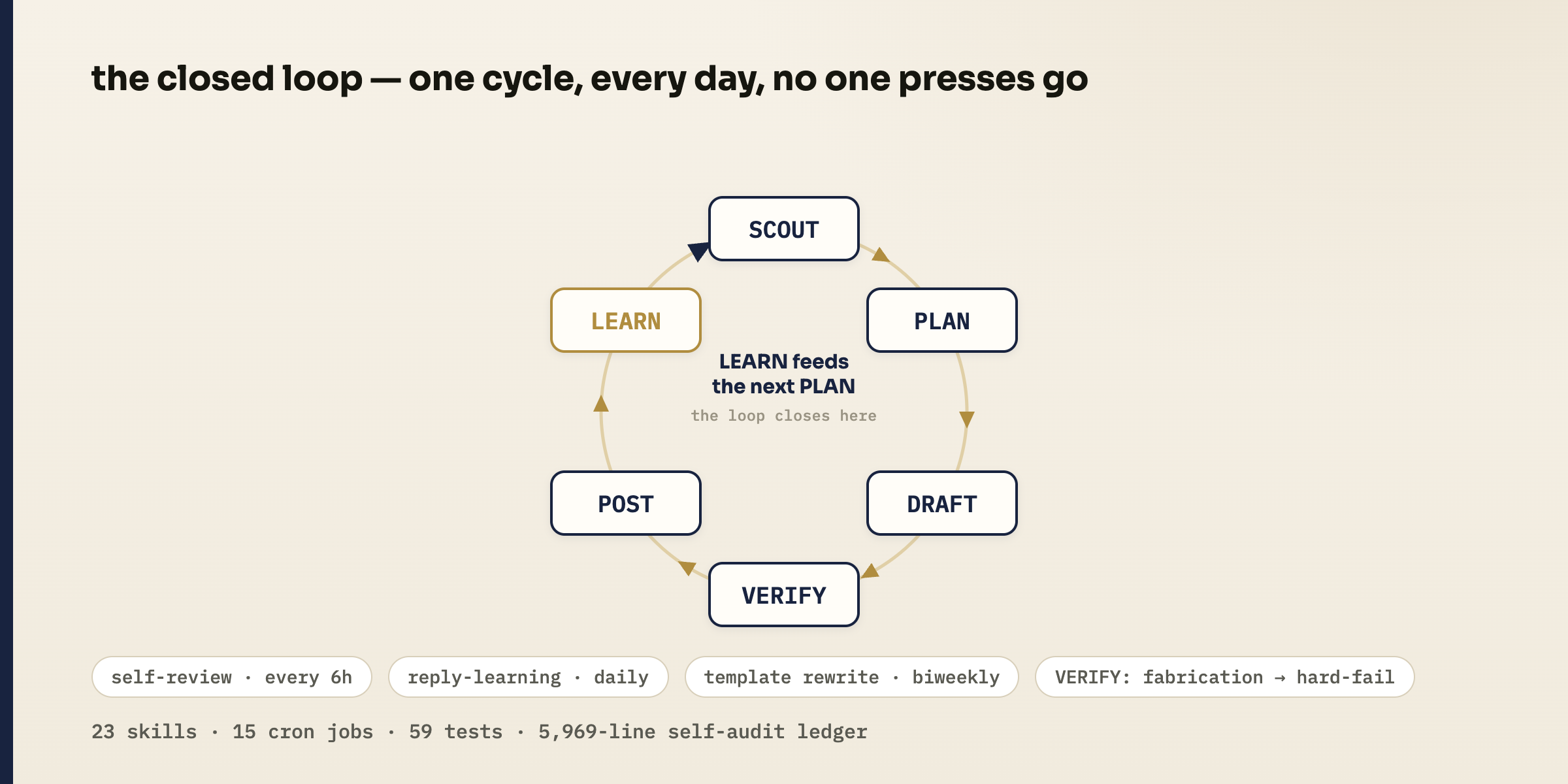
The last arrow, learn back to plan, is the whole thing. The counts below are real and un-rounded, pulled from the live repo. You're looking at the meter readings of a running engine.
5,969
lines of self-audit
59
automated tests
15
cron jobs run the loop
0
employees
It Gets Better While You Sleep
Automation does the same thing forever. A system that measures its own output and rewrites its own instructions gets better while you sleep. That's the difference between a tool and an operating system.
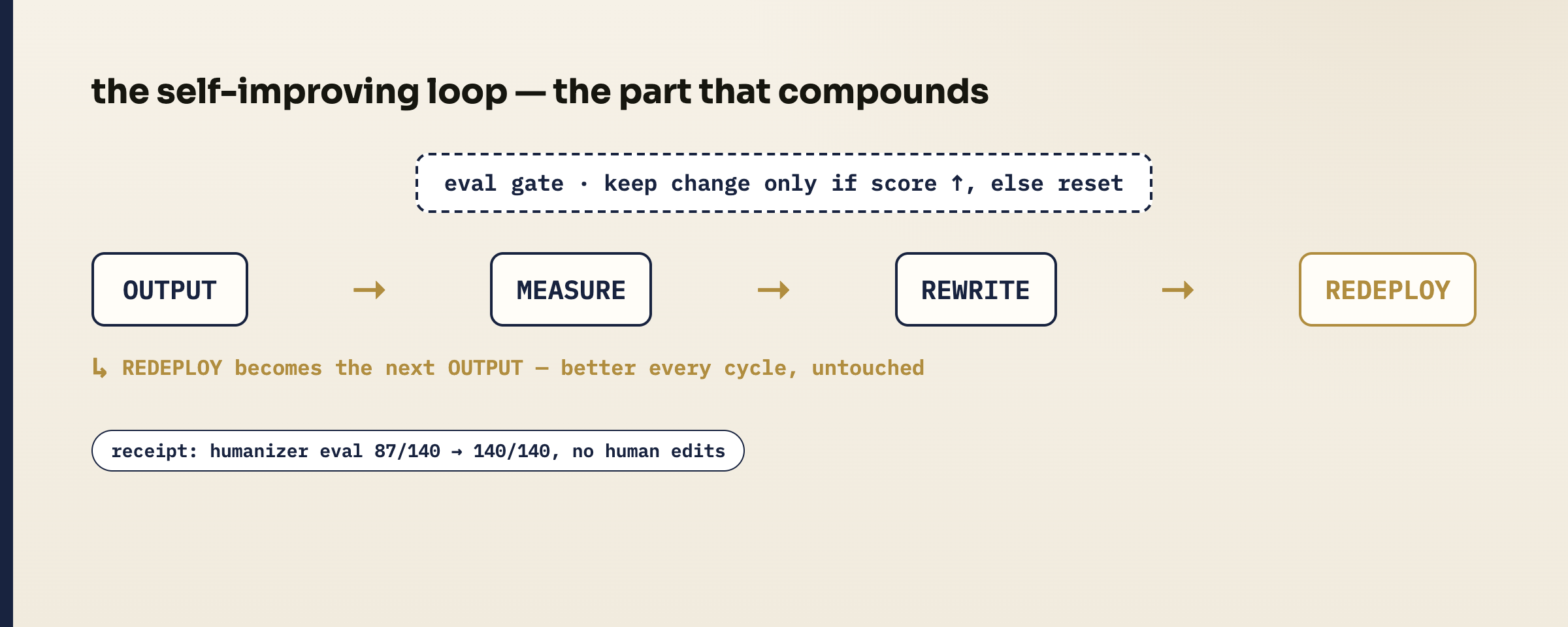
Three things make it real instead of aspirational:
- It runs on a cadence, not a vibe. A deterministic audit fires every 6 hours into a ledger now 5,969 lines long. A daily pass fingerprints the last 235 outputs and injects updated guidance into every future draft, with a 72-hour novelty cooldown so it stops repeating itself.
- Every change is eval-gated. When the system rewrites one of its own skills, it does it on a throwaway branch and keeps the change only if the score goes up. It's allowed to edit itself; it's not allowed to get worse.
- You can see it in the numbers. One quality eval went from 87/140 to a perfect 140/140, with no human edits. The loop measured, rewrote, and redeployed until it hit ceiling.
This is the part you can't buy off a shelf, because it has to be wired into your context. It's also the part the audit is about.
The 5 Building Blocks of an AI-Native Company
None of this is my invention. It's the pattern the frontier converged on: the same five pieces YC runs its own company on, that a two-person team did $2M in revenue on, that I run five products on. The line between bolting AI onto old software and running the company on agents that wrap deterministic tools.
5 Roles I Never Hired For
A team is a set of roles. Here are five I never hired, and the skill or agency that does each one instead. As you read, name the person who does it at your company.
A content strategist → /content-plan
Builds the weekly editorial calendar across the whole portfolio. ICP-value-first, 14 slots a week per product, every Monday, with no one assigning the work.
A social media manager → /scout-x · /scout-reddit · autopilots
Finds the threads worth a reply, drafts in each brand's voice, and posts on a schedule. Around 40 drafts a week, no one logged in.
A copywriter → /blogger · /my-writer
Long-form Medium and blog posts in my voice, written from a plan instead of a blank page, then handed back for one human read.
A designer → /visuals · /imagegen
Renders every product graphic and cover straight from brand tokens. The two diagrams above were built this way, not in Figma.
A QA editor → self-review · /humanizer
Audits every output into a running log every 6 hours and strips the AI-tells before anything ships. The reviewer that never gets tired or skips a Friday.
Each one was a job description before it was a skill. They run on 23 skills and a standing Reddit agency, 15 jobs firing on cron with no one pressing go. The honest part: name the person who does each of these at your company, then ask what happens to that work the week they're out.
What the Machine Ships
Those roles run the operation. This is the output: five products, zero employees between them. The same loop, pointed at five different markets.
Precis · health
Synthesizes where 5 longevity experts agree and disagree, scored across 3,400+ videos. We watch them so you don't have to.
TrueStandard · AI verification
Runs every claim through 4 independent models before you publish. Check every claim before your name is on it.
Gavel · startup strategy
Cited frameworks from operators who've shipped, surfaced when you're stuck on a real decision. No hallucinated quotes, every claim sourced.
GameTape · founder coaching
An ambient coaching layer for founders. It watches how you actually work and turns it into real-time, behavioral feedback.
Sena · events
An AI event concierge. Gives every attendee a personal guide over WhatsApp, matching them to the right sessions and people.
What an Open Loop Costs You Every Quarter
Here's the number most founders never put on paper. Take one senior operator, fully loaded at $120K–$220K. Now estimate the share of their week spent being the system: triage, routing, the same reports, checking others' work. For most ops-heavy companies it's 40–60%.
$50K–$130K
per senior person, per year, poured into an open loop. Work that produces output but never feeds back, never compounds, and walks out the door the day they leave. Most companies have several of these, not one.
And that's only the bleed you can see. The one you can't: while your best people spend their week being the system, a competitor who closed these loops is reaching the same milestones on a fraction of the headcount. Teams are hitting roughly 5x the revenue per employee they would have 18 months ago by burning tokens instead of hiring. That lead compounds whether or not you're looking at it.
The score on the way in told you how much of your company still runs on open loops. The cost is that arithmetic, multiplied by every quarter you wait.
Most Companies Start at the Wrong Layer
Every company built this way follows the same order, bottom to top:
data → intake → routing → notifications → automations → agents → dashboards
Agents are layer six. They only work on top of clean data at layer one. Most companies skip straight to the top: they bolt a chatbot onto a junk drawer, watch it hallucinate, and conclude "AI isn't ready." It was. The foundation wasn't.
The order is the risk management. Get it right and each layer makes the next one cheap; get it wrong and you pay for the whole stack twice. Which layer your company should start on isn't a guess. It's the first thing a real audit settles, before a line of code gets written.
You Can't Audit Your Own Blind Spots
Locked context is invisible to the people holding it. Your score found where it's locked; this showed you what getting it out looks like. Mapping your extraction is the one part you can't DIY.
So start there. An Operator Working Session is 90 minutes to map your highest-leverage locked loop, and the fee credits 100% toward an audit if you go further. I take 2–3 a month.
Apply (5-question form)Not ready? Reply to the email this came in on with the one workflow eating the most senior time at your company. I read every one.