AI Engineer NYC + CODE 2026: An Operator's Field Notes
190 talks, one shift: writing code got cheap, and proving it right did not.
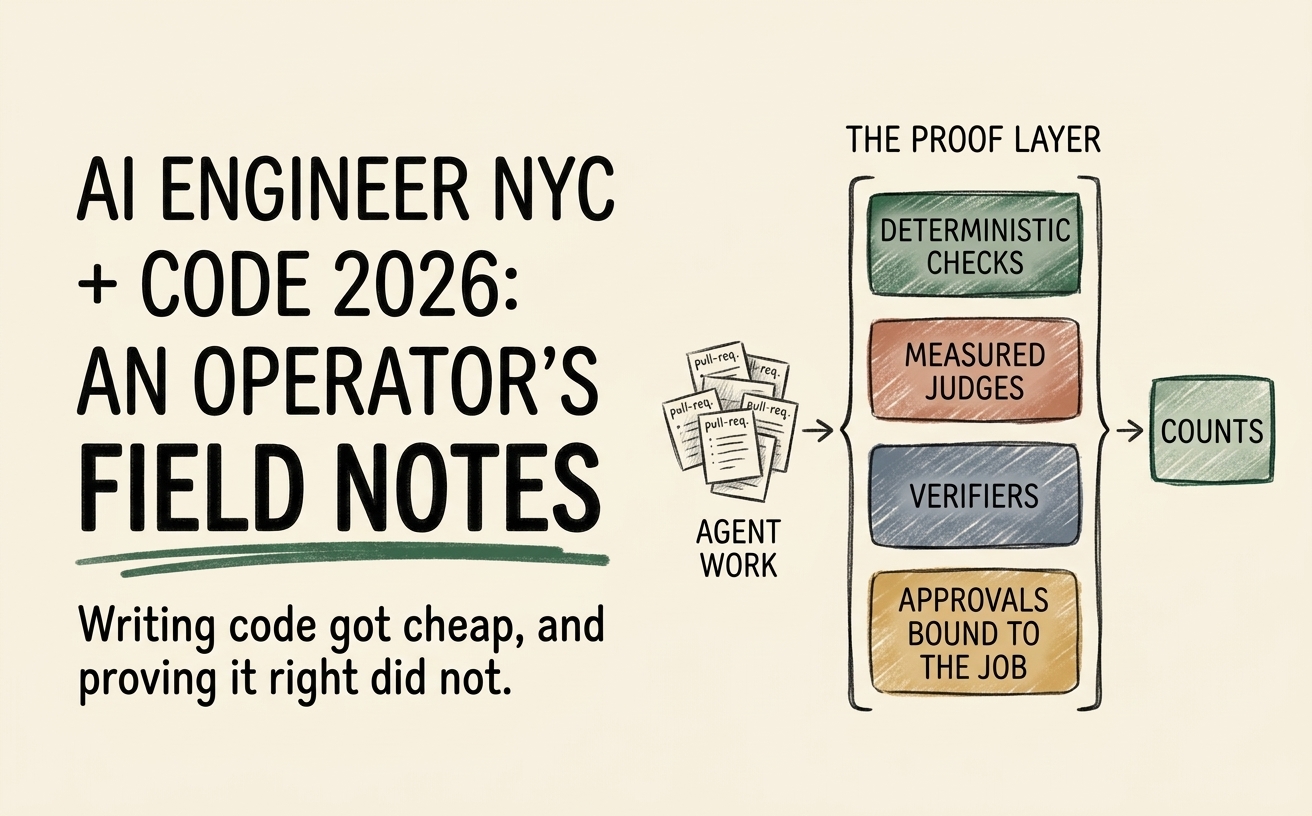
Table of Contents
AI Engineer NYC and CODE 2026 marked one unmistakable turn: generating code and agent output is now cheap, while proving that output safe before it lands is the real constraint. Across about 50,000 engineers at 447 companies, Jellyfish found the AI tool itself explains less than 1% of change in merged pull requests Nicholas Arcolano, Jellyfish 05:07, Nicholas Arcolano, Jellyfish 06:26. If you run an operations-heavy company this quarter, buying smarter models will not move your throughput until you build the verification stack around them.
What actually changed at AI Engineer NYC and CODE 2026?
The main bottleneck at both conferences is now The Proof Layer. The Proof Layer is everything that proves agent work is right before it counts: deterministic checks, measured judges, verifiers, and approvals bound to the job.
Volume is no longer the story. Sonar CEO Tariq Shaukat cited research on asynchronous coding agents showing a 2,450% jump in lines of code and a 240% rise in commits, paired with only a 30% increase in releases Tariq Shaukat, Sonar 05:45. At Anthropic, internal volume climbed from about 2500 changes a day in May to more than 30,000 a day in September Lydia Hallie, Anthropic 01:46. As Shaukat put it, "code is abundant, that confidence is scarce" Tariq Shaukat, Sonar 15:52.
Data from Jellyfish explains why model upgrades alone disappoint leadership teams. When Cursor promoted Grok in its interface, Jellyfish tracked a natural experiment and found no statistical change in merged PR throughput Nicholas Arcolano, Jellyfish 03:40, Nicholas Arcolano, Jellyfish 04:26. Switching between Opus, Sonnet, ChatGPT, Cursor, and Claude Code produced the same flat result Nicholas Arcolano, Jellyfish 07:45.
Jellyfish decomposed merged PR throughput across its 447-company sample Nicholas Arcolano, Jellyfish 05:07. The tool explains less than 1% of the variance Nicholas Arcolano, Jellyfish 06:26. Skills and harness customization explain about 3%, raw token spend explains 9%, and company plus team environment explain 12% Nicholas Arcolano, Jellyfish 06:39. The individual engineer accounts for three quarters of the statistical model Nicholas Arcolano, Jellyfish 12:45.
Those company and skill gaps are large enough to manage. Holding AI spend constant, Jellyfish measured a 2x throughput spread between top 10% and bottom 10% companies Nicholas Arcolano, Jellyfish 12:04. Individual engineers showed a 3.5x spread between top 10% and bottom 10%, and "best engineers before AI by and large are still your best engineers." Nicholas Arcolano, Jellyfish 13:25, Nicholas Arcolano, Jellyfish 13:59.
Skill adoption remains thin outside conference rooms. Almost half of tracked engineering weeks showed essentially no skill use, and only 12% used skills at a modern level Nicholas Arcolano, Jellyfish 09:10. Yet engineers who hit 30 plus skill runs a week saw a 30% bump in PR throughput, holding other factors constant Nicholas Arcolano, Jellyfish 09:53. One caveat: Jellyfish did not include a quality metric in that model Nicholas Arcolano, Jellyfish 06:34.
Business speakers echoed the same gap between individual output and company results. Apollo's Adam Nahari argued that generic chatbots rarely reach the P&L unless leadership redesigns core operational workflows with clear kill metrics Adam Nahari, Apollo 02:40. Basis's Mitchell Troyanovsky made the same point: individual speed stays local until the firm encodes repeatable processes and behavior specs Mitchell Troyanovsky, Basis 01:22.
AI
The next teardown, without checking back
About one a week from the five companies I run with co-founders, AI agents, and zero hired employees — what I changed, and the part that broke.
One click to unsubscribe.
Why did merging replace code review as the bottleneck?
Coding agents open pull requests faster than serial merge queues and CI runners can process them. Adding more agents without adding merge capacity backs up the queue.
Uber gave the clearest breakdown of this failure mode. More than 5,000 Uber developers push over 36,000 commits and 27,000 pull requests weekly across six monorepos Preetam Dwivedi & Manjari Akella, Uber 00:58. In January 2026, Uber's Go merge queue handled roughly 90 requests every hour at a 30-minute P95 land time Preetam Dwivedi & Manjari Akella, Uber 05:45.
Two months later, AI-generated changes pushed volume to 130 requests per hour, roughly a 44% increase Preetam Dwivedi & Manjari Akella, Uber 05:53. At 130 requests per hour, P95 land time exploded from 30 minutes to roughly 3 to four hours Preetam Dwivedi & Manjari Akella, Uber 05:53, Preetam Dwivedi & Manjari Akella, Uber 06:26. Uber kept trunk green, but engineers sat idle waiting for merges.
Uber fixed throughput in three steps, each with a sharp trade-off. First, admission gating rejected expensive multi-target changes during peak hours, lifting throughput over 20% from 130 to about 160 lands per hour Preetam Dwivedi & Manjari Akella, Uber 09:18, Preetam Dwivedi & Manjari Akella, Uber 09:48. Second, a deferred queue stored those expensive changes and replayed them automatically after peak hours so developers stopped acting as manual schedulers Preetam Dwivedi & Manjari Akella, Uber 10:45.
Third, Uber built conflict relaxation. Instead of serializing every pair of PRs with any target overlap, SubmitQ scores overlaps using Jaccard scoring and drops weaker dependency edges at entry time Preetam Dwivedi & Manjari Akella, Uber 14:19, Preetam Dwivedi & Manjari Akella, Uber 17:12. That lifted peak throughput over 50%, from about 160 lands per hour to almost 250 Preetam Dwivedi & Manjari Akella, Uber 18:06.
The catch is for large engineering orgs: some combinations land untested. "What this means is main can now be broken." Preetam Dwivedi & Manjari Akella, Uber 18:52. To protect consumers, Uber runs a post-land validator called StowPipe that advances a verified main pointer on green builds and pages on-call when trunk breaks Preetam Dwivedi & Manjari Akella, Uber 19:54, Preetam Dwivedi & Manjari Akella, Uber 22:47.
Combined, Uber reached roughly 300 lands per hour at peak with a 30-minute P95 land time, a 233% jump over January's 90 lands per hour Preetam Dwivedi & Manjari Akella, Uber 23:50. Broken-trunk recovery, however, is still manual Preetam Dwivedi & Manjari Akella, Uber 25:49.
Harvey hit the same wall at a much smaller scale. After building Spectre, a cloud platform that has produced 10,000 agent-written PRs for about 460 users, Harvey stabilized burst load with alert deduplication and a fair launch queue Joey Wang, Harvey 00:20, Joey Wang, Harvey 07:33, Joey Wang, Harvey 08:38. That queue cut launch latency during a 300-task load test from almost 2 seconds to 70 milliseconds Joey Wang, Harvey 09:23.
Once the platform held up, merging broke. Pull requests jumped around 60% in a single month, merge times stretched from 15 to 30 minutes to over an hour, and the merge queue had to be switched off repeatedly Joey Wang, Harvey 10:15. Joey Wang admitted plainly: "we haven't cracked this one yet." Joey Wang, Harvey 10:41.
Other infrastructure talks confirmed this pattern. Sonar's Gautam Korlam urged teams to shift fast checks left and move non-critical checks post-merge to keep AI-scale commit queues moving Gautam Korlam, Sonar 08:10. Tessl's Patrick Debois described the shift from continuous delivery to concurrent delivery, relying on isolated workspaces and speculative merge trains Patrick Debois, Tessl 01:58.
Who lets AI approve code, and what stays with people?
Several engineering teams let scripts and review agents merge routine pull requests without a human reviewer. People keep approval over high-risk changes that code checks cannot verify.
Human psychology drives this shift alongside speed. Tariq Shaukat cited a study on cognitive surrender showing humans agree with AI 93% of the time when it is right Tariq Shaukat, Sonar 06:26. Worse, "And four out of five times they agree with it when the AI is wrong." Tariq Shaukat, Sonar 06:26.
Anthropic's own internal studies showed the same rubber-stamping problem. In a workshop, CJ Avilla noted that "like 97% of the time we're going to click approve as humans" when prompted repeatedly CJ Avilla & Harrison Stall, Anthropic 1:27:16. In another Anthropic study comparing people to auto mode, only about 14% of humans caught a dangerous command, while auto mode blocked 89%, leaving about one in 10 slipping past Lydia Hallie, Anthropic 05:49.
Robinhood runs a tiered review system in production for data-pipeline pull requests. Chetas Joshi summarized the design: "An agent judges what needs context and people own the calls only they should make." Chetas Joshi, Robinhood 03:39. Before any model runs, Layer 1 deterministic scripts verify schema registry contracts, owner and PII tags, registered lineage blast radius, and staging performance at production volume Chetas Joshi, Robinhood 06:22, Chetas Joshi, Robinhood 08:06, Chetas Joshi, Robinhood 08:48.
Layer 2 is a repository-reading agent that hunts for risks scripts miss, such as query anti-patterns or unregistered jobs that break when a column type widens Chetas Joshi, Robinhood 10:54, Chetas Joshi, Robinhood 12:16. The agent lacks visibility into dashboards and ad-hoc queries outside the repo, so an empty search result still leaves blind spots Chetas Joshi, Robinhood 13:54.
Robinhood never lets the agent approve three categories: grants touching sensitive data, migrations that alter data intent, and low-confidence verdicts Chetas Joshi, Robinhood 16:56. As of August 31, 2026, about 60% of data-pipeline PRs merged without human review, cutting manual review effort by about 75%, saving about 132 engineering hours a month, and lowering related incidents by about 30% Chetas Joshi, Robinhood 23:24. The miss rate stood at about 2%, mostly from rule gaps, though Robinhood still lacks a clean false-escalation metric Chetas Joshi, Robinhood 20:57.
SpaceXAI's Lauren Tan pushed deterministic constraints even further on the GrokBot desktop client. Tan shipped 3,000 PRs herself in one month Lauren Tan, SpaceXAI 00:43, and her team shipped 11,000 PRs while cutting a stable release about once a day Lauren Tan, SpaceXAI 13:39. With about 227 contributors, the revert rate stayed steady at about half a percent Lauren Tan, SpaceXAI 14:05.
Tan enforces agent constraints directly in code. Her team banned useEffect in product code Lauren Tan, SpaceXAI 05:28, blocked cross-directory Electron imports with lint rules Lauren Tan, SpaceXAI 06:32, and banned 99% of code comments because agents used comments to justify shortcuts Lauren Tan, SpaceXAI 08:21. "And so our general principle is that every time we correct our agents, it turns into one of these deterministic checks," Tan said Lauren Tan, SpaceXAI 09:09. On every release, a fuzzing agent now finds bugs, opens fix PRs, and auto-merges them Lauren Tan, SpaceXAI 16:04.
Anthropic uses a tiered model as well. Every PR gets a fresh-context review from Claude first, doc or copy edits merge without a human once checks pass, ordinary product changes get one reviewer, and risky changes get two Lydia Hallie, Anthropic 14:45. For irreversible actions like reading secrets, Hallie uses committed deny rules that run before any classifier Lydia Hallie, Anthropic 06:45.
Speakers still disagree on unattended merges. In financial workflows, Wise binds customer consent to an immutable payment job enforced by backend services Emil Chetty, Wise 05:48, while Perpetual requires human approval on a hashed workflow plan before execution Karthic Rao, Perpetual 09:38. At Bloomberg, Andrey Rybka enforces the Rule of Two: whenever untrusted input, sensitive data, and external action intersect, a person must sign off Andrey Rybka, Bloomberg 05:49.
Can you trust an LLM judge?
No, not until you calibrate it against human labels and monitor its variance. Production data from regulated firms showed that off-the-shelf LLM judges inflate scores, flip verdicts on identical inputs, and break silently on model upgrades.
NatWest brought the sharpest production evidence. The UK bank serves 19 million retail customers, handles around 100,000 daily conversations through its Cora assistant, and is moving approximately a third of those flows to RAG and agents Jonathan Osborne, NatWest 00:47, Jonathan Osborne, NatWest 01:48.
Before automating evaluation, NatWest ran human validation on 111 payment-agent conversations across 37 payment flows with three independent scorers per chat Jonathan Osborne, NatWest 07:50. The 83% overall pass rate hid a 54-point spread: 97% on happy paths, 76% on edge cases, and just 43% on topic changes Jonathan Osborne, NatWest 08:00. Even human validators agreed 95% of the time on bias and fairness, but only 64% on intent understanding Jonathan Osborne, NatWest 08:06, Jonathan Osborne, NatWest 08:43.
When NatWest evaluated around 14,000 cases from its live internal complaints agent with both humans and an LLM judge, the judge failed cleanly Jonathan Osborne, NatWest 09:39. On faithfulness, the LLM judge mean sat pinned at .97 against a human mean of 0.83, with almost zero correlation Jonathan Osborne, NatWest 09:39. Osborne warned that "a judge which doesn't discriminate between the actually good cases and the bad cases is basically worthless." Jonathan Osborne, NatWest 10:14.
NatWest hit a second problem when swapping only the judge model while keeping inputs and outputs identical. The margin above threshold plunged, showing that the judge model behaves like versioned production configuration and can introduce breaking changes Jonathan Osborne, NatWest 10:42. Moving the judge to a different model family from the agent pulled judge and human scores closer together Jonathan Osborne, NatWest 10:42.
NatWest also solved the labeling bottleneck by making feedback a gate. Complaint handlers cannot rerun an investigation until they enter structured feedback, which generated those 14,000 colleague labels Jonathan Osborne, NatWest 16:09. For ongoing monitoring, NatWest samples 5% of conversations randomly plus every failure, angry user, or long chat, scoring offline every four hours behind a hard CI/CD regression gate Jonathan Osborne, NatWest 11:20, Jonathan Osborne, NatWest 11:58.
PayPal AI research cited by Tariq Shaukat backs NatWest's findings, showing between 7 and 17% of LLM judge verdicts change across identical replications Tariq Shaukat, Sonar 09:33. Asking "are you sure?" flipped the judge's verdict 7 to 34% of the time in a Meta study Shaukat cited Tariq Shaukat, Sonar 09:45. Self-preferential bias also appeared in Anthropic's workshop: ask an agent to grade its own output and it says yes, which requires an isolated adversarial reviewer CJ Avilla & Harrison Stall, Anthropic 1:14:14, CJ Avilla & Harrison Stall, Anthropic 1:15:03.
Practitioners converged on five rules for making judges usable inside The Proof Layer:
- Use deterministic code checks for rules that code can verify Lance Martin, Anthropic 29:40. At Air Canada, Nathanael Weill limits LLM judges and plants intentional defects in signed contracts so code grades detection Nathanael Weill, Air Canada 16:29.
- Replace 1-to-10 rating scales with crisp binary pass/fail rubrics or pairwise comparisons, and run replicates to measure variance Lance Martin, Anthropic 30:49, Lance Martin, Anthropic 31:45.
- Score quality as a multi-dimensional vector (such as safety, task completion, and experience) rather than one blended number Jonathan Osborne, NatWest 06:53.
- Use a different model family to judge than the one generating output, a pattern Greptile calls model inversion Daksh Gupta, Greptile 07:45.
- Audit rubric ambiguities against human experts before blaming the model, as LinkedIn and Upstart both did to lift judge alignment Saloni Gandhi & Ziwei Guo, LinkedIn 25:59, Shiv Indap & Brooke Hopkins, Upstart & Coval 07:14.
Why does the harness now set your AI bill?
Frontier models have absorbed basic coding scaffolding, so your agent harness barely moves benchmark scores anymore. The harness now controls prompt caching, reasoning effort, turn count, and stale prompt debt, which drive the biggest swings in task cost.
Jediah Katz, Cursor's longest-tenured harness engineer before joining SpaceXAI, laid out the shift plainly. A UC Berkeley study tested seven frontier models across harnesses including Pi, Codex, and Claude Code and found no significant score gap on SWE-bench Lite Jediah Katz, SpaceXAI 04:58. Katz's conclusion was direct: "A fancy harness in this day and age, no longer adds coding intelligence." Jediah Katz, SpaceXAI 05:44.
Those same studies found "a significant difference in cost per task" across harnesses Jediah Katz, SpaceXAI 13:32. Inside GrokBot, tuning cache hit rate, token efficiency, and model mix let Katz cut cost and improve speed without hurting quality Jediah Katz, SpaceXAI 13:33. Centralized logging tracks guardrail shims so a bot opens PRs to delete any shim once newer models stop triggering it Jediah Katz, SpaceXAI 16:03.
George Cameron of Artificial Analysis broke down why agent bills explode. Task costs across models now span two orders of magnitude, from 5 cents or less to above $5 on frontier models George Cameron, Artificial Analysis 07:41, George Cameron, Artificial Analysis 09:19. On Artificial Analysis's knowledge-work benchmark, Opus averages $21 per task across 165 steps at 13 cents per call George Cameron, Artificial Analysis 11:07.
Input tokens, cache hit percentage, and turn counts drive that bill George Cameron, Artificial Analysis 12:04. Cached input tokens carry roughly a 10x discount George Cameron, Artificial Analysis 11:54. With zero cache hits, Cameron noted, "instead of $21 per task, this costs over $200." George Cameron, Artificial Analysis 13:14.
Changing reasoning effort on one model moves costs just as much. Opus 5.5 cost a dollar per task at low effort versus $21 at max effort George Cameron, Artificial Analysis 14:35. Open-weight models remain 3 to 9 months behind leading proprietary ones George Cameron, Artificial Analysis 06:19, while an intelligence tier drops roughly 10x in price within 1 year George Cameron, Artificial Analysis 08:38.
Anthropic's Lance Martin showed how misconfigured harnesses leave huge savings on the table. First, "prompts accumulate debt just like code." Lance Martin, Anthropic 01:36. Legacy rituals like "think step-by-step," "double-check your work," and contradictory rules burn extra tokens and confuse frontier models Lance Martin, Anthropic 01:32, Lance Martin, Anthropic 02:26. Lydia Hallie added that bloated CLAUDE.md files cause extra tool calls; keep only context the model cannot read from code Lydia Hallie, Anthropic 03:26.
Second, prefix discipline protects caching. Because prompt caches require a strict prefix match and cost roughly a tenth of base tokens, changing one byte early invalidates the cache Lance Martin, Anthropic 05:41. Ordering prompts from global instructions to project memory, session state, and turn messages cut costs on internal benchmark harnesses by "up to 72%" with no meaningful performance drop Lance Martin, Anthropic 07:54, Lance Martin, Anthropic 07:54.
Third, tune model and effort against a real eval with a train-test split to avoid overfitting Lance Martin, Anthropic 14:19. On a 50-ticket support benchmark, Anthropic's cost hill-climber delivered a "90% reduction in cost" with improved performance Lance Martin, Anthropic 17:37, Lance Martin, Anthropic 03:35. Martin's default rule: try a stronger model at low effort first, because it often thinks less and costs less than a weaker model at high effort Lance Martin, Anthropic 40:13.
Multi-agent routing and navigation matter too. Anthropic pairs Fable as an orchestrator or reviewer with cheaper Opus or Haiku workers Lydia Hallie, Anthropic 15:48, CJ Avilla & Harrison Stall, Anthropic 27:34, a hierarchical split Cohere also validated for coding teams Nouha Dziri, Cohere 19:40. On large codebases, Sonar cited a 30x token variance just from repository navigation Tariq Shaukat, Sonar 07:17 and reported 36% lower token costs using Sonar Vortex guide rails Tariq Shaukat, Sonar 13:03.
Token spend hits diminishing returns. Across about 500,000 developer weeks, Jellyfish found doubling output from median to top 10% costs about 10x the tokens Nicholas Arcolano, Jellyfish 10:29, Nicholas Arcolano, Jellyfish 10:59. Speakers also split on infrastructure: Revolut cut bills by self-hosting open-weight models David Abitbol, Revolut 04:28, while Vals AI warned cheaper models can cost more per finished task when they burn extra turns Rayan Krishnan, Vals AI 03:41.
Where are agents already shipping in production?
Production agents are already shipping at high volume in software delivery, data platforms, and internal operations when wrapped in cloud sandboxes, deterministic checks, and clear escalation paths. Unattended workflows on messy external data remain far harder.
| Company or talk | What they deployed | Reported result | Link |
|---|---|---|---|
| Robinhood | Hybrid script and agent reviewer for data-pipeline PRs | About 60% merge without human review; about 132 hours/month saved; incidents down about 30% | Chetas Joshi, Robinhood 23:20 |
| Uber | SubmitQ gating, deferrals, conflict relaxation, and StowPipe post-land checks | Roughly 300 lands/hour peak (233% over January); P95 land time at 30 minutes | Preetam Dwivedi & Manjari Akella, Uber 23:40 |
| SpaceXAI | Dune lint-heavy framework, verification artifacts, and auto-merged fuzzing fixes | 11,000 team PRs in one month; stable release about once a day | Lauren Tan, SpaceXAI 12:54 |
| Harvey | Spectre cloud agent platform running Cursor, Claude Code, and Codex | 10,000 agent-written PRs across about 460 users; more than one agent started per minute | Joey Wang, Harvey 00:00 |
| Anthropic | Multi-session Claude Code with automated hooks and fresh-context AI review | About 2500 changes/day in May to more than 30,000/day in September | Lydia Hallie, Anthropic 01:03 |
| NatWest | Internal complaints summary agent with mandatory human feedback gate | Around 14,000 cases scored by both humans and LLM judge since February | Jonathan Osborne, NatWest 09:39 |
| Sonar (vendor-reported) | Sonar Vortex intent and in-loop guide rails on complex codebases | 36% reduction in token cost; 92% reduction in issues in commits | Tariq Shaukat, Sonar 12:53 |
Two operational patterns separate working cloud deployments from laptop demos. First, Harvey discovered that laptops cap out at five to 10 agents, and the most useful cloud component is a CI follow-up loop Joey Wang, Harvey 01:04, Joey Wang, Harvey 04:17. Four out of five agent PRs merged into Harvey's backend passed through that loop Joey Wang, Harvey 04:17. By making every browser action callable via CLI ("If a person can click it, an agent can call it."), terminal tasks reached about 6,500 a month Joey Wang, Harvey 05:34.
Second, cloud agents require hard containment. Harvey puts budgets, expiry dates, and a five-failure shutoff rule on scheduled automations used by about 110 people Joey Wang, Harvey 11:15. Anthropic's Managed Agents separates the brain (session log and harness) from the hands (recoverable sandboxes) and keeps secrets in vaults swapped at an egress proxy so models never see plaintext keys Lance Martin, Anthropic 20:26, CJ Avilla & Harrison Stall, Anthropic 1:22:19. Google DeepMind presented the same egress-proxy credential architecture for managed agents Philipp Schmid, Google DeepMind 10:38.
Chapter reports from across the conference show production deployments expanding well beyond software teams. Duolingo orchestrates iOS unit-test backfill agents through Temporal workflows Kush Agrawal, Duolingo 02:37. Monzo runs an internal Slack teammate called Agent Chip inside sandboxed environments with an MCP gateway Felippe Felisola Caso & Francesco Galletta, Monzo 04:58. Vanguard exposed legacy cash-ledger code through an MCP server to speed up modernization research Gareth Yoder, Vanguard 02:26.
In finance and operations, Apollo and Rowspace run agents for portfolio construction and trade reconciliation while keeping human oversight on final refinements Jack McDonald & Michael Manapat, Apollo & Rowspace 03:38. Bridgewater combines permission-aware vector search with an always-on investor workbench Sam Green & Aaron Linsky, Bridgewater 14:20. Brainbase Labs built a competitor-pricing browser agent for Domino's by codifying domain definitions and iterating on traces Milind Sunil Shah, Brainbase Labs 02:39. Range lets financial planners write their own workflow skills while separating skill authors from reviewers Matthew Ragone, Range 03:59.
Still, honest speakers showed where production remains fragile. At Harvey, only one merge in 20 carries automated proof before a human reviews it Joey Wang, Harvey 11:49. Anthropic's multi-agent flows cap at 1,000 agents with one nesting layer, and CJ Avilla's 1,000-agent operating-system run was still unfinished after 85 hours CJ Avilla & Harrison Stall, Anthropic 46:04, CJ Avilla & Harrison Stall, Anthropic 46:32, CJ Avilla & Harrison Stall, Anthropic 1:38:54. In messy procurement contracts and insurance claims, AlixPartners and Wisedocs both found naive agents fail unless wrapped in structured parsing pipelines and human checks Natalia Connolly & Kevin Madura, AlixPartners 05:47, Denys Linkov, Wisedocs 33:54.
From the Operator's Desk: what the conference gets right, and what it misses
What the conference gets right matches what keeps my own companies running every day. I run five companies (Sena, Precis, Gavel, TrueStandard and GameTape) with co-founders and AI agents and zero hired employees: no W2 staff and no recurring contractors.
You cannot run five companies that way by reading every line of agent output by hand. Across eight of my repos there are 1,058 written lesson files, one per gotcha an agent or I hit, and every one of those repos has a one-command verifier (bin/verify) that my agents run before they commit. That is The Proof Layer in plain operating form. It matches Lauren Tan turning every correction into a deterministic check Lauren Tan, SpaceXAI 09:03 and Chetas Joshi putting scripts ahead of AI judgment Chetas Joshi, Robinhood 03:53.
Even this report ran on the same principle. For this study I ran 11 study agents in parallel over 190 talks and 188 transcripts. All 188 quotes they cited matched their transcripts word for word, and a script checked every cited number against the transcript of the talk it cites.
Model shopping wastes time. Jellyfish found the tool accounts for less than 1% of output change Nicholas Arcolano, Jellyfish 06:26. Teams get compounding output by encoding domain rules, pruning stale instructions, and verifying outcomes automatically.
Here is what the conference misses. None of these talks showed audited P&L unit economics for a $2M to $50M operating company after accounting for human review, rework, and escalations, a due-diligence gap Soukaïna Abelhad flagged directly Soukaïna Abelhad 04:40.
The talks also left three operational holes open. First, no speaker published independent quality audits of fully auto-merged code outside narrow pipelines. Second, even Robinhood still lacks a clean false-escalation number Chetas Joshi, Robinhood 20:54. Third, much of the headline infrastructure on stage, like Uber's 300-lands-per-hour merge queue or Revolut's GPU fleet, solves problems a mid-market company does not have yet Preetam Dwivedi & Manjari Akella, Uber 23:50, David Abitbol, Revolut 04:28.
If you run a $2M to $50M company, start with five concrete actions this month:
- Build one deterministic verifier before adding more agents. Across eight of my repos there are 1,058 written lesson files, one per gotcha an agent or I hit, and every one of those repos has a one-command verifier (bin/verify) that my agents run before they commit. Robinhood proves facts with scripts before spending a token on review Chetas Joshi, Robinhood 03:41.
- Write a one-page protected-calls list and enforce it outside the model. Follow Robinhood and Anthropic: keep sensitive data grants, intent changes, and irreversible actions with people behind hard deny rules Chetas Joshi, Robinhood 16:56, Lydia Hallie, Anthropic 06:19.
- Audit your prompts, prefix caching, and reasoning effort before switching vendors. Fixing caching cut benchmark costs by up to 72% at Anthropic Lance Martin, Anthropic 07:54, and skipping caching turns a $21 agent task into over $200 George Cameron, Artificial Analysis 13:16.
- Gate any LLM judge on measured human agreement. Require structured human feedback when staff rerun or reject agent output, just as NatWest did to collect 14,000 labels Jonathan Osborne, NatWest 16:09.
- Track skill adoption and cap every unattended job. Aim for 30 plus skill runs per builder each week Nicholas Arcolano, Jellyfish 09:45, and put a budget, expiry date, and five-failure kill switch on every scheduled automation on day one Joey Wang, Harvey 11:17.
Frequently asked questions
Should a mid-market company build its own AI agent harness or buy one?
Buy the coding agent and build only the shared checks, secrets vault, and context around it. Harvey built Spectre to run existing tools like Cursor and Claude Code rather than compete with them. SpaceXAI cited a UC Berkeley study across seven models showing harness choice made no significant coding score difference, while strongly affecting cost per task.
Joey Wang, Harvey 01:04Jediah Katz, SpaceXAI 04:58Jediah Katz, SpaceXAI 13:19
How do you stop an autonomous AI agent from leaking API keys or running up a huge bill?
Store credentials in an external vault and put hard budget caps with automatic shutoffs on every job. Anthropic's Managed Agents stores secrets in vaults and swaps placeholder values at an egress proxy to isolate plaintext keys from the model. Harvey attaches budgets, expiry dates, and a five-failure kill switch to every scheduled automation.
CJ Avilla & Harrison Stall, Anthropic 1:22:45Joey Wang, Harvey 11:17
Should we switch to a cheaper AI model or tune reasoning effort first?
Tune prompt caching and reasoning effort first to cut agent bills. Artificial Analysis measured Opus 5.5 at a dollar per task on low effort versus $21 on max effort. Lance Martin at Anthropic advises starting with a stronger model at low effort, since it often burns fewer thinking tokens than weaker high-effort models.
George Cameron, Artificial Analysis 14:35Lance Martin, Anthropic 41:33
How do you collect enough human labels to calibrate an LLM judge?
Make human feedback a mandatory gate inside an existing workflow rather than an optional thumbs-up click. On NatWest's internal complaints agent, handlers cannot rerun an investigation until they enter feedback, which produced 14,000 colleague-labeled cases. At Robinhood, engineers reply to agent review comments with written reasons, and on-call staff update rules from those replies weekly.
Jonathan Osborne, NatWest 16:09Chetas Joshi, Robinhood 18:02
What is the fastest way to stop AI agents from repeating the same codebase mistakes?
Convert every agent correction into a deterministic check rather than adding another paragraph to a prompt file. SpaceXAI's Lauren Tan turns corrections into lint rules, directory constraints, and verification tests so mistakes cannot recur. Across eight of my repos there are 1,058 written lesson files, one per gotcha an agent or I hit, and every one of those repos has a one-command verifier (bin/verify) that my agents run before they commit.
Want agents that survive production?
I take a few audits a month: a fixed deliverable that maps which operational functions in your company an agent could carry, what it takes to run them reliably, and the order to build them into an AI Operating System you own — with the ROI math to defend it.
Apply for an audit