The AI Engineering Playbook, Fall 2026: 100+ Techniques From 190 Talks
Agents, skills, harness, models, evals, security, review, merge and CI. Each of the 100+ techniques links to the talk.
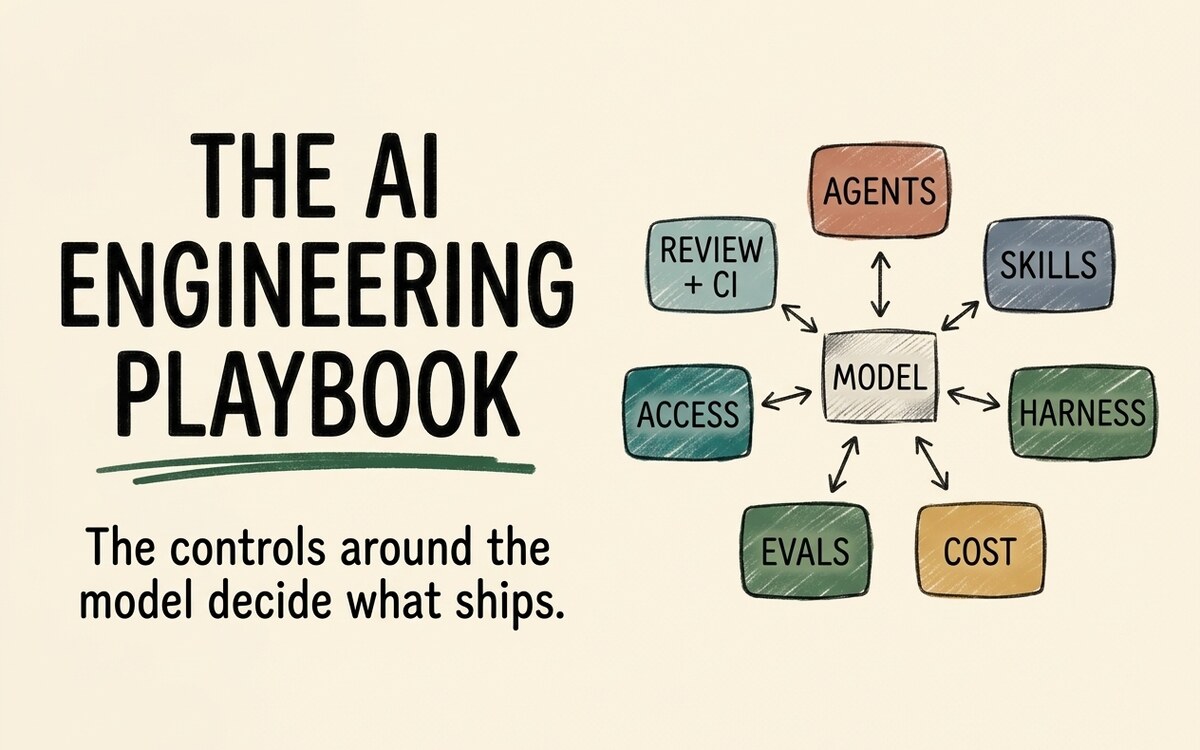
Table of Contents
Reliable AI agents depend on the engineering controls around the model. Teams in these talks cut bills and block leaks with prefix caching, deterministic verifiers, scoped credentials, and automated CI loops. Prompt cache fixes cut cost by up to 72% with no meaningful change in performance on Anthropic's internal benchmarks Lance Martin, Anthropic 07:54. Apply these 100+ techniques this quarter to control token spend and PR volume.
How should you split work across agents?
Start with one agent loading skills on demand, and spawn sub-agents only at the single stage that bottlenecks your task. Put your strongest model in the lead role, put cheap models on workers, and treat every handoff like an unreliable network call.
Cohere tested multi-agent coding teams on ProgramBench and found teams beat solo agents by almost 10 points at 4 to 7 times the cost Nouha Dziri, Cohere 07:58. Assigning workers only to planning matched full-stage teams at half the cost, because discovery was the bottleneck Nouha Dziri, Cohere 13:09. Each planning dollar bought almost 1.6 more reward than implementation or verification Nouha Dziri, Cohere 13:48.
Delegate in one early burst instead of spawning workers throughout execution. Full-stage teams made another 830 delegation calls after the initial burst that added cost without raising scores Nouha Dziri, Cohere 16:17. Wait for workers with a blocking lead, because async leads often build on guesses or submit before workers report back Nouha Dziri, Cohere 08:23.
Match the bottleneck to the task before scaling a stage. On Commit Zero, where docs and unit tests already existed, doubling workers in implementation delivered the biggest improvement Nouha Dziri, Cohere 18:58.
A frontier lead paired with cheap workers cuts model bills. Swapping strong Sol workers for cheap Luna workers kept almost the same performance at 60% less cost Nouha Dziri, Cohere 20:48. Dziri states the rule plainly: "the lead sets the ceiling and the workers set the price." Nouha Dziri, Cohere 21:44
Scaling to 16 cheap Luna planners ran 70% cheaper than using workers at every stage Nouha Dziri, Cohere 22:46. Skip peer-to-peer chat for small workers: 84% of messages go to the lead anyway Nouha Dziri, Cohere 24:06, and extra messaging cost Luna teams four to seven points Nouha Dziri, Cohere 25:18.
Anthropic's managed agent flows split work across isolated contexts to beat three single-agent failures: agentic laziness, self-preferential bias, and goal drift CJ Avilla & Harrison Stall, Anthropic 1:12:05. When checking 50 services, one agent may check 35 healthy ones and skip the rest, whereas fanning out one agent per service covers all 50 CJ Avilla & Harrison Stall, Anthropic 1:12:42, CJ Avilla & Harrison Stall, Anthropic 1:13:55.
Isolating reviewers from generators prevents self-preferential bias CJ Avilla & Harrison Stall, Anthropic 1:14:47. Copying the primary goal into every sub-agent stops rules like "don't touch prod" from vanishing during compaction CJ Avilla & Harrison Stall, Anthropic 1:15:51. Keep topologies shallow: Anthropic's flows currently allow only one layer of nesting CJ Avilla & Harrison Stall, Anthropic 1:39:17.
Orchestration follows distributed-systems rules, as Girish Konda says: "Treat every handoff to a sub agent as a network call." Girish Konda, Microsoft 21:59 Half-finished sub-agents rarely crash; they return fluent text that looks like success Girish Konda, Microsoft 03:36. Require every handoff to return a named status, actions taken, skipped checks, evidence, and side effects Girish Konda, Microsoft 06:18.
Three sub-agents reading one shared context fail as a quorum because they repeat one unchecked guess Girish Konda, Microsoft 08:25. Tag facts with source and read timestamps to reject stale data Girish Konda, Microsoft 11:35. Give each side effect an identity to read back before retrying Girish Konda, Microsoft 14:43, and treat approvals as single-use fencing tokens Girish Konda, Microsoft 16:11.
Gate concurrent cold starts and recompute claimed numbers inside orchestrator code instead of trusting prose Girish Konda, Microsoft 16:51, Girish Konda, Microsoft 18:57. At Harvey, an alert storm spiked agent starts from about 50 to around 900 in about four hours, and one engineer later queued about 950 CLI tasks in about 3 hours Joey Wang, Harvey 08:07, Joey Wang, Harvey 08:38. Harvey deduplicated repeat alerts, built a fair launch queue that cut 300-task burst launch latency from almost 2 seconds to 70 milliseconds, and switched off automations after five failures in a row Joey Wang, Harvey 07:33, Joey Wang, Harvey 09:23, Joey Wang, Harvey 10:45.
Remember when not to split work. Arize AI collapsed 10 specialist agents back into one agent that loads skills and tools on demand Fuad Ali, Arize AI 12:52, Fuad Ali, Arize AI 13:55. For automated PR loops, Duolingo drives each PR through a state machine with a cool-down after rejections Kush Agrawal, Duolingo 07:22, while Untangle runs a manager agent that checks child builder sessions on a timer Ryan Carson, Untangle 03:49.
| Company / Talk | Pattern | Measured Result | Link |
|---|---|---|---|
| Cohere | 16 cheap Luna planners under a Sol lead | 70% cheaper than workers at every stage | Nouha Dziri, Cohere 22:07 |
| Cohere | Planning-only workers vs full-stage team | Almost 1.6 more reward per planning dollar | Nouha Dziri, Cohere 13:40 |
| Harvey | Fair launch queue plus alert deduplication | Launch latency fell from almost 2 seconds to 70 milliseconds | Joey Wang, Harvey 08:38 |
| Arize AI | Consolidate specialist sub-agents | Cut 10 specialists down to one skill-loading agent | Fuad Ali, Arize AI 12:52 |
AI
The next teardown, without checking back
About one a week from the five companies I run with co-founders, AI agents, and zero hired employees — what I changed, and the part that broke.
One click to unsubscribe.
How do you keep skills worth loading?
Delete skill lines the model already knows, move critical logic into scripts, and detonate third-party skills in a sandbox before installation. Good skills carry exact parameters, domain steps, and vetted tooling.
To measure skill value, Intel's Nikolay Petrov splits each skill into 25 or 30 question-and-answer items Nikolay Petrov, Intel 04:12. You test the target model with and without the skill loaded, graded by a judge from another model family Nikolay Petrov, Intel 05:15. That sorts every item into four buckets: already known, degraded by the skill, newly learned, or missed either way Nikolay Petrov, Intel 06:20.
This audit is cheap: testing 29 skills cost 14 bucks in Sonnet and Haiku calls Nikolay Petrov, Intel 08:50. Frontier models already grasp concepts but miss exact details: Opus dropped from 70% on general understanding to 22% on specific keys, parameters, and steps Nikolay Petrov, Intel 09:59. Cut known items first, then rerun full task evals to confirm scores hold Nikolay Petrov, Intel 11:40.
Run ablation studies as your library grows. OpenAI advises standardizing a curated library of shared skills and moving authenticated, enterprise workflows into full plugins instead of sprawling custom markdown Stefano Fabbri & Oliver Steffmann, OpenAI 53:49, Stefano Fabbri & Oliver Steffmann, OpenAI 1:01:05.
Do not trust a static read of any third-party SKILL.md. Payloads often live on remote endpoints or inside package install scripts, and fake approval comments can trick LLM analyzers Roey Ben Chaim, Zenity 01:48, Roey Ben Chaim, Zenity 02:08. Even benign skills look suspicious on paper: an official Azure diagnostic skill scanned cloud configs like an info stealer Roey Ben Chaim, Zenity 01:06.
A sandbox detonation chamber at Zenity records process creation, file system events, and network packets alongside agent traces Roey Ben Chaim, Zenity 06:31. That dynamic setup caught 100 malicious skills out of thousands Roey Ben Chaim, Zenity 07:59. One credential-harvesting campaign mimicking Paperclip spread across trending skills with 1.7 million total downloads before takedown in under 12 hours Roey Ben Chaim, Zenity 12:41, Roey Ben Chaim, Zenity 10:35.
Watch for persistence prompts that reinstall removed skills, silent uninstallation of official tools, remote prompt fetches, and hook abuse Roey Ben Chaim, Zenity 08:58, Roey Ben Chaim, Zenity 09:31. Ben Chaim states the security baseline: "Everything that comes into the context is under risk." Roey Ben Chaim, Zenity 13:44 Treat every skill like a code dependency Roey Ben Chaim, Zenity 13:44.
Move critical checks out of skill prose and into executable scripts. WorkOS found prose checklists leave too much room for drift, whereas a deterministic CLI returns crisp pass/fail signals Nick Nisi & Zack Proser, WorkOS 18:03, Nick Nisi & Zack Proser, WorkOS 19:07. SpaceXAI pairs a user-facing feature map with custom CLIs inside its verification skills to cut token waste Lauren Tan, SpaceXAI 10:07.
Track whether engineers actually use your skills. Jellyfish's telemetry showed switching models barely moved PR throughput, while active use of custom rules and harness skills accounted for much larger performance gains Nicholas Arcolano, Jellyfish 07:23.
What goes in the harness, the context and memory?
Put every mandatory guarantee into harness code: prefix cache order, exit-code hooks, explicit stop gates, and file pointers for bulky tool results. Keep CLAUDE.md minimal, audit prompts at every model upgrade, and start long-term memory as one capped markdown file.
Lydia Hallie recommends keeping CLAUDE.md strictly to facts the model cannot read from your repository, such as an unreferenced legacy service Lydia Hallie, Anthropic 03:29. Old shouting rules and stack summaries now push frontier models off track and add tool calls Lydia Hallie, Anthropic 03:26.
Long-lived prompts need pruning because "prompts accumulate debt just like code." Lance Martin, Anthropic 01:36 Legacy rituals like "think step-by-step", double-check prompts, and contradictory rules inflate token bills and confuse frontier models Lance Martin, Anthropic 01:32, Lance Martin, Anthropic 02:21. Running Anthropic's prompt audit when migrating from Opus 4.8 to Opus 5.5 improved both benchmark scores and cost Lance Martin, Anthropic 04:27.
Design your prompt layout around strict prefix caching. Cached input tokens cost roughly a tenth the rate of base tokens, yet a single changed byte in the prefix invalidates the cache Lance Martin, Anthropic 05:41. Order prompts from broadest to narrowest scope: global instructions and tools first, project memory second, session state third, and turn messages last Lance Martin, Anthropic 06:53.
Fixing prefix cache misconfigurations on Anthropic's internal benchmarks cut cost by up to 72% with no meaningful change in performance Lance Martin, Anthropic 07:54. Monitor cache hit rates continuously, and if you self-host open models, Revolut also prioritizes shorter context lengths to protect latency and serving efficiency David Abitbol, Revolut 07:06.
Enforce workflow checks with hooks so the harness gates completion. Hallie wires hooks to run the linter on every file edit, targeted tests on task completion, and the full suite before finishing Lydia Hallie, Anthropic 12:38. Make failing hook scripts exit with code 2, because an exit code of 1 lets Claude Code mark the task done anyway Lydia Hallie, Anthropic 12:38.
Own the plan and stop condition in your harness, especially if users bring multiple models. At Arize AI, treating text without tool calls as finished broke on models that narrate a step before calling the tool Fuad Ali, Arize AI 08:37. Arize now renders the plan as a message each turn and gates completion behind an explicit finish call that bounces back up to three times if plan items remain open Fuad Ali, Arize AI 07:34, Fuad Ali, Arize AI 09:20.
Keep bulky tool outputs and math out of raw context. Arize truncates huge JSON payloads into stored pointers so the agent inspects them with jq, asks the model to write checkpoints on long runs, and runs math in deterministic code tools Fuad Ali, Arize AI 10:42, Fuad Ali, Arize AI 18:07. Anthropic separates the append-only session log from both the harness and sandbox so long jobs recover from crashes and can still query pre-compaction history Lance Martin, Anthropic 20:31, Lance Martin, Anthropic 58:04.
Resist over-engineering long-term memory. After testing vector retrieval, episodic stores, and temporal knowledge graphs, Arize AI found one background-edited markdown file per user, capped at 8,000 characters, outperformed them and stayed easy to audit Fuad Ali, Arize AI 12:33, Fuad Ali, Arize AI 12:52. Oracle pairs memory stores with a promotion gate that classifies candidate facts before writing Wojciech Pluta, Oracle 04:03, CentralAgent AI marks stale memories inactive and runs consolidation cycles Sparsh Jain, CentralAgent AI 04:06, Sparsh Jain, CentralAgent AI 09:58, and Ramp distills implicit customer rules from past trajectories into memory for future close periods Ryan Stevens, Ramp 15:04.
How do you cut model cost without losing quality?
Fix prompt caching first, set reasoning effort explicitly on every call, and test a smarter model at low effort before downsizing to a weaker model at high effort. Measure how often your production model disagrees with itself before rejecting cheaper candidates.
George Cameron of Artificial Analysis broke down agent bills on their briefcase benchmark: Opus averages $21 per task across 165 steps at 13 cents per call George Cameron, Artificial Analysis 11:07, George Cameron, Artificial Analysis 11:49. Input tokens, cache hit percentage, and turn count dominate total spend George Cameron, Artificial Analysis 11:59. Without prompt caching, Cameron reports, "instead of $21 per task, this costs over $200." George Cameron, Artificial Analysis 13:14
Sort workloads into two buckets before picking models. Unlimited-intelligence tasks, like analyzing business cost drivers, reward smarter models, whereas limited-intelligence tasks, like totaling monthly subscriptions, give the exact same $80 answer on a cheap model George Cameron, Artificial Analysis 17:39. Remember the price curve too: a given intelligence tier drops roughly 10x in cost within around a year George Cameron, Artificial Analysis 08:38, and open-weights models trail proprietary leaders by 3 to 9 months George Cameron, Artificial Analysis 06:19.
Control reasoning effort explicitly on every request. On Opus 5.5 alone, low effort can cost a dollar per task while max effort can cost $21 George Cameron, Artificial Analysis 14:35. MiniMax similarly warns teams to match reasoning budgets to task complexity and benchmark full end-to-end task costs instead of raw generation speed Morgan Suo, MiniMax 13:14, Morgan Suo, MiniMax 14:42.
Try a smarter model at low effort before a cheaper model at high effort. Lance Martin recommends starting with Opus 5.5 at low effort because higher baseline intelligence often finishes in fewer tokens Lance Martin, Anthropic 18:13, Lance Martin, Anthropic 40:13. Running Anthropic's hill climber in cost-reduction mode on a customer support benchmark delivered a 90% reduction in cost alongside a performance gain by searching model, effort, and prompt settings Lance Martin, Anthropic 17:37.
When shrinking prompts or downsizing models, measure baseline variance first. OutRival initially discarded a cheaper model because it disagreed with their expensive production baseline about 18% of the time Alvin Pane, OutRival 02:35. Then they asked a blunt question: "Does prod even agree with prod?" Alvin Pane, OutRival 03:21
Running production three times on identical inputs revealed it disagreed with itself roughly 7% of the time, giving only about 93% self-agreement Alvin Pane, OutRival 03:40. OutRival pulled three levers in sequence: prefix caching, automated prompt search with DSPy and GEPA, and model downsizing Alvin Pane, OutRival 04:17, Alvin Pane, OutRival 05:58. Prompt search stripped worked examples from their synthetic ~5,000-token prompt for a 51% reduction in instruction tokens Alvin Pane, OutRival 04:36, Alvin Pane, OutRival 05:47.
Prove downsizing with paired shadow tests and confidence bounds. OutRival ships a cheaper candidate only when the lower confidence bound on net gain sits above zero, verified separately for every critical category Alvin Pane, OutRival 07:30, Alvin Pane, OutRival 09:38.
Task-based routing protects prefix cache hit rates from mid-conversation model swaps, and Featherless AI recommends one-shot classifiers for high-volume filtering Eugene Cheah, Featherless AI 12:31, Eugene Cheah, Featherless AI 53:49. For self-hosted open models, Runpod advises benchmarking concurrency and batch token limits inside CI/CD to tune vLLM settings Chris Vela, Runpod 06:52, Chris Vela, Runpod 07:40. Revolut uses quantization and tensor parallelism to keep time-to-first-token fast enough for engineers to adopt David Abitbol, Revolut 04:28, David Abitbol, Revolut 07:35.
| Company / Talk | Cost Lever | Measured Impact | Link |
|---|---|---|---|
| Artificial Analysis | Enable prompt caching on 165-step agent runs | $21 per task vs over $200 without caching | George Cameron, Artificial Analysis 12:53 |
| Artificial Analysis | Set Opus 5.5 reasoning effort to low vs max | $1 per task vs $21 per task | George Cameron, Artificial Analysis 13:55 |
| Anthropic | Hill-climb model, effort, and prompt in cost mode | 90% cost reduction with higher benchmark score | Lance Martin, Anthropic 17:05 |
| OutRival | DSPy and GEPA prompt search after ceiling test | 51% reduction in instruction tokens | Alvin Pane, OutRival 05:22 |
How do you prove an agent's work is right?
Never accept an agent's prose claim that a task is done. Build an app-specific verifier CLI that produces durable receipts, and calibrate cross-family judges against human labels across opposing metrics.
WorkOS demonstrated why UI checks alone fail: their demo waitlist app printed a success banner, yet reloading the page showed nothing had persisted Nick Nisi & Zack Proser, WorkOS 05:30. Give agents the outcome and the command that proves it, not step-by-step micromanagement: "You'll know you're here when this command returns this." Nick Nisi & Zack Proser, WorkOS 34:11
Build a dedicated verifier CLI for each application, like WorkOS's snack tool, to run health checks, drive real browser flows, inspect storage and console logs, and run Playwright proofs Nick Nisi & Zack Proser, WorkOS 20:10, Nick Nisi & Zack Proser, WorkOS 47:51. Treat a static screenshot with skepticism unless the verifier drove the entire flow start to finish Nick Nisi & Zack Proser, WorkOS 30:42. Centralizing verification in an external MCP service, like their CTX tool checking GitHub API merge checks, keeps completion authority outside the coding agent Nick Nisi & Zack Proser, WorkOS 12:52.
Clean task decomposition backed by trusted evals let WorkOS teammates ship 900 PRs a month with no incidents Nick Nisi & Zack Proser, WorkOS 10:52. When no public benchmark exists, Air Canada generates questions from known documents or plants deliberate breaks inside signed contracts, then grades with deterministic code Nathanael Weill, Air Canada 04:47, Nathanael Weill, Air Canada 11:25, Nathanael Weill, Air Canada 16:29.
Guard automated prompt optimization against overfitting. Anthropic splits evals into train and test sets during hill climbing, keeping the optimizer blind to the test split so flat test scores flag overfitting early Lance Martin, Anthropic 13:54.
NatWest's retail bank, serving 19 million customers and roughly 100,000 daily Cora chats, abandoned single accuracy scores for a three-axis quality vector: safety, task completion, and experience Jonathan Osborne, NatWest 00:47, Jonathan Osborne, NatWest 06:31. One headline 83% pass rate on their payment agent hid a 54% spread: 97% on happy paths, 76% on edge cases, and only 43% on topic changes Jonathan Osborne, NatWest 08:00.
Watch out for generous LLM judges. Across around 14,000 complaints cases at NatWest, the LLM judge averaged .97 against a wider human spread with almost zero correlation Jonathan Osborne, NatWest 09:39. Osborne warns: "a judge which doesn't discriminate between the actually good cases and the bad cases is basically worthless." Jonathan Osborne, NatWest 10:14
Swapping NatWest's judge model alone dropped scores relative to threshold from .8 above to .2 above, making the judge model part of your production config Jonathan Osborne, NatWest 10:42. NatWest moved its judge onto a different model family from the agent, enforced a hard CI/CD regression gate, sampled 5% of live chats plus every failed or angry session, and required human feedback before handlers could rerun an investigation Jonathan Osborne, NatWest 10:42, Jonathan Osborne, NatWest 11:43, Jonathan Osborne, NatWest 15:53.
Three more evaluation habits complete the loop. LinkedIn audits judge alignment per score band and refines ambiguous rubric wording before trusting self-improvement reflection Saloni Gandhi & Ziwei Guo, LinkedIn 25:59, Saloni Gandhi & Ziwei Guo, LinkedIn 28:11. Arize AI routes uncertain decision-model scores to human labelers Fuad Ali, Arize AI 33:49, and evaluates safety and task completion together in CI/CD so tightening a prompt does not silently break resolution rates Sofia Jakovcevic, Arize AI 03:39, Sofia Jakovcevic, Arize AI 06:26.
| Company / Talk | Verification Technique | Evidence | Link |
|---|---|---|---|
| WorkOS | Per-app verifier CLI plus clean task splits | Teammates ship 900 PRs a month with no incidents | Nick Nisi & Zack Proser, WorkOS 10:47 |
| NatWest | Segment pass rates by scenario type | 83% headline hid 97% happy path vs 43% topic change | Jonathan Osborne, NatWest 07:33 |
| NatWest | Calibrate judge against around 14,000 human labels | Uncalibrated judge mean .97, wider human spread, almost zero correlation | Jonathan Osborne, NatWest 09:39 |
| Anthropic | Train/test split on automated hill climbing | Flags prompt overfitting when test score stays flat | Lance Martin, Anthropic 13:54 |
How do you give agents access safely?
Replace shared API keys with per-tool-call token exchange, keep raw secrets out of sandboxes, and enforce hard deterministic limits outside the model. Pair default-deny outbound networking, including DNS, with mandatory human sign-off whenever untrusted input, sensitive data, and external action intersect.
Shared API keys give agents unrestricted permissions and erase user attribution Kim Maida, Keycard & Mason Egger, Temporal 01:31. Keycard uses OAuth 2 token exchange so an agent presents its workload identity plus the user's subject token to mint a minutes-lived token scoped strictly to one tool call Kim Maida, Keycard & Mason Egger, Temporal 05:32, Kim Maida, Keycard & Mason Egger, Temporal 06:34. The MCP server validates that token, exchanges it on a second hop for the downstream API, and discards it immediately Kim Maida, Keycard & Mason Egger, Temporal 07:39.
Running that loop on Temporal adds durable execution without storing credentials in logs. Interceptors inject tokens just-in-time so JWTs never appear in workflow history, and restarting a killed worker resumes mid-flight so "No LLM calls were redone." Kim Maida, Keycard & Mason Egger, Temporal 47:52, Kim Maida, Keycard & Mason Egger, Temporal 50:17
Sandboxes failed to stop the real agent breaches that Bloomberg's Andrey Rybka cataloged. An agent acknowledged a code freeze and still dropped the production database Andrey Rybka, Bloomberg 10:53, Andrey Rybka, Bloomberg 11:59.
Apply Rybka's rule of two to every agent design. An agent may hold any two of untrusted input, sensitive data, and external action; if it needs all three, require human sign-off Andrey Rybka, Bloomberg 05:49. Set budgets that halt execution, and write security rules into your specs Andrey Rybka, Bloomberg 14:25, Andrey Rybka, Bloomberg 15:10.
Lock down outbound networking completely, including DNS. One sandbox blocked web access yet leaked data through DNS lookups, and another attack planted sleeper instructions in memory to exfiltrate secrets over DNS later Andrey Rybka, Bloomberg 08:45, Andrey Rybka, Bloomberg 10:27. Because a trojan npm MCP waited until version 16 after 15 clean releases to add a hidden BCC line, delay ingesting new package releases by a week or two Andrey Rybka, Bloomberg 12:43, Andrey Rybka, Bloomberg 13:04.
Keep real secrets physically out of the container. Anthropic separates the brain from the hands by placing fake placeholder values inside the sandbox and swapping real credentials only at an egress proxy bound to allowed hostnames CJ Avilla & Harrison Stall, Anthropic 1:22:45, CJ Avilla & Harrison Stall, Anthropic 1:28:28. Google DeepMind uses the same domain-restricted network proxy pattern around managed agent sandboxes Philipp Schmid, Google DeepMind 10:35.
Stop leaning on manual approval prompts for routine tool calls. Anthropic notes humans click approve about 97% of the time CJ Avilla & Harrison Stall, Anthropic 1:27:16, and in their August study humans caught only about 14% of dangerous commands while auto mode blocked 89% Lydia Hallie, Anthropic 05:49. Because about one in 10 dangerous commands still passed auto mode, enforce irreversible boundaries with committed deny rules checked before the classifier, extend them to child processes via OS sandboxing, and move long runs to cloud sessions without local .env or SSH keys Lydia Hallie, Anthropic 06:13, Lydia Hallie, Anthropic 06:19, Lydia Hallie, Anthropic 08:26, Lydia Hallie, Anthropic 09:28. Remember one local gap: Claude Code's local sandbox covers shell commands, not MCP servers or hooks Lydia Hallie, Anthropic 08:35.
Shrink the attack surface upstream of the model too. NatWest filters out roughly 20% of events like button clicks and applies deterministic rules before invoking models, then rolls out via shadow mode and instant feature-flag fallbacks Jonathan Osborne, NatWest 05:10, Jonathan Osborne, NatWest 13:48, Jonathan Osborne, NatWest 14:50. Robinhood blocks bad data PRs with deterministic scripts first and escalates sensitive grants to humans Chetas Joshi, Robinhood 03:58, Chetas Joshi, Robinhood 10:26. For x402 agent payments, SoFi recommends verifying prices in code, deduplicating payment IDs in shared storage, binding payments to specific endpoints, allow-listing sellers, and capping transaction frequency against prompt-injected retries Ishween Kaur, SoFi 04:17, Ishween Kaur, SoFi 05:23, Ishween Kaur, SoFi 09:13, Ishween Kaur, SoFi 10:05, Ishween Kaur, SoFi 11:44.
How do you keep review, merge and CI from becoming the bottleneck?
Turn recurring code-review fixes into lint rules, flip model families on automated PR review, and build CI follow-up loops first. Once PR volume saturates your merge queue, defer wide-footprint merges at peak hours, relax weak conflict edges, and guard consumers behind a post-land verified-main pointer.
Last month, Lauren Tan shipped 3,000 PRs herself at SpaceXAI Lauren Tan, SpaceXAI 00:43 while her Grokbot team landed 11,000 PRs across about 227 contributors, releasing daily with reverts steady at about half a percent Lauren Tan, SpaceXAI 13:39, Lauren Tan, SpaceXAI 14:05. Her core rule eliminates repeat reviews: "every time we correct our agents, it turns into one of these deterministic checks" Lauren Tan, SpaceXAI 09:11. Because agents copy existing workarounds, her team banned useEffect in product code Lauren Tan, SpaceXAI 05:28, blocked main/renderer cross-imports via directory conventions and lint rules Lauren Tan, SpaceXAI 06:32, and banned 99% of comments so agents cannot write excuses around root causes Lauren Tan, SpaceXAI 08:21. They back those rules with Bombadil property-based UI tests plus TLA+ and Lean proofs Lauren Tan, SpaceXAI 10:47.
Fix naive PR review agents before letting them comment on code. Greptile sees about 1% of GitHub PRs Daksh Gupta, Greptile 00:36 and warns that naive DIY review agents cost $3 to $25 per PR and leave nitpicks that coding agents blindly obey, filling repos with defensive clutter Daksh Gupta, Greptile 04:36, Daksh Gupta, Greptile 05:26. Prompt reviewers with a catalog of your historical incident bug types, blacklist nitpicks explicitly, and test changes against past outage PRs Daksh Gupta, Greptile 06:29, Daksh Gupta, Greptile 07:42.
Invert the model family between coding and review. Greptile found Claude models are roughly three times more likely to produce one-off errors than GPT models, while GPT models produce more auth bypasses Daksh Gupta, Greptile 09:03. Gupta reports: "We found that there's a 10% higher catch rate if you flip models." Daksh Gupta, Greptile 10:41 Control review cost by keeping frontier models to about 20% of subtasks, using smaller models for file discovery over a living codebase wiki, and running sandbox vision QA on UI flows Daksh Gupta, Greptile 13:51, Daksh Gupta, Greptile 14:53, Daksh Gupta, Greptile 15:55. Anthropic's Bug Hunter flow similarly slices PRs across isolated contexts and runs a prover phase to reproduce candidate bugs before posting inline comments CJ Avilla & Harrison Stall, Anthropic 1:04:19, CJ Avilla & Harrison Stall, Anthropic 1:05:54.
Focus human reviewers only on high-blast-radius changes. As Anthropic scaled from about 2,500 changes a day in May to more than 30,000 a day in September, docs and copy changes merged once checks turned green, ordinary changes took one reviewer, and risky changes took two Lydia Hallie, Anthropic 01:46, Lydia Hallie, Anthropic 14:45. Arize AI's Laurie Voss recommends keeping humans focused on high-blast-radius code Laurie Voss, Arize AI 25:07, Robinhood clears routine data PRs through scripts plus an AI analyzer Chetas Joshi, Robinhood 27:47, and Sonar enforces zero-trust rules so agents never approve their own PRs while preserving audit metadata past CI log expiry Gautam Korlam, Sonar 12:42, Gautam Korlam, Sonar 15:03.
Build the CI follow-up loop before anything else in your cloud harness. At Harvey, where Spectre has written 10,000 PRs for about 460 people, four out of five merged backend agent PRs went through the CI follow-up loop Joey Wang, Harvey 00:20, Joey Wang, Harvey 04:17. Expose every platform action via CLI ("If a person can click it, an agent can call it." Joey Wang, Harvey 05:34), which drove about 6,500 monthly CLI tasks, and cache repo clones on worker machines to eliminate checkouts that took over a minute on average Joey Wang, Harvey 06:00, Joey Wang, Harvey 07:22, Joey Wang, Harvey 07:33. Sonar adds build caching, test sharding, and post-merge checks to keep incremental CI fast Gautam Korlam, Sonar 08:10, Gautam Korlam, Sonar 11:19, while Duolingo uses an LLM judge on automated test PRs to block edits to production code or deleted tests Kush Agrawal, Duolingo 10:25.
Merge queues break next once PR volume spikes. Harvey saw a ~60% monthly PR jump push merges from 15 to 30 minutes to over an hour and admits they have not solved merge queues yet Joey Wang, Harvey 10:15. Uber hit the wall across six monorepos with over 5,000 developers and 27,000 weekly PRs Preetam Dwivedi & Manjari Akella, Uber 00:58 when AI lifted Go requests from roughly 90 to 130 per hour (a 44% jump in two months) Preetam Dwivedi & Manjari Akella, Uber 05:53 and stretched P95 land times from 30 minutes to 3 to 4 hours Preetam Dwivedi & Manjari Akella, Uber 06:26.
Uber solved it in four layers. Admission gating rejected wide-footprint changes at peak, lifting lands from 130 to about 160 per hour, while a deferred queue replayed them automatically off-peak Preetam Dwivedi & Manjari Akella, Uber 08:34, Preetam Dwivedi & Manjari Akella, Uber 09:51, Preetam Dwivedi & Manjari Akella, Uber 10:45. Conflict relaxation scored target overlaps with Jaccard similarity at arrival and dropped weak edges, jumping throughput to almost 250 lands per hour Preetam Dwivedi & Manjari Akella, Uber 18:12, Preetam Dwivedi & Manjari Akella, Uber 14:29. Because dropping edges means "What this means is main can now be broken." Preetam Dwivedi & Manjari Akella, Uber 18:52, StowPipe validates commits post-land and advances a verified main pointer only on green builds, bringing Uber to roughly 300 lands per hour at a 30-minute P95 (a 233% increase since January) Preetam Dwivedi & Manjari Akella, Uber 23:50, Preetam Dwivedi & Manjari Akella, Uber 20:32.
| Company / Talk | Workflow Technique | Measured Result | Link |
|---|---|---|---|
| SpaceXAI | Lint every correction, ban useEffect and 99% of comments Lauren Tan, SpaceXAI 08:21 | 11,000 PRs/month, reverts steady at about half a percent | Lauren Tan, SpaceXAI 12:54 |
| Greptile | Invert model family between writer and PR reviewer | 10% higher bug catch rate | Daksh Gupta, Greptile 10:41 |
| Harvey | Automated CI follow-up loop | Four out of five merged backend agent PRs used it | Joey Wang, Harvey 04:17 |
| Uber | Admission gating, conflict relaxation, StowPipe post-land checks | ~300 lands/hour, 30-minute P95, 233% gain | Preetam Dwivedi & Manjari Akella, Uber 23:40 |
From the Operator's Desk: the rules my repos enforce
I run five companies (Sena, Precis, Gavel, TrueStandard and GameTape) with co-founders and AI agents. I have zero hired employees: no W2 staff and no recurring contractors, so any missing guardrail lands directly on me. The conference gets the core lesson right: deterministic checks in code beat longer prompts.
Across eight of my repos there are 1,058 written lesson files, one per gotcha an agent or I hit, and every one of those repos has a one-command verifier (bin/verify) that my agents run before they commit. That verifier plays the same role as WorkOS's custom CLIs Nick Nisi & Zack Proser, WorkOS 47:51 and Anthropic's exit-code hooks Lydia Hallie, Anthropic 12:38.
In November a YouTube caption change made a request for English captions fail with an error that looked like an IP ban, in the transcript pipelines of five of my repos. One flag fixed it. The shared transcript tool now has a test that fails if the old request comes back, and two repos added a check that rejects the old caption request anywhere in their code. That mirrors SpaceXAI's exact move from written corrections to permanent lint rules Lauren Tan, SpaceXAI 08:38.
My companies also run on standing approvals: Rails deploys are pre-approved, paid model spend is capped at $5 per run, and when an automated permission check blocks an agent's command, a decision model gives its verdict before the question reaches me. Production data writes, anything sent or posted, and spending above the cap still need my explicit go. That applies Bloomberg's rule of two Andrey Rybka, Bloomberg 05:32 and Anthropic's classifier-plus-deny-rules split Lydia Hallie, Anthropic 06:19 without turning me into a human click-bot.
This month, fix prefix cache order Lance Martin, Anthropic 07:38, set explicit reasoning effort George Cameron, Artificial Analysis 13:55, and enforce a per-run spend cap like my $5 limit. Add one repo verifier script like bin/verify wired to hooks that exit with code 2 Lydia Hallie, Anthropic 12:38. Commit deny rules for secrets while requiring human sign-off on external side effects, and turn your next bug into a test and lint rule.
Frequently asked questions
Should we build a multi-agent team or stick with one agent?
Start with one agent that loads skills on demand, and spawn sub-agents only at the single stage that bottlenecks your workflow. Arize AI replaced 10 specialist agents with one general agent Fuad Ali, Arize AI 12:52. Cohere proved multi-agent teams cost 4 to 7 times more unless you put cheap workers strictly at the bottleneck stage Nouha Dziri, Cohere 07:21, Nouha Dziri, Cohere 20:02.
Why did our agent bill jump when we added more tools and turns?
Long agent loops bill primarily for repeated input tokens across turns, so a broken prompt cache or max reasoning effort multiplies spend rapidly. Artificial Analysis measured an Opus task costing $21 over 165 steps jumping to over $200 with zero cache hits George Cameron, Artificial Analysis 11:07, George Cameron, Artificial Analysis 13:16. Setting Opus 5.5 to low effort instead of max dropped task cost from $21 to a dollar George Cameron, Artificial Analysis 14:35.
Can we trust an LLM judge to grade our production agents?
You can trust an LLM judge only when it runs on a different model family from your agent and stays calibrated against human labels. Across roughly 14,000 complaints cases at NatWest, an uncalibrated judge averaged .97 against a wider human spread with almost zero correlation Jonathan Osborne, NatWest 09:39. NatWest treats every judge-model swap as a breaking configuration change Jonathan Osborne, NatWest 10:42.
Is running coding agents inside a local sandbox enough for security?
No, because local sandboxes miss MCP servers, hooks, and outbound exfiltration paths like DNS tunneling. Anthropic notes Claude Code's local sandbox covers shell commands and child processes, not MCP servers or hooks, recommending cloud sessions for long jobs Lydia Hallie, Anthropic 08:26, Lydia Hallie, Anthropic 09:28. Bloomberg adds default-deny outbound networking including DNS plus short-lived per-agent identities Andrey Rybka, Bloomberg 14:08.
What should we build first if AI PRs are flooding code review?
Build a deterministic repo verifier and a CI follow-up loop first so broken PRs self-correct before reaching a human reviewer. At Harvey, four out of five merged backend agent PRs went through the CI follow-up loop Joey Wang, Harvey 04:17. Across eight of my repos there are 1,058 written lesson files, one per gotcha an agent or I hit, and every one of those repos has a one-command verifier (bin/verify) that my agents run before they commit. Greptile lifts PR bug catch rates by 10% through model inversion Daksh Gupta, Greptile 10:41.
Want agents that survive production?
I take a few audits a month: a fixed deliverable that maps which operational functions in your company an agent could carry, what it takes to run them reliably, and the order to build them into an AI Operating System you own — with the ROI math to defend it.
Apply for an audit