AI Implementation Services: What the Work Actually Involves
"AI implementation" is where the value is and where most projects die. The work is the doing — data made legible, workflows encoded, agents on top, the whole thing operated — not the advising. Here's what implementation involves, why so many pilots stall on the last mile, and how to pick a partner who hands you a running system you own.
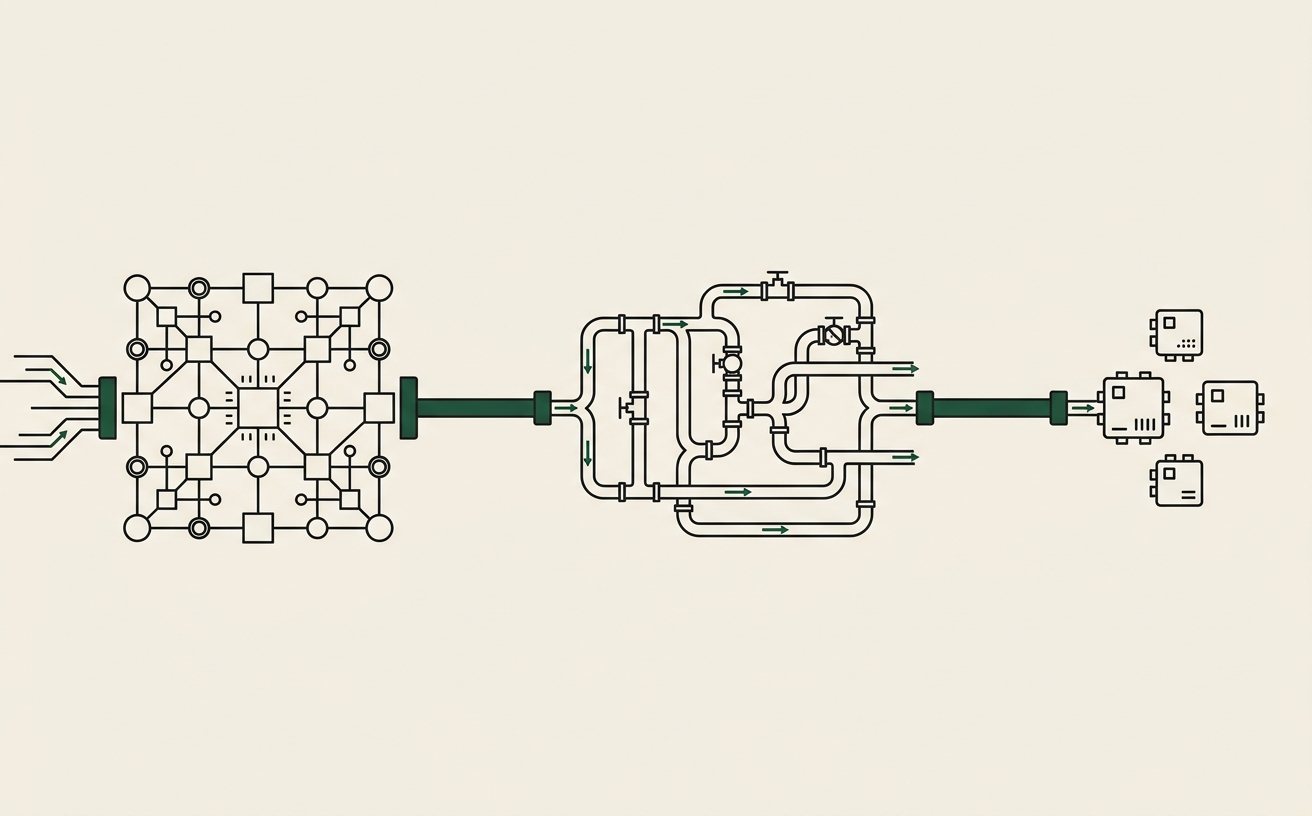
Plenty of firms will tell you what to do with AI. Far fewer will build it and keep it running. That gap — between a strategy and a system in production — is where roughly 95% of AI pilots quietly die, and it's exactly what "implementation services" are supposed to cross.
I keep five companies running in production on agents, with zero hired employees, so I've lived on the implementation side of that line. Here's what the work is, and how to tell an implementation partner who'll get you across the last mile from one who'll leave you with a demo.
4
phases: data, workflows, agents, operate
95%
of AI pilots never reach production
5
companies I keep running in prod
0
hired employees
What Are AI Implementation Services?
AI implementation services take AI from a plan to a system running in production: making your data legible, encoding the workflows, putting agents on top with quality checks, and operating the result. It's the doing, not the advising.
Implementation is the part where AI stops being a slide and starts being how work gets done. Concretely, it's four phases, in order:
- Data. Make the company legible — capture the operational data and the judgment in senior heads into a layer agents can search and write back to.
- Workflows. Encode how the work gets done as repeatable procedures — clear goal, right skills, right tools — so the same input reliably produces the same output.
- Agents. Put execution on top, with evaluators and verifiers checking quality before anything ships to a customer.
- Operate. Run it, keep a human at the edge for the decisions that matter, and feed results back so it improves.
Those four phases are the same three layers of an AI operating system, plus the loop that keeps it alive. Skip the first two and bolt an agent onto scattered data, and you get the confident-but-wrong output that gives AI projects a bad name.
AI
The next teardown, without checking back
About one a week from the five companies I run with co-founders, AI agents, and zero hired employees — what I changed, and the part that broke.
One click to unsubscribe.
Strategy vs Implementation: Where Pilots Die
Strategy decides where to apply AI. Implementation builds it and puts it in production. Most spend stops at strategy — which is why ~95% of pilots never ship. The last mile is the hard, valuable half.
A pilot dies in a predictable place. The demo works, everyone's excited, and then it needs a home: somewhere to run, an owner, a recovery path when it breaks, a predictable run-cost, and a check so a wrong answer never reaches a customer. None of that is strategy. All of it is implementation, and it's where projects stall because it's harder than the demo.
This is why "we have an AI strategy" and "we have AI in production" are worlds apart. If you've already got the strategy and nothing shipped, you don't have a strategy problem — you have an implementation gap. I wrote the operator's playbook for crossing it, the last-mile handoff that survives the person who built it, in The Last Mile Is the Offer.
What to Look For in a Partner
Five signals separate an implementation partner from a demo shop: they operate what they build, price on fixed scope, build the layers underneath, design for reliability, and leave you owning the system.
- They operate what they build. The strongest signal is a system they run themselves and can show you — architecture you can inspect, not slideware.
- They build the layers underneath. Not a bolt-on agent on top of scattered data, but the data and workflow layers that make the agent reliable.
- They design for reliability. Evaluators and verifiers so quality is measured, and a wrong number never ships unchecked.
- They price on fixed scope. A defined deliverable and a fixed fee, not open-ended hours that grow with the project.
- You own the result. You end with a system your team runs — including the skills that encode your judgment — not a permanent dependency.
If a provider hits all five, the last mile is in good hands. If they can't show you something they operate, ask harder about who's on the hook when it breaks in production.
Red Flags
The warning signs are consistent. Each one predicts a pilot that demos well and never reaches production.
- The deliverable is a deck. If the engagement ends at recommendations, it's advice priced as implementation.
- No mention of data or reliability. A plan that jumps straight to "an agent that does X" with nothing about legible data or quality checks will produce plausible, confident, wrong output.
- Open-ended hours. Time-and-materials with no fixed scope means the incentive is more hours, not a shipped system.
- They can't show you a running system. Case-study screenshots aren't the same as "here's one I operate." Ask to see the real thing.
- You'd be locked in. If you can't run it without them, you bought a dependency, not a capability.
None of these mean a provider is bad — some do fine work within their lane. But each one raises the odds you end up in the 95% that never ship. Price and scope accordingly.
Fixed-Scope vs Time-and-Materials
Fixed scope aligns the incentive with shipping. One workflow, a defined deliverable, a fixed fee — build it, prove it, expand. That beats open-ended hours for almost every mid-market company.
The commercial structure quietly decides the outcome. Time-and-materials rewards more hours; the project can drift and still bill. Fixed scope rewards a shipped result: the provider commits to a defined workflow, in production, for a defined fee, and the risk of it taking longer sits with them, not you.
That's how the Operator Method is structured — an audit to scope and price the work, then a fixed-scope implementation of one workflow, then a recurring engagement to operate it. What the numbers look like, and how to budget the first project, is in What AI Implementation Actually Costs.
Frequently Asked Questions
What are AI implementation services?
AI implementation services take AI from a plan to a system running in production: making your data legible, encoding the workflows, putting agents on top with quality checks, and operating the result. It's the doing, not the advising. The distinguishing question is whether the provider hands you a running, owned system or stops at recommendations.
What's the difference between AI strategy and AI implementation?
Strategy decides where to apply AI and in what order; implementation builds it and puts it in production. Most engagements — and most spend — stop at strategy, which is why roughly 95% of AI pilots never reach production. Implementation is the harder, more valuable half: the last mile from a demo to a system people depend on.
What should I look for in an AI implementation partner?
Look for someone who operates what they build, prices on fixed scope rather than open-ended hours, builds the data and workflow layers (not just a bolt-on agent), designs for reliability with evaluators and verifiers, and hands you a system you own. The strongest signal is whether they can show you a system they run themselves.
How long does AI implementation take?
For a single well-chosen workflow, a first working slice in production is usually weeks, not a year. A company-wide program takes much longer — which is why the operator approach builds one workflow end to end, proves it, then expands, instead of running a long transformation before anything ships.
Are AI implementation services worth it for a mid-market company?
They're worth it when the work is scoped to one high-value workflow and priced on outcome. A mid-market company usually already owns the hard part — years of data and judgment — so implementation is largely translation into a system agents can run, which is more defensible and lower-risk than a broad, open-ended program.
Get it into production, not just piloted
I take a few audits a month: a fixed deliverable that maps where your company is carrying weight a stack of agents could lift, and the order to build and operate your own AI Operating System — across the last mile, not up to it.
Apply for an audit