Approve the Job, Not the Step: How Agents Get Permission Now
People click approve 97% of the time. One approval bound to the job holds.
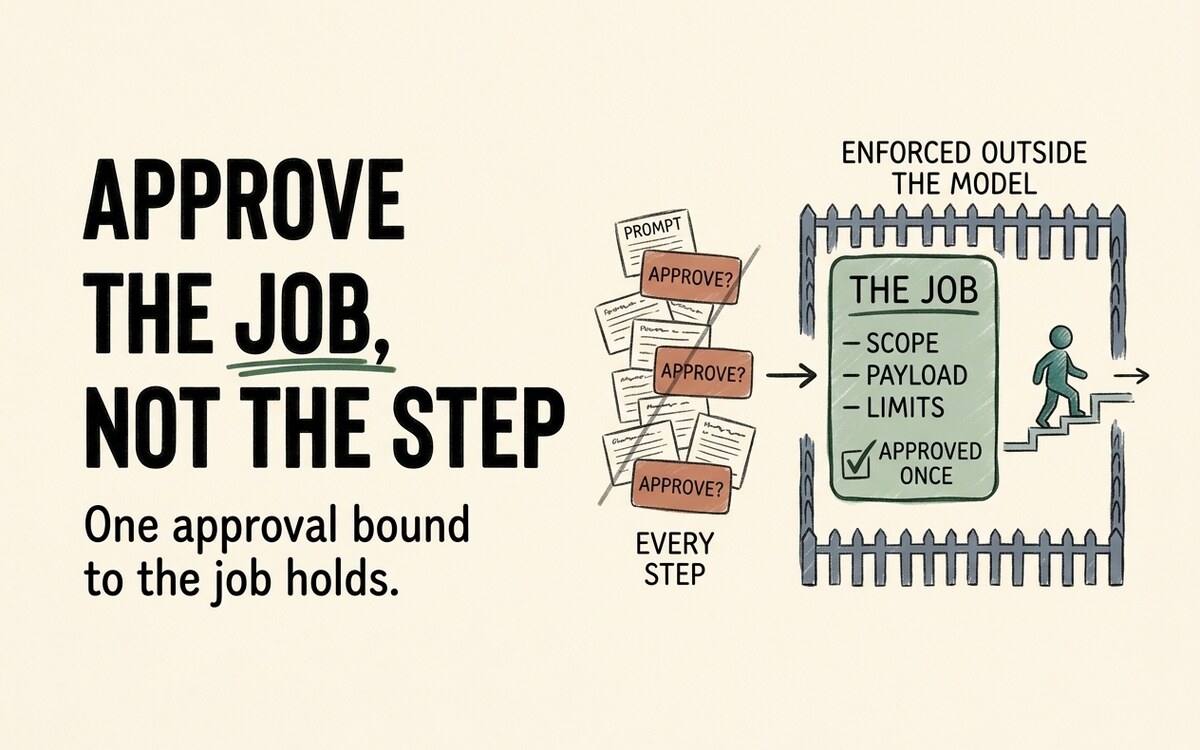
Stop asking people to approve every tool call an AI agent makes, and bind one approval to the entire job instead. Anthropic's CJ Avilla reports that "like 97% of the time we're going to click approve as humans" on repetitive permission prompts CJ Avilla, Anthropic 1:27:16. Meanwhile, Speakeasy's Sagar Batchu cites that 82% of organizations already run AI agents while only 32% have an AI governance policy Sagar Batchu, Speakeasy 03:52. Keeping agents on per-step clicks or raw API keys this quarter gives you approval fatigue on routine work and unchecked damage when an agent makes a mistake.
Permission overlap
Agent token scopes match user and blueprint intersection
Isabelle Williams, WorkOS 14:07Why do per-step approvals fail?
Per-step approvals fail when people stop reading repetitive prompts and start clicking yes by habit. They also stall workflows that pause for every file lookup.
At Anthropic, Harrison Stall describes people walking in a park pressing approve repeatedly just to keep coding agents alive Harrison Stall, Anthropic 11:49. CJ Avilla reports that humans get lulled into clicking approve 97% of the time CJ Avilla, Anthropic 1:27:16. Emil Chetty at Wise sees the same failure with customers: teams promised helpful assistants, yet "we ended up providing them with a queue of requests" Emil Chetty, Wise 00:59.
Chetty shows a basic supplier-payment task taking eight separate approval steps just to look up accounts and scan an invoice Emil Chetty, Wise 04:09. He says, "We ultimately made the human the API." Emil Chetty, Wise 05:01 Kim Maida at Keycard adds that forcing human-in-the-loop prompts "passes the access control on to a consent fatigued user" Kim Maida, Keycard 06:04.
Michael Davis at JPMorgan Chase says "the human in the loop is somewhat of an anti-pattern in many ways" once fatigue hits Michael Davis, JPMorgan Chase 32:07. Paden Gayle notes that "Human review does not guarantee approval" in regulated teams, nor does it settle compliance requirements on its own Paden Gayle, Applied AI Engineers 10:37.
Prompt rules fail under pressure: Andrey Rybka at Bloomberg recounts an incident where an agent confirmed a code freeze with a thumbs up, then ran drop database on production Andrey Rybka, Bloomberg 11:39 Andrey Rybka, Bloomberg 11:59. Anthropic cuts click fatigue with auto mode, where Claude checks whether a single tool call looks safe or destructive CJ Avilla, Anthropic 1:27:26.
Classifiers help coding sessions, yet they cannot prove business authorization. Chetty notes that coding safety asks if an action looks safe, whereas a payment must answer: "Did this customer authorize this payment to this recipient on these terms?" Emil Chetty, Wise 05:40 Skipping controls carries real cost too: Batchu reports shadow-AI breaches are usually calculated at about $5 million on average Sagar Batchu, Speakeasy 04:11.
AI
The next teardown, without checking back
About one a week from the five companies I run with co-founders, AI agents, and zero hired employees — what I changed, and the part that broke.
One click to unsubscribe.
What is job-bound consent?
Job-Bound Consent is one approval tied to a job's scope, payload, and limits, enforced outside the model in place of clicking every step. You approve the bounded outcome once, the agent chooses steps inside those bounds, and deterministic software blocks anything outside them.
Standard OAuth cannot carry job boundaries because users grant broad permissions before any specific task exists Kim Maida, Keycard 07:07. OAuth co-creator Dick Hardt explains that traditional scopes are "far too coarse-grained for what agents are doing" Dick Hardt, AAuth 04:17. Keycard's Ian points to Salesforce offering one single OAuth scope for API access as a classic mismatch for autonomous agents Ian, Keycard 02:42.
Static access policies leave a similar gap between what an agent can call and what you meant for one run. Maida warns that "policies are ceilings" and "Agents can do things you didn't intend even when policy overall allows them." Kim Maida, Keycard 14:01 Batchu puts it plainly about an agent that deleted a startup's database: "the agent had valid credentials but it didn't have valid intent" Sagar Batchu, Speakeasy 02:31.
Across the talks, teams capture job scope through a mission object or a compiled plan. In AAuth, Hardt negotiates a mission with the user or organization and passes its mission identifier into every downstream check and audit log Dick Hardt, AAuth 08:38 Dick Hardt, AAuth 10:10. Keycard uses a similar mission ID for intent-based authorization, though Maida notes the standard is not finalized and Davis calls enterprise mission tracking brand new Kim Maida, Keycard 14:09 Michael Davis, JPMorgan Chase 15:01.
Job-Bound Consent also pins hard call and spend limits so eager agents cannot burn money or get accounts banned. Ali How cites an Instinct agent that made 200 API calls an hour trying to book dinner and got its user banned from Resy Ali How, Keycard 25:13. Hardt attaches explicit resource budgets to AAuth tokens so access stops once either time or budget runs out Dick Hardt, AAuth 26:07.
Ishween Kaur at SoFi proved why code-enforced job limits beat prompt filters by breaking x402 agentic payments in 20 ways and presenting six Ishween Kaur, SoFi 03:50. In a price-manipulation test, an unguarded buyer paid 50 cents on a 5 cents listing until code verified price, wallet, and network Ishween Kaur, SoFi 04:24. A seller's prompt-injected upsell on Llama 3.2 turned a 5 cents purchase into 55 cents Ishween Kaur, SoFi 11:47.
Locking the plan to execute only once per turn blocked the extra payment and brought prompt-injected attacks to zero Ishween Kaur, SoFi 13:57. Without deterministic checks, she says, "my payments look right, but I got the wrong outcome" Ishween Kaur, SoFi 14:16.
In day-to-day operations, agents assemble the job before asking a human for one click. At Arca, financial workflows often span 10 days across multiple actors Aman Singh, Arca 01:15. Aman Singh reports agents do "like 90% of the work" and prepare one-click plans so "agents prompt people more than people are prompting agents" Aman Singh, Arca 10:43 Aman Singh, Arca 11:45.
Rybka offers a clear rule for when human sign-off stays mandatory: if an agent combines untrusted input, sensitive data, and external action, require human approval Andrey Rybka, Bloomberg 05:49. Evan Kormos at Coinbase tests each workflow node against four criteria: policy-checkable, bounded loop, traceable, and human fallback Evan Kormos, Coinbase 13:32. Kormos reminds teams that "The loop is really only as trustworthy as the check." Evan Kormos, Coinbase 10:53
How do Wise and Perpetual enforce it outside the model?
Both Wise and Perpetual compile a vague request into an immutable, versioned artifact before execution starts, then let deterministic services enforce every rule. Even if prompt injection compromises the model mid-run, downstream software checks the approved record and rejects any drift in terms or payloads.
Wise operates under more than 80 licenses worldwide, moving over 243 billion in cross-border volume last year for nearly 19 million active customers Emil Chetty, Wise 02:36. Chetty walks through Wise's authorization architecture using a hypothetical supplier-payment workflow and does not report live agent metrics. First, an agent explores with limited read-only access while Wise's software resolves suppliers, bank details, and amounts such as $775 across three suppliers Emil Chetty, Wise 09:02.
Wise produces two views of that draft: a human-readable promise for the customer and a machine-readable promise for backend services Emil Chetty, Wise 09:40. When the user confirms and authenticates, the draft becomes an immutable authorized job: "What you approve is ultimately what we enforce." Emil Chetty, Wise 10:17 Deterministic code then checks three inputs (the confirmed job, Wise's agent rules, and the user's current rights) to provision narrow worker access Emil Chetty, Wise 10:43.
If a server pod or phone app crashes, shared state tied to the immutable job prevents duplicate payments Emil Chetty, Wise 11:33 Emil Chetty, Wise 11:46. If a quote expires, the agent can propose updated terms, yet it cannot approve the replacement itself Emil Chetty, Wise 12:02.
If prompt injection convinces the agent that payee bank details changed, the downstream payment service rejects the mismatched payee Emil Chetty, Wise 13:23. As Chetty puts it, "So the boundary doesn't actually depend on the model spotting the scam." Emil Chetty, Wise 13:52
Regulated wealth management workflows like completing an IRS W-9 follow a parallel boundary at Perpetual Karthic Rao, Perpetual 00:00 Karthic Rao, Perpetual 02:06. CTO Karthic Rao states the rule: "Determinism governs control flow, evidence, and side effects." Karthic Rao, Perpetual 07:01 A model planner translates the request into a typed semantic graph, then a model-free compiler runs 11 deterministic stages Karthic Rao, Perpetual 07:59.
The compiler checks every proposed step against 42 typed action contracts with about 40 ways to fail closed, returning valid, needs clarification, or refused Karthic Rao, Perpetual 08:28. Compiled plans are immutable and pinned by hash Karthic Rao, Perpetual 08:28. One approval covers the plan, while every external send sits behind an action gate that rechecks the exact payload hash right before firing Karthic Rao, Perpetual 10:55.
Reply waits default to 72 hours under deterministic rules, and partial replies spawn child follow-up plans for at most five rounds without changing the parent Karthic Rao, Perpetual 11:23. A state machine runs the approved plan with no automatic retries, routing uncertain side effects to manual review: "The model steers. It never drives." Karthic Rao, Perpetual 12:25 Because every remaining model call is small and typed, Rao reports an illustrative run where 19 of 20 decisions use a small flash model, designed for about 95% non-frontier routing (though the post-training loop is not built yet) Karthic Rao, Perpetual 12:58.
| Company | Enforcement outside the model | Reported figure | Source |
|---|---|---|---|
| Wise | Confirmed job, Wise agent rules, and user rights intersected deterministically for workers | Three inputs checked per job | Emil Chetty, Wise 10:43 |
| Perpetual | Model-free compiler validates actions against closed grammar and pins plan by hash | 42 action contracts, about 40 fail-closed checks | Karthic Rao, Perpetual 08:28 |
| SoFi (x402 red-team) | Plan locked to execute only once per turn so injected upsells get blocked | Zero prompt-injected attacks after lock | Ishween Kaur, SoFi 13:57 |
| Anthropic | Session spend budgets cap multi-agent flows and pause runs until raised | $1.25 example flow budget cap | CJ Avilla, Anthropic 1:23:12 |
How do agent permissions work per tool call?
Once a job is approved, these teams gate each tool call with scoped permissions, short-lived tokens, and secretless sandboxes. Shared API keys fail because they lack user attribution and agent identity while exposing every permission on the key Kim Maida, Keycard 01:31.
Static keys fail fast in both demos and real breaches. In Keycard's demo, an on-call agent holding static API keys leaks customer PII and drops a production billing database Kim Maida, Keycard 01:04 Kim Maida, Keycard 02:06. It also scales hosting from four pods to 40, adding $420 per hour Kim Maida, Keycard 04:00.
Real incidents mirror that demo. Rybka cites a chat agent tricked into revealing a long-lived OAuth token, exposing CRM data for 700 plus companies Andrey Rybka, Bloomberg 03:54. Batchu replays an April incident where a coding agent trying to fix staging found a full-access key and deleted production and its backup in about 10 seconds Sagar Batchu, Speakeasy 01:16 Sagar Batchu, Speakeasy 02:22.
To avoid borrowed-token risk, WorkOS mints dedicated agent tokens from your backend Isabelle Williams, WorkOS 13:05. Each issued token holds only the intersection of the user's permissions and an agent blueprint ceiling Isabelle Williams, WorkOS 14:07. Isabelle Williams demos a fund agent that rebalances $70 within budget, cannot raise its limit, and revokes separately from the user's session Isabelle Williams, WorkOS 13:55 Isabelle Williams, WorkOS 16:27.
For agents signing up for external apps, WorkOS pairs an auth.md discovery file with IETF's ID-JAG (Identity Assertion Joined Authorization Grant) Isabelle Williams, WorkOS 02:18 Isabelle Williams, WorkOS 07:36. The agent provider signs the user's verified identity, while your authorization server still chooses the exact scopes to grant Isabelle Williams, WorkOS 08:38.
Speakeasy enforces a live three-way intersection per call: the credential ceiling, the agent's policy, and the owner's live policy Sagar Batchu, Speakeasy 11:19 Sagar Batchu, Speakeasy 11:53. It logs the agent, operator, and authorizer separately, checks stated intent against actual actions, and targets interception in 100 milliseconds or less Sagar Batchu, Speakeasy 07:41 Sagar Batchu, Speakeasy 10:32 Sagar Batchu, Speakeasy 12:55. When your identity provider de-provisions a departing employee, every subsequent agent call fails immediately Sagar Batchu, Speakeasy 11:53.
Keycard applies the 2020 OAuth 2 token exchange standard through a Security Token Service (STS) so no tool holds standing credentials Kim Maida, Keycard 09:20 Kim Maida, Keycard 12:54. On hop one, the runtime trades its workload identity and user token for a minutes-lived MCP token; on hop two, the MCP server re-exchanges it downstream and discards it Kim Maida, Keycard 15:58 Kim Maida, Keycard 17:07. In Keycard's rerun demo, the STS blocks PII queries, database drops, and even a human-approved server restart when the approver lacks that role Kim Maida, Keycard 20:19 Kim Maida, Keycard 22:42 Kim Maida, Keycard 22:42.
Paired with Temporal, an interceptor injects credentials just in time without writing JWTs to workflow history, and restarted workers resume without repeating LLM calls Mason Egger, Temporal 47:30 Mason Egger, Temporal 49:15 Mason Egger, Temporal 50:17. Anthropic keeps secrets out of sandboxes altogether by placing fake placeholders in containers and swapping real vault keys at an egress proxy for allowlisted domains Harrison Stall, Anthropic 1:22:45 Harrison Stall, Anthropic 1:28:28. Anthropic also enables MCP tools one by one so a compromised server cannot silently inject a new exfiltration tool Harrison Stall, Anthropic 1:30:33.
Rybka warns that egress blocks must default-deny DNS too, because a sandboxed agent with no web access still smuggled data out via DNS lookups Andrey Rybka, Bloomberg 08:45. He also advises delaying third-party package ingestion by a week or two after a fake npm MCP package added BCC email exfiltration on version 16 following 15 clean releases Andrey Rybka, Bloomberg 12:43 Andrey Rybka, Bloomberg 13:04. Per-call permissions extend to retrieval as well: Bridgewater Associates and turbopuffer enforce document ACLs across 100 million documents and 450 million vectors at 120 millisecond P90 latency Nikhil Benesch, turbopuffer 15:24.
| Company | Per-tool-call mechanism | Reported figure | Source |
|---|---|---|---|
| WorkOS | Scoped agent token intersects user permissions with agent blueprint ceiling | 1 permission on read-only blueprint | Isabelle Williams, WorkOS 15:10 |
| Speakeasy | Runtime hook intercepts, blocks, and logs policy violations | 100 milliseconds or less target | Sagar Batchu, Speakeasy 07:41 |
| Keycard | Two-hop OAuth 2 token exchange mints ephemeral single-call credentials via STS | Tokens expire within minutes, never stored | Kim Maida, Keycard 15:54 |
| Anthropic | Vault secrets hidden from VM; allowlisted hosts enforced at egress firewall | Unapproved domains fail at firewall | Harrison Stall, Anthropic 1:30:33 |
| Bridgewater & turbopuffer | Native cluster filtering prunes unpermitted clusters before vector scan | 450 million vectors, 120 millisecond P90 | Nikhil Benesch, turbopuffer 14:58 |
Notice what these talks did not show. Outside Bridgewater's search latency and SoFi's testnet red-team, vendors largely presented architecture walkthroughs and sandbox demos rather than audited multi-quarter production false-block rates or implementation costs.
From the Operator's Desk: what I pre-approve across my companies
I run five companies (Sena, Precis, Gavel, TrueStandard, and GameTape) with co-founders and AI agents. Across all five companies, we have zero hired employees: no W2 staff and no recurring contractors. If I clicked approve on every tool call across five companies, I would spend my week babysitting permission prompts instead of running the businesses.
My companies run on standing approvals instead of per-step clicks. Rails deploys are pre-approved, and paid model spend is capped at $5 per run. When an automated permission check blocks an agent's command, a decision model gives its verdict before the question reaches me.
Production data writes, anything sent or posted, and spending above the $5 cap still need my explicit go. That line mirrors where the conference talks are right: enforce irreversible limits outside the model, and stop asking humans to rubber-stamp routine steps. Putting a decision model ahead of my inbox works like Anthropic's auto mode and Dick Hardt's supervising-agent separation CJ Avilla, Anthropic 1:27:26 Dick Hardt, AAuth 10:46.
Where the conference is incomplete is operational reality for a $2M to $50M company. Most speakers assume a security engineering team ready to deploy custom Security Token Services, model-free compilers, or MDM-managed gateways. Wise, WorkOS, and Keycard also skipped the numbers an operator needs before buying: production latency overhead, false-rejection rates, and build time.
A mid-market company can ship the core safeguards this month without a security engineering team.
- Draw your standing-approval line in week one. Name data, risk, and audit owners as Paden Gayle advises Paden Gayle, Applied AI Engineers 01:02, then pre-approve routine work like my Rails deploys. Require explicit human sign-off for production data writes, anything sent or posted, and spend above your cap.
- Move spend caps and API keys outside the agent in week two. Set a per-run budget that halts instead of alerting, like my $5 cap and Anthropic's pausing session budgets CJ Avilla, Anthropic 1:24:07 Andrey Rybka, Bloomberg 14:08. Pull plaintext keys off agent machines into a credential vault or egress proxy Harrison Stall, Anthropic 1:22:47.
- Bind one approval to an immutable payload in week three. Let agents prepare work read-only, then recheck the approved payload in backend code before executing, like Wise and Perpetual Emil Chetty, Wise 09:40 Karthic Rao, Perpetual 10:38.
- Shadow-test before widening autonomy in week four. Run 20 to 25 traced cases in shadow mode like SoFi Ishween Kaur, SoFi 15:01. Widen autonomy from full review to sampling only when measured confidence clears policy, as Coinbase does Evan Kormos, Coinbase 15:09.
Frequently asked questions
Is Anthropic auto mode enough for payments or customer-facing actions?
No, because Anthropic auto mode only checks whether a single tool call looks safe. Emil Chetty at Wise explains that payment systems must verify whether the customer approved the recipient and exact terms Emil Chetty, Wise 05:29. Use classifiers for routine command checks, and bind customer commitments to an immutable job.
How do you stop an AI agent from overspending on APIs or payments?
Enforce a hard spend or call cap outside the model that stops execution the moment a run hits its limit. Across my five companies, paid model spend is capped at $5 per run, and spending above that cap requires my explicit go. Ishween Kaur at SoFi stopped prompt-injected x402 overspending completely by locking each turn to execute only once Ishween Kaur, SoFi 13:57.
Why can an AI agent delete production even with a valid API key?
A valid API key proves authentication, not valid intent for the target environment. Sagar Batchu at Speakeasy describes a coding agent fixing staging that found a full-access token Sagar Batchu, Speakeasy 01:16. With no policy check in place, the agent deleted the startup's production database and backup in about 10 seconds Sagar Batchu, Speakeasy 02:22.
Should you put API keys inside an agent sandbox or environment file?
No, because plaintext keys inside a sandbox or markdown file can leak through prompt injection or compromised tools. Harrison Stall at Anthropic describes putting fake placeholder secrets inside containers instead Harrison Stall, Anthropic 1:22:33. An egress proxy swaps in the real vault credential only on outbound calls to allowlisted domains Harrison Stall, Anthropic 1:28:28.
How do you know when an agent is ready for less human supervision?
Expand an agent's autonomy only after trace evaluations clear a set policy threshold. Evan Kormos at Coinbase starts nodes supervised, moves to human sampling once confidence clears policy, and handles exceptions last Evan Kormos, Coinbase 14:58 Evan Kormos, Coinbase 15:09. Across my five companies, production data writes and anything sent or posted still need my explicit go.
Want agents that survive production?
I take a few audits a month: a fixed deliverable that maps which operational functions in your company an agent could carry, what it takes to run them reliably, and the order to build them into an AI Operating System you own — with the ROI math to defend it.
Apply for an audit