Do You Need an LLM for Every Decision? The Cheap Layer Agents Grew This Fall
Many agent calls are yes/no questions. A decision model answers them for a fraction of a cent.
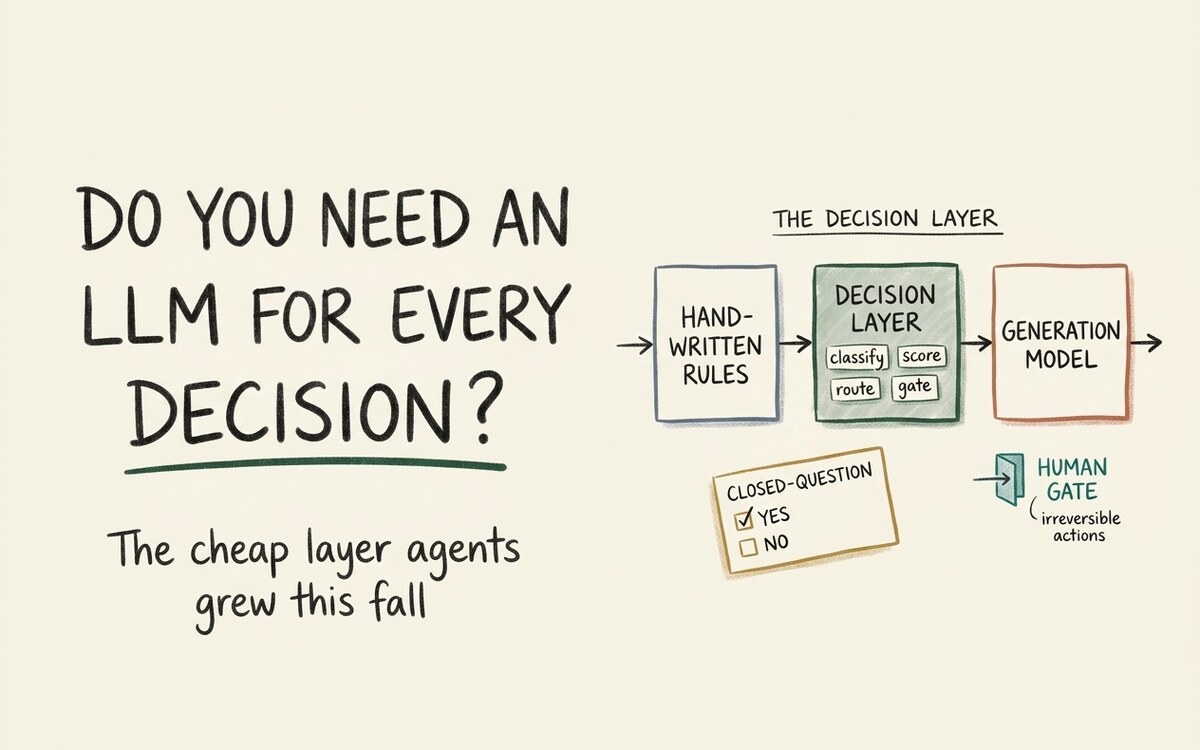
Table of Contents
You do not need a generative LLM for every step inside an AI agent. Many agent calls are closed yes/no, routing, or scoring checks that a small decision model answers faster and for a fraction of the spend. At Southbridge AI, adding a decision model to an Ohio campaign-finance pipeline cut a job projected to cost about $10,000 down to under $800 Hrishi Olickel, Southbridge AI 01:24. If your team runs agents in production this quarter, splitting judgment calls away from text generation is one of the cleanest cost and speed levers available.
11 of 190
talks naming Jev in this study
$0.011
cost to sort 375 regex hits
What is a decision model, and how is it different from an LLM?
A decision model is a small classifier that picks from fixed options, scores an input, or answers yes or no without writing prose. The Decision Layer is a tier of small decision models that classify, score, route, and gate between hand-written rules and a generation model, answering closed questions fast and cheap.
TypeSafe released Jev under the label System One models, borrowing Daniel Kahneman's distinction between fast intuitive judgment and slow deliberate reasoning Raymond Weitekamp, OpenProse 00:29. Most builders outside TypeSafe call them decision models, while holdouts call them zero-shot classifiers Raymond Weitekamp, OpenProse 01:02, 02:19. In my word search of all 188 transcripts across the 190 talks I studied, Jev came up in 11 talks. I have no stake in or deal with TypeSafe.
The core difference from an LLM is convergence versus divergence. Generation models produce open-ended text streams, whereas Raymond Weitekamp at OpenProse notes that "the decision model cannot generate text." Raymond Weitekamp, OpenProse 05:57. TypeSafe even gates its API key behind a quiz asking if Jev can generate text; answer yes, and you do not get a key Raymond Weitekamp, OpenProse 23:17.
WorkOS speakers Nick Nisi and Zack Proser frame the split the same way. Naming the color of a light is System One thinking, while explaining the physics behind that color is System Two Nick Nisi & Zack Proser, WorkOS 41:17. Fuad Ali at Arize AI notes that decision models return typed outputs (yes, no, choice, or score) along with an explicit confidence score Fuad Ali, Arize AI 22:13, 32:51.
Hrishi Olickel at Southbridge AI separates data-pipeline intelligence into three distinct roles: heavy models that design pipelines, cheap workers that execute inside them, and optimizers that tune them Hrishi Olickel, Southbridge AI 08:30, 09:33. Decision models sit purely in the worker tier, "deployed at the bottom end of large workloads." Hrishi Olickel, Southbridge AI 10:05. Alternatives already exist beyond Jev, including Cloudflare's Cleft, which shipped two days after Jev Nick Nisi & Zack Proser, WorkOS 40:15, and Featherless AI's open-source Simple Jev running on Qwen 27B Eugene Cheah, Featherless AI 46:35.
AI
The next teardown, without checking back
About one a week from the five companies I run with co-founders, AI agents, and zero hired employees — what I changed, and the part that broke.
One click to unsubscribe.
Which agent calls are really yes/no questions?
Many production agent calls handle routing, gating, verification, and classification. Any step that chooses from a closed menu of answers fits a decision model.
Enterprise AI splits into two economic tracks, according to Eugene Cheah at Featherless AI: long-context agentic runs and high-volume process automation Eugene Cheah, Featherless AI 05:07, 05:33. Tasks like call-center routing, message filtering, approvals, and transaction risk are volume games Eugene Cheah, Featherless AI 07:40. One telco Featherless works with peaks at 10 million messages in a single minute scanning for profanity or sexual content Eugene Cheah, Featherless AI 07:51. Cheah notes that many customer support teams already supply predefined responses and only need a classifier to pick one Eugene Cheah, Featherless AI 22:48.
Inside coding and operations agents, speakers pointed to four recurring closed-question jobs for The Decision Layer:
Permission and safety gates: Within 24 hours of Jev's release, engineers used it to decide whether a tool call should execute, handle context compaction, and route requests Raymond Weitekamp, OpenProse 08:37. Will Brown at Prime Intellect highlights tool-call approvals and bespoke company rules as clear labelable judgments Will Brown, Prime Intellect 13:10, 13:36. Related talks described similar runtime classifiers screening safe actions at Two Sigma John Feminella, Two Sigma 16:18, checking agent scope drift at Runlayer Aiden Sochowski, Runlayer 06:31, and enforcing banking policy funnels at NatWest Jonathan Osborne, NatWest 02:24.
Workflow routing and triage: Standard Agents embeds Jev inside agent threads to check customer sentiment and decide whether to escalate to a human Justin Schroeder, Standard Agents 26:13. Dan and Raymond at OpenProse plan to use decision models to route incoming GitHub webhooks and check whether upstream state changed before re-running downstream jobs Raymond Weitekamp, OpenProse 27:37, Dan, OpenProse 42:46.
Post-run verification and evals: WorkOS pairs deterministic Playwright checks with a System One judge that verifies UI copy without brittle exact-string assertions Nick Nisi & Zack Proser, WorkOS 21:17, 39:12. Arize AI uses decision models to score production traces cheaply instead of paying for a full LLM judge on every trace Fuad Ali, Arize AI 22:30.
Search and state-machine transitions: TypeSafe's launch cookbook used hierarchical Jev calls to navigate 12,000 Shopify product categories without overloading a context window Raymond Weitekamp, OpenProse 17:43, 18:33. Kush Agrawal at Duolingo floated replacing a hand-written pull-request lifecycle decision tree with a fast classifier that picks the next action in milliseconds Kush Agrawal, Duolingo 11:56.
Weitekamp pushes the question even further, asking "what if reasoning was actually many small decisions?" Raymond Weitekamp, OpenProse 02:57.
Where did teams put decision models at NYC and CODE?
Speakers across NYC and CODE put decision models into five roles: data-pipeline workers, trace evaluators, workflow gates, code-review screeners, and real-time control loops. Because Jev launched less than two months before these talks, most examples were fresh demos or early pipelines Raymond Weitekamp, OpenProse 00:00.
| Company / Talk | What they built with a decision model | Reported result | Link |
|---|---|---|---|
| Southbridge AI | Resolved Ohio campaign-finance donors with Jev plus cross-model checking against Luna | 203,317 cases completed for $795 on an $800 budget (vs. about $10,000 projected) | Hrishi Olickel, Southbridge AI 11:39, 12:43 |
| OpenProse (RDM) | Built recursive decision trees (Factorio, smart home, Earshot voice control) with an arbiter gate | Voice control reached essentially 45 millisecond response time in Earshot demo | Raymond Weitekamp, OpenProse 45:28 |
| Arize AI | Scored agent traces and routed low-confidence calls to human annotation queues | 4.6% of spam-test cases routed to people, leaving the rest at 99.5% accuracy | Fuad Ali, Arize AI 33:48 |
| Neo4j | Compiled loan approval policies into a YAML graph with scripts for hard rules and Jev for risk and approval gates | Demo almost cut a Fable run of 2.7 minutes in half | Zachary Blumenfeld, Neo4j 16:01, 19:10 |
| WorkOS (Fruit Fly) | Used Jev to ask 30 unbiased questions per PR diff and feed a simulated fruit-fly brain | About 88% accuracy in testing; 96% and 98% on harder test cases | Nick Nisi, WorkOS 10:50, 09:46, 04:23 |
| Featherless AI | Replicated Jev's API on open models (Simple Jev) using prompt-tuned Qwen 27B | Beat most 27B fine-tunes on over 10,000 Hugging Face benchmark questions | Eugene Cheah, Featherless AI 46:35 |
| Standard Agents | Embedded Jev directly into agent thread runtimes for sentiment and human escalation | Part of runtime spec; no standalone classifier metric reported | Justin Schroeder, Standard Agents 26:13 |
Three architectural patterns stood out across these builds. First, Southbridge AI treated entity resolution as a "just-in-time ontology" because "There is no concept of a customer that's divorced from the question that you want to answer." Hrishi Olickel, Southbridge AI 04:40. Instead of forcing every record into one universal schema up front, their system split 800,000 rows into 200,000 specialized cases and asked typed yes/no questions at decision time Hrishi Olickel, Southbridge AI 18:27.
Second, Neo4j compiled inconsistent agent traces into a deterministic YAML procedure graph executed by a small CLI Zachary Blumenfeld, Neo4j 14:58. Hard policy rules ran in ordinary scripts, judgment gates like risk tier and approve-or-deny routed to Jev, and only the final report generation used a language model Zachary Blumenfeld, Neo4j 16:07. Storing every run in the graph also let compliance teams inspect which branches were taken or skipped Zachary Blumenfeld, Neo4j 18:09.
Third, OpenProse paired decision models with generative LLMs through two primitives: a shared "map" and an "arbiter" Raymond Weitekamp, OpenProse 29:40, 32:06. The decision model picks fast actions from the map, while the LLM edits the map whenever a user introduces a novel behavior Raymond Weitekamp, OpenProse 30:43. When multiple cheap classifiers run speculatively in parallel, the arbiter gates which branch is allowed to write state Raymond Weitekamp, OpenProse 32:47, 34:51.
OpenProse is still adding Jev to its hosted workflow runner as a contract verifier and semantic cache Dan, OpenProse 26:31, 42:25. Duolingo still relies on a hand-written state machine and an LLM-as-a-judge that rejected 73 test PRs, naming Jev only as a thought experiment Kush Agrawal, Duolingo 10:25, 11:53.
How accurate and how cheap are they?
When backed by clear definitions and a second-opinion check, decision models hit very high accuracy on closed questions while slashing spend by an order of magnitude.
Southbridge AI's optimizing agent ran for 10 days and tested over a dozen architectures Hrishi Olickel, Southbridge AI 12:43. It executed more than 4,000 harness runs alongside 90,000 calls to Jev while processing roughly 6 billion tokens Hrishi Olickel, Southbridge AI 13:09. Total spend across all 203,317 Ohio donor cases landed at $795 on an $800 budget, down from about $10,000 projected before Jev Hrishi Olickel, Southbridge AI 12:01, 12:43.
Look closely at where Southbridge's money went. Checking cost about four times as much as doing: $545 went to second opinions, settling disagreements, and auditing, versus $128 for first answers Hrishi Olickel, Southbridge AI 12:32. Because the pipeline is now verified, Olickel expects the audit budget for the next state to be close to zero Hrishi Olickel, Southbridge AI 12:43.
Jev and Luna agreed on 194 of 200 held-out families, and "none of those shared answers was wrong." Hrishi Olickel, Southbridge AI 15:53. All errors fell in the six families where the two models disagreed Hrishi Olickel, Southbridge AI 15:53.
Arize AI reported a parallel pattern using confidence bands instead of a second model. In a spam test Fuad Ali cited, routing the 4.6% of cases that scored between 0.3 and 0.7 confidence to humans left the rest at 99.5% accuracy Fuad Ali, Arize AI 33:48. Because decision models are cheaper than LLM judges, Ali expects more teams to evaluate production traces continuously and even move checks inside the live execution loop Fuad Ali, Arize AI 48:34.
Vendor claims and demos point in the same direction on unit economics and latency, though each comes with caveats:
- Cost: Eugene Cheah of inference provider Featherless AI says one-shot classifiers like Jev are commonly 10x cheaper than generative models and often faster Eugene Cheah, Featherless AI 12:55.
- Open-model parity: Cheah's prompt-tuned Qwen 27B (Simple Jev) beat most 27B fine-tunes across over 10,000 Hugging Face benchmark questions, though he suspects Cloudflare's newer fine-tuned model now beats his Eugene Cheah, Featherless AI 47:09.
- Sub-second latency: OpenProse's Earshot demo used a recursive decision model to learn when to trust a tiny local audio model, reaching "essentially 45 millisecond" response time Raymond Weitekamp, OpenProse 46:18. Weitekamp also cited a separate project, Hunch, classifying doodles locally in WebGPU with Embedding Gemma 2 in 150 milliseconds Raymond Weitekamp, OpenProse 47:50.
- Demo speedups: Zachary Blumenfeld at Neo4j stressed that his loan-approval benchmark was a demo, not a formal study, yet moving routing into scripts and Jev cut Fable's 2.7-minute runtime nearly in half Zachary Blumenfeld, Neo4j 19:16, 10:45.
What the talks did not show matters just as much. None of the speakers published a standardized cost-per-thousand-calls table comparing Jev, Cleft, and open-source classifiers on identical business workloads. None reported six-month production drift numbers either, because these models had barely been out for two months.
Where do decision models fail?
Decision models break down when teams ask for open-ended reasoning or supply loose definitions. Speakers documented six failure modes in these talks.
1. Unenumerated options break pure decision trees. Because a decision model can only pick among options given to it, a script, app, or another agent must pre-enumerate every valid path Raymond Weitekamp, OpenProse 24:10, 24:19. It cannot generate a chat reply Eugene Cheah, Featherless AI 12:55 or invent a new workflow step when a customer asks for something outside your map Raymond Weitekamp, OpenProse 28:37.
2. Loose definitions create confident wrong answers. In Southbridge AI's first Ohio donor runs, Jev got core answers right but missed nine household links because it confidently answered no to every one of them Hrishi Olickel, Southbridge AI 11:20. The fix was not changing models or thresholds: rewriting the question to define what counted as enough evidence flipped Jev from no to yes on all 13 development questions Hrishi Olickel, Southbridge AI 11:39. Scaling statewide still took over a dozen rounds of tightening definitions like committee, filer, and shared address Hrishi Olickel, Southbridge AI 11:39.
3. Shared priors slip past cross-model checks. Cross-model checking only works when models come from different pedigrees and were not distilled from the same parent Hrishi Olickel, Southbridge AI 15:53. On one Southbridge benchmark, four different model families produced the exact same wrong total because they shared a sign convention Hrishi Olickel, Southbridge AI 15:53. Earlier pipeline priors left 99.4% of transaction dates empty and turned a net of 784,000 into 5.3 million dollars of debt Hrishi Olickel, Southbridge AI 14:50.
4. Classifiers never understand intent or explain fixes. Nick Nisi's Jev-backed fruit-fly reviewer can flag removed logic or suspicious diffs, "but nothing knows why." Nick Nisi, WorkOS 12:17. It went two for three live on stage and cannot tell an engineer how to fix a broken pull request Nick Nisi, WorkOS 09:46, 10:50.
5. Uncalibrated thresholds and missing ground truth breed false confidence. Fuad Ali warns that an 80% confidence cutoff is not universal across industries Fuad Ali, Arize AI 33:30. Without real ground truth behind your evals, you end up "just vibing" with agent outputs Fuad Ali, Arize AI 47:57. Similarly, Zachary Blumenfeld notes that raw LLM confidence scores in loan workflows are often uncalibrated Zachary Blumenfeld, Neo4j 13:54.
6. Bad wiring breaks caches, state, and security. Running parallel decision models without an arbiter causes write collisions when a faster branch flips state before a slower branch finishes Raymond Weitekamp, OpenProse 33:50, 34:51. Using a router to switch among 30 models on every turn ruins prompt-cache hit rates; Eugene Cheah advises capping turn-based routing at two to three models Eugene Cheah, Featherless AI 54:12. Finally, calling Jev inside a sandbox requires vaulting credentials so secrets never leak into context Mikyo King, Arize AI 08:41, and any judge that writes prose explanations can un-redact PII unless its reasoning is checked or suppressed Al Chen, Cisco 10:52, 12:10.
From the Operator's Desk: how I use one across my companies
I run five companies (Sena, Precis, Gavel, TrueStandard, and GameTape) with co-founders and AI agents and zero hired employees: no W2 staff and no recurring contractors. Across those operations, I use The Decision Layer in two narrow places: filtering noisy regex matches and screening blocked agent commands before they interrupt me.
The first deployment lives in my SEO backend's AI-visibility scorer. It used a regex to spot rival brands inside AI answers, which caught plenty of incidental text alongside real recommendations. I put Jev behind that regex across 149 of Taffy's non-branded answers. Out of 375 regex hits, Jev called 285 real suggestions and 90 incidental, for $0.011 in total. I hand-checked 15 of its calls, and 14 were right.
That single job shows why a decision tier works. A regex alone mixes real brand suggestions with incidental mentions, and a frontier LLM costs more than a binary check needs. Putting Jev behind that regex closed the accuracy gap for $0.011.
My second deployment works with standing approvals: Rails deploys are pre-approved, and paid model spend is capped at $5 per run. When an automated permission check blocks an agent's command, a decision model gives its verdict before the question reaches me. I require my explicit go for production data writes, anything sent or posted, and spending above the $5 cap.
The conference talks got two lessons right. First, Southbridge AI showed how much rewriting question definitions improves accuracy Hrishi Olickel, Southbridge AI 11:39. Second, Featherless AI advises teams spending less than 10K a month on AI to find strong use cases first Eugene Cheah, Featherless AI 02:41.
Where the conferences are incomplete is day-two operations. Almost every Jev example on stage was weeks old, skewed toward coding tools, and light on ongoing drift audits. Mid-market operators do not need a fruit-fly PR reviewer; they need reliable gates on tickets, invoices, and agent permissions.
If you run operations at a $2M to $50M company, do four things this month:
- Split your API keys by department and workflow. Featherless AI sees 30% to 40% of new customers running on one shared key Eugene Cheah, Featherless AI 03:52. You cannot right-size calls you cannot see.
- Pick one noisy binary gate. Put a decision model behind a brittle regex, a support escalation rule, or a blocked-command check, rather than rebuilding your whole stack.
- Hand-check a small slice and tighten your definitions. I audited 15 calls; Southbridge tested 200 held-out families Hrishi Olickel, Southbridge AI 15:53. Rewrite ambiguous wording before touching thresholds.
- Keep irreversible actions behind a human. Let a decision model pre-screen routine blocks, while keeping production writes, external sends, and spend above your cap on explicit human approval.
Frequently asked questions
What alternatives to TypeSafe's Jev exist for decision models?
Competing models include Cloudflare's Cleft, released two days after Jev launched, plus open-source options that already replicate the same API Nick Nisi & Zack Proser, WorkOS 40:15. Featherless AI also built Simple Jev by prompt-tuning Qwen 27B, which beat most 27B fine-tunes across over 10,000 Hugging Face benchmark questions Eugene Cheah, Featherless AI 47:09. You are not locked into one vendor.
Should my company add decision models if our AI spend is under $10,000 a month?
If you spend less than 10K a month, focus on strong use cases before optimizing token bills Eugene Cheah, Featherless AI 02:29. Eugene Cheah at Featherless AI notes one strong workflow brings way more than 10K a month Eugene Cheah, Featherless AI 02:41. Even so, putting Jev behind a noisy filter is quick: my SEO backend sorted 375 regex hits for $0.011.
How do I know when to send a decision model's call to a human?
Route uncertain calls to humans using confidence scores or cross-model disagreement. In an Arize AI spam test, routing 4.6% of cases (0.3 to 0.7 confidence) to people left 99.5% accuracy Fuad Ali, Arize AI 33:48. At Southbridge AI, every error across 200 held-out families sat in the six cases where Jev and Luna disagreed Hrishi Olickel, Southbridge AI 15:53.
Will routing every agent turn to a different model cut my token bill?
Turn-based routing across many models usually raises costs because it breaks prompt caching Eugene Cheah, Featherless AI 53:56. Eugene Cheah at Featherless AI recommends task-based routing by department or workflow instead Eugene Cheah, Featherless AI 54:04. If you run turn-based routing, Cheah caps it at two to three models because 30 models wreck cache hits Eugene Cheah, Featherless AI 54:04.
Can a decision model replace human approvals for high-risk agent actions?
No, a decision model should screen routine cases rather than approve irreversible actions. Across my five companies, one gives a verdict when a permission check blocks an agent command. Production data writes, anything sent or posted, and spend above $5 per run still need my explicit go. Nick Nisi at WorkOS notes that automated classifiers still cannot know why Nick Nisi, WorkOS 11:55.
Want agents that survive production?
I take a few audits a month: a fixed deliverable that maps which operational functions in your company an agent could carry, what it takes to run them reliably, and the order to build them into an AI Operating System you own — with the ROI math to defend it.
Apply for an audit