Engineering as Marketing: How Founders Build Free Tools That Drive 50K Clicks/Month
We analyzed how founders use free tools, open-source projects, and data-moat products to acquire customers with zero ad spend. Real playbooks from real founders.
Jump to a section:
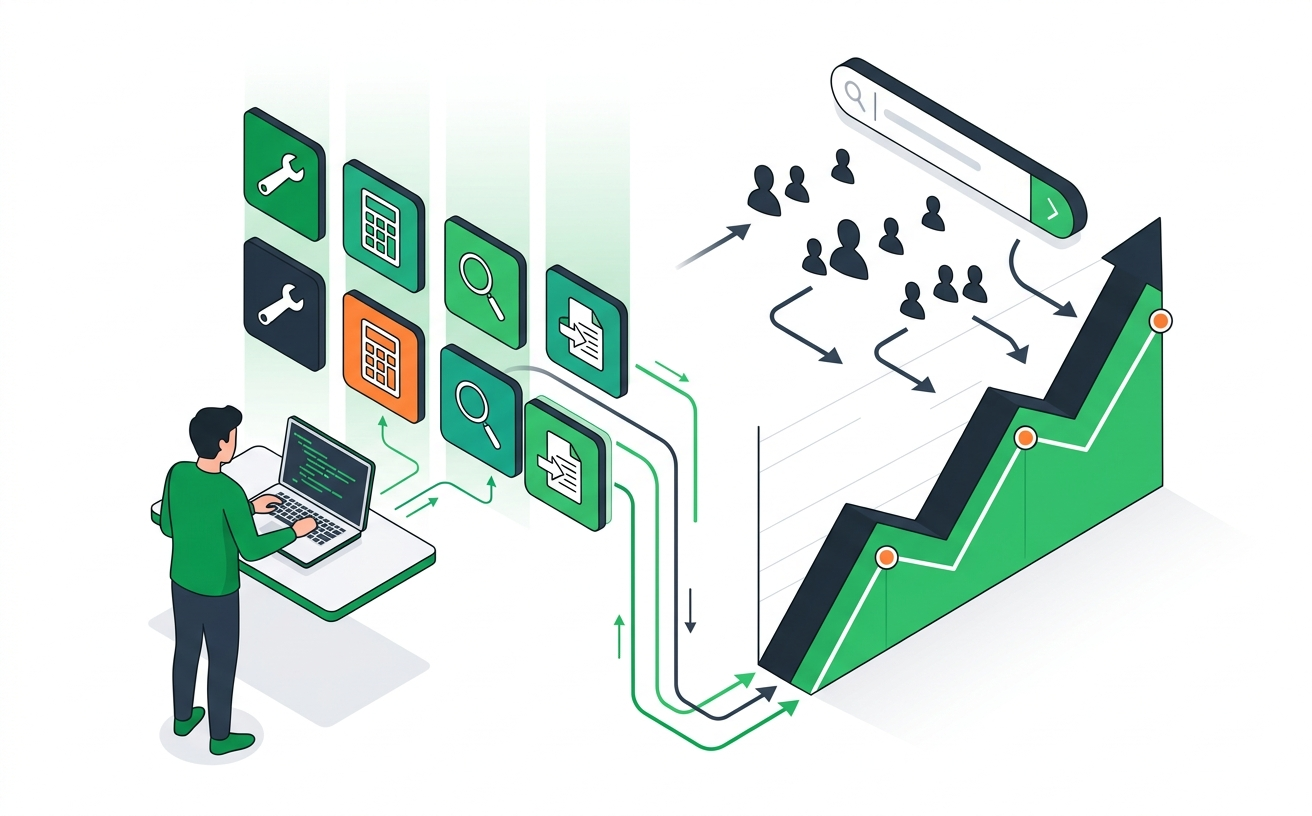
Most SaaS founders know they need marketing. The problem is they hate doing it. They are builders. They want to write code, not cold emails. Engineering as marketing solves this by turning the thing you already love doing — building — into your primary acquisition channel.
We studied how founders across StarterStory interviews used free tools, open-source projects, freemium products, and data-moat strategies to acquire customers without spending a dollar on advertising. The numbers are striking: one founder built 50 free tools and now pulls 50K clicks per month from Google alone.
This guide breaks down each flavor of engineering as marketing, with the exact playbooks founders are using right now. No theory. Real numbers, real tools, real results.
What Is Engineering as Marketing?
"I'm a builder. I'm not a marketer." — Bonu, SiteGPT ($13K MRR)
Engineering as marketing means building free tools, calculators, generators, or any useful utility that attracts your target audience and converts them into customers of your paid product. The term was coined by Gabriel Weinberg in his book "Traction," and the original case study was HubSpot's Website Grader, which scored over 4 million websites and became one of the most successful inbound marketing tools ever built.
The concept spans a wide spectrum. On one end, you have simple SEO-driven tools like calculators and converters. On the other, you have full open-source projects and data-moat platforms. The common thread: you build something useful, give it away for free, and let it pull your ideal customers toward your paid product.
The Six Flavors of Engineering as Marketing
- SEO keyword tools: Free tools targeting specific search queries (SiteGPT built 50 of these)
- Open-source projects: Give away the core product, monetize with hosting or premium features (Postiz, Cal.com)
- Freemium hooks: Free tiers that convert to paid (Canva, Notion, Loom)
- Data-moat tools: Aggregate valuable data that is hard to replicate (Uplead, BuiltWith)
- Content automation tools: Help users create content, generating organic amplification (Subscribr, CoSchedule)
- Viral shareable tools: Build something people share for organic amplification (HubSpot Website Grader)
The 2026 Advantage
What makes this strategy especially powerful right now is AI. Tools like Cursor and Claude Code have collapsed the time to build a free tool from days to minutes. Bonu from SiteGPT puts it directly: "If I want to create a new tool, it takes less than 5 minutes." That changes the math completely. When the cost of building a new tool approaches zero, the only question is whether you can find the right keyword to target.
Why this works for builders:
Engineering as marketing converts a founder's natural strength — building things — into their primary growth engine. Instead of forcing yourself to write blog posts, send cold emails, or run ads, you build small useful tools that attract your ideal customers through search. The marketing happens automatically once the tool ranks.
Marketing
The next teardown, without checking back
About one a week from the five companies I run with co-founders, AI agents, and zero hired employees — what I changed, and the part that broke.
One click to unsubscribe.
How Do SEO Keyword Tools Drive 50K Clicks/Month?
"This is the cheapest and low-effort way to drive traffic to your SaaS." — Bonu, SiteGPT ($13K MRR)
Bonu built SiteGPT to $13K MRR using a strategy most founders overlook entirely. He built approximately 50 free tools — things like PDF to markdown converters, chatbot name generators, and AI writing utilities. These tools now pull 50K clicks per month from Google. Ninety percent of his traffic comes from these free tools. He gets 300 leads per month. He spends zero on paid marketing.
Bonu's 7-Step Ahrefs Playbook
- Open Ahrefs Keywords Explorer. Leave the search field blank and click search. This surfaces all indexed keywords.
- Add an include keyword filter. Use terms relevant to your niche. Bonu uses combinations like "AI" plus "generator" or "AI" plus "tool."
- Set keyword difficulty filter under 10. This ensures you are targeting keywords that are realistic to rank for, even with a new domain.
- Set volume filter above 1,000 monthly searches. This filters out keywords that are too small to be worth building a tool for.
- List qualifying keywords in Notion. Track each keyword along with its volume and keyword difficulty score for easy comparison.
- Design CTAs connecting each free tool to your main product. Every tool needs a bridge to your paid offering. SiteGPT's free tools all funnel toward their AI chatbot product.
- Create a prioritization table. Score each keyword on four factors: high volume, low KD, easy to build, and relevant to your core product. Build the highest-scoring tools first.
The Funnel Numbers
Here is how Bonu's funnel breaks down. Fifty thousand clicks per month flow into his free tools. Of those visitors, roughly 300 convert to leads (a 0.6% lead rate). About 60 of those leads start a trial (20% trial rate). Approximately 20 convert to paying customers (33% trial-to-paid rate). At $100 average revenue per user and a $1,700 lifetime value, this is a machine that runs on search traffic alone.
The types of tools SiteGPT built:
PDF to markdown converter, chatbot name generator, AI writing assistants — all related to SiteGPT's core product (AI chatbots for websites). The key is relevance. Every free tool should attract someone who could plausibly become a paying customer.
Validation Before Building
Another founder — building an AI appointment setter — used the same Ahrefs approach and found the keyword "cold call automation" had high search volume but zero keyword difficulty. He validated the opportunity before writing a single line of code. This is the discipline: research first, build second.
Ahrefs itself practices what it preaches. The company maintains dozens of free tools including a word counter, backlink checker, and SERP checker. These tools drive millions of visits per month and serve as the top of funnel for their paid SEO platform. The strategy works at every scale.
Can Open Source Be a Marketing Strategy?
Neo grew Postiz to 32K GitHub stars and $17K/month by making his social media scheduling tool open source.
Neo built Postiz, an open-source social media scheduling tool. The project grew to 32K GitHub stars and generates $17K per month. His path to this was deliberate: he worked at a co-working space where he met people building open-source notification infrastructure. He joined that company and helped grow it from zero to 32K stars. Then he applied the exact same playbook to his own product.
Why Open Source Works as a Marketing Channel
- User-generated content: People write blog posts, reviews, and tutorials about your product without being asked. Each piece of content is a free backlink and a free endorsement.
- Directory listings: Open-source directories have high domain authority. Getting listed on these directories provides valuable backlinks that boost your SEO across the board.
- Developer advocacy: Contributors become product advocates. They have skin in the game — they have invested time in your project and naturally promote it to their networks.
- Free QA through bug reports: The community finds and reports bugs that your team would have missed. This improves product quality at no cost.
- Blue ocean positioning: Being open-source instantly differentiates you in crowded markets. When every competitor is closed-source, going open is a strategic wedge.
When Open Source Makes Sense
Open-source marketing works best for developer tools, infrastructure products, and productivity tools where the target audience is technical. It is less effective for consumer apps or products with proprietary algorithms that constitute the core value.
Other successful open-source marketing examples:
Cal.com (open-source scheduling), Supabase (open-source Firebase alternative), and Tally (open-source forms) all used this playbook. They give away the core product, build community-driven distribution, and monetize through hosted versions, premium features, or enterprise plans.
The compounding effect is what makes this strategy powerful. Once a project hits critical mass on GitHub, it generates its own momentum. New contributors join, new content gets created, and new users discover the project through organic channels — all without any marketing spend from the founding team.
How Do Freemium Hooks Convert Free Users to Paid?
"The free version IS the marketing." — Pattern observed across multiple StarterStory founders
There is an important distinction between free tools and free tiers. Free tools are standalone utilities separate from your product — SiteGPT's PDF converter exists independently. Free tiers are part of your product itself — a limited version that users can upgrade from. Both work as acquisition channels, but the mechanics are different.
Free Versions as the Primary Acquisition Channel
Multiple StarterStory founders mentioned "free version" as their primary acquisition method. Max, who runs 28 apps generating $10K per month combined, offers free versions of every app as his user acquisition strategy. The free version gives users enough value to be useful on its own, then the paid version solves a bigger or recurring problem.
SiteGPT's free tools follow a different pattern. The PDF to markdown converter and the chatbot name generator are not the product itself — they are entry points. Someone searching for "PDF to markdown" has no idea SiteGPT exists. They find the free tool, use it, and then see the CTA for SiteGPT's actual product. This is lead generation through utility.
Where to Draw the Line Between Free and Paid
The principle is straightforward: free should solve a complete problem, and paid should solve a bigger or recurring problem. If your free version feels broken or intentionally crippled, users leave frustrated. If your free version is too generous, nobody upgrades.
Conversion benchmarks from established companies:
Canva's free tier converts approximately 4% of users to paid plans. Notion's free tier is remarkably generous — they deliberately over-deliver on free to maximize adoption and word-of-mouth. Loom switched from paid-only to offering a free tier and grew 10x. These are not small numbers. At 4% conversion, you need 25 free users to generate one paying customer.
For bootstrap founders, the freemium model works best when your marginal cost per free user is near zero. If each free user costs you meaningful server resources, the math gets difficult. But for most SaaS products, serving a limited free tier costs almost nothing while providing a constant stream of qualified leads.
What Are Data-Moat Tools and Why Do They Win?
"There was a need in the market for customers that wanted a simple version of a tool that was already on the market." — Will, Uplead ($30M in sales)
Will built Uplead to $30M in total sales. He also built Signature Lead to over $1M. His model is built on a concept called the data moat: aggregate valuable data that is hard to replicate, and the data itself becomes your competitive advantage.
The opportunity Will identified was that existing tools in his market were too expensive or too complicated. Enterprise solutions existed, but small teams could not afford them or did not need all the features. He built simpler, cheaper alternatives that provided the same core data. The switching costs are high because the data is what users pay for, and rebuilding that dataset from scratch is prohibitively expensive.
Will's Framework for Finding Data-Moat Opportunities
Will's approach starts with your own skills. His advice: "Whether it's cold email, cold calling, SEO — figure out what you're good at and find a tool that needs it." The insight is that data-moat tools work best when you have domain expertise in the data you are aggregating. You know what matters, what is missing from existing tools, and how to structure the data for maximum value.
Why Data Moats Have Higher LTV
Data-moat tools command higher lifetime value than other types of engineering-as-marketing products because switching costs are built into the model. Users integrate your data into their workflows. They build processes around your dataset. Moving to a competitor means re-training teams, re-building integrations, and accepting a period where the data is less accurate or less complete.
Notable data-moat companies:
BuiltWith (technology profiling for any website), SimilarWeb (traffic data and competitive analysis), and Clearbit (company data enrichment) all follow this model. They aggregate data that would be expensive and time-consuming to replicate, then sell access to it. The data compounds in value over time as it becomes more comprehensive and historically deep.
For bootstrap founders considering this approach, start with a narrow data niche you understand deeply. You do not need to compete with Crunchbase on day one. Find a specific dataset that a specific audience needs and that nobody else is aggregating well. The moat builds over time as your dataset grows.
How Do Content Automation Tools Create Growth Loops?
"You need to build a pipe or workflow that makes you able to ship content that's going to fuel everything you do." — Tibo ($100K MRR across 4 SaaS apps)
Subscribr built tools that help YouTube creators write better scripts and grew to $30K per month. Tibo built four SaaS apps to $100K MRR total, with his content engine central to growth across all of them. The pattern they share: build tools that help users create content, and the users naturally talk about your tool, creating organic amplification.
Tibo's Content Distribution Framework
Tibo started with social media — specifically Twitter — as his distribution channel. He built his initial audience there, then layered SEO and affiliate partnerships on top for an additional $20K+ in monthly growth. His framework treats content as infrastructure, not a one-off activity. The "pipe" he describes is a repeatable system where content creation feeds product awareness, which feeds more content, which feeds more awareness.
The Self-Reinforcing Loop
Content automation tools have a unique advantage: the output IS the marketing. When someone uses Subscribr to write a YouTube script, the resulting video is implicitly an advertisement for Subscribr. When someone uses CoSchedule's Headline Analyzer to improve their blog title, they are more likely to mention the tool in their content or share it with other writers. The product creates its own distribution.
CoSchedule's Headline Analyzer is a textbook example. The tool has been used millions of times and drives massive awareness for their scheduling product. HubSpot's Blog Ideas Generator follows the same logic — give creators a useful tool, and they become ambassadors for your brand without any formal referral program.
The content tool formula:
Build a free tool that helps users create content. Users create content mentioning or implicitly endorsing your tool. That content reaches new potential users. Those users discover your tool, use it, and create more content. The loop compounds. Unlike SEO tools that rely on search traffic, content tools generate their own distribution through the content they help produce.
For founders considering this approach, identify the content format your target audience creates (blog posts, videos, social media posts, newsletters) and build a tool that makes one specific step of that process faster or better. The more visible your tool is in the final output, the stronger the loop.
What Are the Economics of Free Tool Marketing?
SiteGPT's 50 free tools cost nearly $0/month to maintain. The ROI compared to paid acquisition is not even close.
The cost structure of engineering as marketing is what makes it so powerful for bootstrap founders. Once built, free tools have near-zero marginal cost. SiteGPT runs approximately 50 tools that collectively cost almost nothing per month to serve. Compare that to paid advertising, where every click costs money, every day.
Time Investment: Before AI vs. Now
The initial time investment has collapsed. Before AI coding tools, building a free tool might take a developer two to five days of focused work. With tools like Cursor and Claude Code, Bonu says it takes less than 5 minutes per tool. Even accounting for polish, deployment, and testing, you are looking at hours instead of days. That changes the portfolio math dramatically.
The Portfolio Approach
SiteGPT built 50 tools. Max runs 28 apps. The strategy is deliberate: more tools equals more surface area equals more traffic. Each individual tool might only drive 500 to 2,000 visits per month. But at scale, the numbers add up fast.
Running the Numbers
Here is the math using SiteGPT's actual numbers as a baseline. If each tool averages 1,000 visits per month and you have 50 tools, that is 50,000 monthly visits. At a 0.6% lead rate, you get 300 leads. At a 10% trial rate, that is 30 trials. At a 30% conversion rate, you add 9 new customers per month. At $100 average revenue per user, that is $900 in new MRR every month — from a channel that costs nothing to maintain.
Comparison to paid acquisition:
To generate $900 in new MRR through paid advertising, you would typically spend $4,500 to $9,000 per month at standard SaaS customer acquisition costs. And the moment you stop paying, the traffic stops. Free tools keep compounding. SEO tools build backlinks over time, which strengthens their rankings, which drives more traffic — a virtuous cycle that paid ads can never replicate.
When It Compounds vs. When It Plateaus
SEO-driven free tools compound as they age. Older pages accumulate backlinks, build domain authority, and often rank higher over time. However, individual tools will plateau at their keyword's search volume ceiling. If a keyword gets 2,000 searches per month, your tool will cap somewhere around that level regardless of how well-optimized it is.
This is why the portfolio approach matters. No single tool will make your business. But 30 to 50 tools, each driving a steady stream of relevant traffic, creates a marketing engine that outperforms most paid acquisition channels on a per-dollar basis. Engineering as marketing is the most capital-efficient acquisition channel available to technical founders.
Frequently Asked Questions
How do you build free tools for marketing your SaaS?
Bonu from SiteGPT uses a 7-step Ahrefs workflow: open Keywords Explorer with a blank search, add include keyword filters for your niche, filter for keyword difficulty under 10 and volume above 1,000, list keywords in Notion, design CTAs connecting each tool to your paid product, then prioritize by volume, difficulty, build effort, and relevance. He built 50 tools this way and gets 50K clicks per month from Google.
What is engineering as marketing with examples?
Engineering as marketing means building free tools that attract your target audience and convert them to paid customers. The six main types are: SEO keyword tools (SiteGPT built 50 free tools for 50K monthly clicks), open source (Postiz grew to 32K GitHub stars and $17K/month), freemium hooks (Canva converts roughly 4% of free users to paid), data-moat tools (Uplead reached $30M in sales), content automation (Subscribr earns $30K/month), and viral shareable tools (HubSpot's Website Grader scored 4M+ websites).
How many free tools should you build for SEO?
SiteGPT built approximately 50, but start with 3 to 4. Focus on keywords with low difficulty (under 10) and high relevance to your core product. Each tool should have a clear CTA connecting it to your paid offering. Once your first tools rank and you validate the approach, scale to 10 to 50 tools based on what works. The portfolio approach compounds: more tools means more surface area for organic search traffic.
Does engineering as marketing work for non-technical founders?
Yes. AI coding tools have changed the equation. Bonu from SiteGPT says it takes "less than 5 minutes to create a new tool" using AI assistance. The keyword research and strategy work is more important than the coding. Non-technical founders can use tools like Cursor and Claude Code to handle implementation while focusing on finding the right keywords and designing the conversion funnel.
How long until free tools drive significant traffic?
SEO typically takes 2 to 6 months to show results. Three to four well-targeted tools built around low keyword difficulty and high volume searches should drive measurable traffic within 90 days. The compounding effect accelerates over time as tools build backlinks and domain authority. Plan for a 3-month minimum investment before expecting meaningful lead flow.