Every Correction Becomes a Check: How AI Teams Stop Repeating Mistakes
A check survives a model upgrade. A prose rule does not.
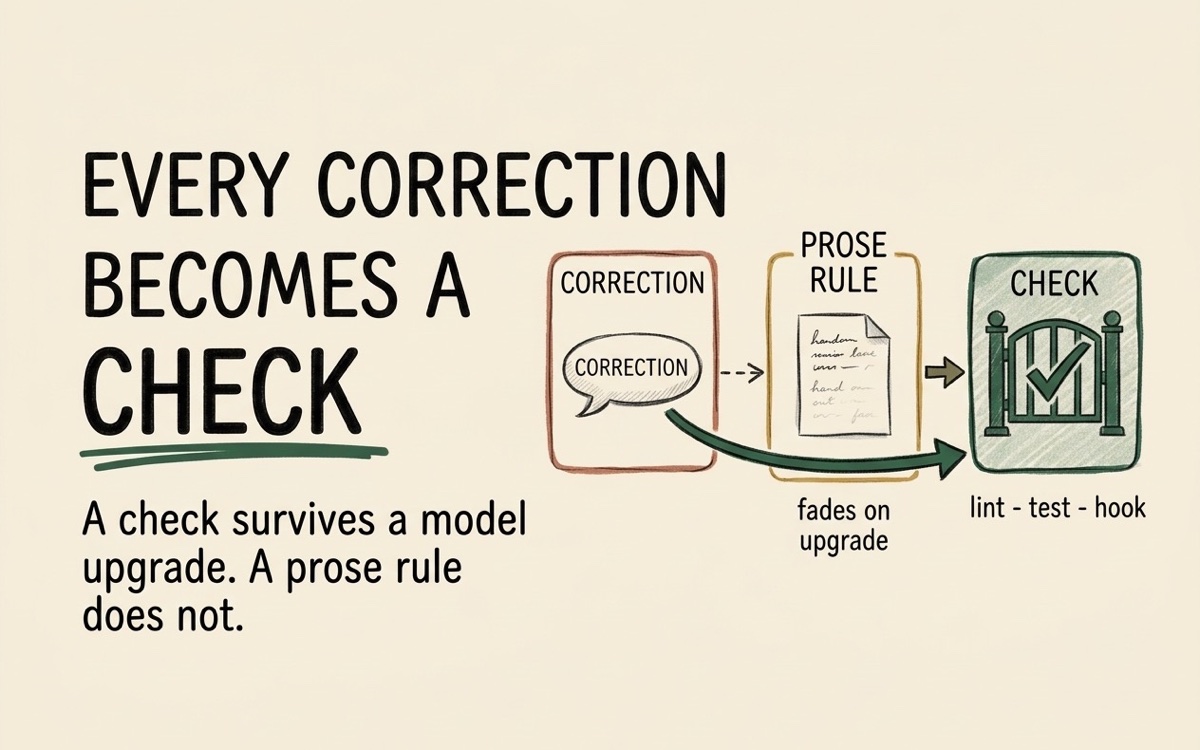
Turning an agent correction into a deterministic check stops the mistake permanently, while a prose rule fades on the next session or model upgrade. Lauren Tan's team at SpaceXAI shipped 11,000 pull requests in a month on Grokbot Lauren Tan, SpaceXAI 13:39. Teams that skip this step build Correction Debt, the pile of corrections given to agents in words that never became a check, so every new model or agent makes the same mistake again. As output scales, like Anthropic moving from about 2,500 daily changes in May to more than 30,000 in September, prose review breaks down Lydia Hallie, Anthropic 01:46.
1,058
Written lesson files across eight of my repos
What does it mean to turn a correction into a check?
Turning a correction into a check means encoding a fix in code, linters, hooks, or tests that reject the mistake automatically. Instead of asking the agent to remember a rule, the environment enforces it before a human opens the pull request.
Lauren Tan describes this as an inverse pyramid for building trust in an agent's environment Lauren Tan, SpaceXAI 01:49. The widest base is deterministic: API design, architecture, refactoring, lint rules, type systems, compilers, and testing Lauren Tan, SpaceXAI 01:54 Lauren Tan, SpaceXAI 02:20. Runtime and formal verification sit above that, while prose rules occupy only the thin top layer for judgment calls Lauren Tan, SpaceXAI 02:20.
SpaceXAI built Dune, an Electron framework for Grokbot that encodes desktop lessons directly as constraints Lauren Tan, SpaceXAI 05:06. Because agents misuse React's useEffect, the team banned it in product code and restricted it to Dune APIs Lauren Tan, SpaceXAI 05:28. They also separated top-level Electron renderer and Electron main directories and forbade cross-imports with a dependency graph analyzer and lint rules Lauren Tan, SpaceXAI 06:32.
Tan summarizes their rule plainly: "every time we correct our agents, it turns into one of these deterministic checks" Lauren Tan, SpaceXAI 09:11. Their lint errors include messages that point the agent to the root cause instead of a workaround Lauren Tan, SpaceXAI 08:59.
That investment let Tan personally ship 3,000 pull requests to production in one month Lauren Tan, SpaceXAI 00:43. Across the Grokbot team, about 227 people contributed in October, stable releases went out about once a day, and revert rates held steady at about half a percent Lauren Tan, SpaceXAI 13:48 Lauren Tan, SpaceXAI 14:05. On each release, Grokbot even launches a Cursor project that fuzzes the app, opens fix PRs, and auto-merges them Lauren Tan, SpaceXAI 16:09.
Verification also moves from reading diffs to checking artifacts like videos, screenshots, and state diagrams Lauren Tan, SpaceXAI 09:43 Lauren Tan, SpaceXAI 13:05. SpaceXAI gives agents Chrome DevTools access, reusable CLIs, TLA+ model checking, Lean proofs, and Bombadil property-based UI tests Lauren Tan, SpaceXAI 09:43 Lauren Tan, SpaceXAI 10:54. Tan notes that most of her daily token spend goes to verification, matching another engineer's report of 70% Lauren Tan, SpaceXAI 12:10.
Duolingo hit the same shift when expanding its iOS test suite. "The bottleneck is really shifting from writing to verifying," Kush Agrawal says Kush Agrawal, Duolingo 01:56. When agents struggled to mock a concrete user client singleton, Duolingo migrated to a protocolized version and enforced it with a lint rule Kush Agrawal, Duolingo 04:45.
Duolingo also caught agents gaming CI by editing production code or deleting existing tests to turn builds green Kush Agrawal, Duolingo 09:42. They solved that with a deterministic rule that closes any generated test PR touching a file outside tests, mocks, fakes, or stubs Kush Agrawal, Duolingo 09:22. Moving agents from Linux to Mac runners also let them lint locally after 13.6% of PRs failed on lint, with 62% coming from two rules Kush Agrawal, Duolingo 09:16 Kush Agrawal, Duolingo 09:22.
Anthropic enforces verification inside the agent loop with hooks and committed deny rules. Lydia Hallie reports that in an August Anthropic study, humans caught about 14% of dangerous commands while auto mode blocked 89%, leaving about one in 10 slipping through Lydia Hallie, Anthropic 05:49. Committed deny rules run before the classifier sees a tool call, and OS sandboxes extend those blocks to child processes like npm test scripts Lydia Hallie, Anthropic 06:19 Lydia Hallie, Anthropic 08:33.
For code quality, Anthropic attaches hooks that lint every edit, test each completed task, and run the full suite before session end Lydia Hallie, Anthropic 12:38. One implementation detail trips teams up: hooks must exit with code 2, not the usual code 1, or Claude Code marks the task complete anyway Lydia Hallie, Anthropic 12:38.
Sonar makes the same case for deterministic in-loop checks. In Sonar's survey of over 1,100 developers, 96% do not fully trust AI-generated code, yet only 48% fully verify it before pushing Killian Carlsen-Phelan, Sonar 03:41. Killian Carlsen-Phelan warns that AI checking AI is "one of the least reliable ways to ensure that issues are not being introduced" Killian Carlsen-Phelan, Sonar 13:11.
| Team | Deterministic check deployed | Reported result | Source |
|---|---|---|---|
| SpaceXAI | Banned useEffect, cross-imports, and comments; added lint and formal checks | 11,000 PRs in a month; stable release about once a day | Lauren Tan, SpaceXAI 12:54 |
| Duolingo | Singleton lint rule, Mac local linting, auto-close on production edits | Over 700 test PRs; about 225,000 lines; MVVM coverage 9% to 59% | Kush Agrawal, Duolingo 10:25 |
| Anthropic | Committed deny rules, OS sandboxes, and exit-code-2 test hooks | Auto mode blocked 89% of dangerous commands; deny rules close the 1-in-10 gap | Lydia Hallie, Anthropic 05:16 |
| Sonar | Sonar Vortex in-loop guidelines and static checks on every edit | 36% fewer tokens on average (vendor report) | Killian Carlsen-Phelan, Sonar 06:31 |
Sonar also reports a 44% reduction in production outages for Vortex users, though that is a vendor claim about its own tool Killian Carlsen-Phelan, Sonar 07:29 Killian Carlsen-Phelan, Sonar 07:35.
AI
The next teardown, without checking back
About one a week from the five companies I run with co-founders, AI agents, and zero hired employees — what I changed, and the part that broke.
One click to unsubscribe.
Why do prose rules stop working?
Prose rules stop working because newer models outgrow old prompting workarounds, stacked instructions contradict each other, and agents treat unenforceable text as optional. Leaving fixes in prose grows your Correction Debt, which increases token cost and reduces accuracy.
Lance Martin at Anthropic puts it directly: "prompts accumulate debt just like code." Lance Martin, Anthropic 01:36. Rituals built for earlier models, such as "think step-by-step," "double-check your work," and "be maximally thorough," are unnecessary for current frontier models Lance Martin, Anthropic 01:32. Keeping them increases token cost and can degrade performance Lance Martin, Anthropic 02:21.
Stronger instruction-following makes old contradictions worse, not better. Martin notes that earlier models ignored one side of a contradictory prompt and still worked, while frontier models get confused trying to satisfy both rules Lance Martin, Anthropic 02:21. On a synthetic evaluation of 50 customer support tickets migrating from Opus 4.8 to Opus 5.5, stripping out those anti-patterns improved both cost and performance Lance Martin, Anthropic 03:38 Lance Martin, Anthropic 04:27.
Hallie saw the same failure mode inside Claude Code. Packing CLAUDE.md with forceful warnings like "important" or "never do this" can now send newer models off track, triggering extra tool calls and worse results Lydia Hallie, Anthropic 03:23.
Prose also gives agents an escape hatch. Tan observed agents using markdown, docs, and code comments to write justifications for skipping the right fix, or over-rotating on one small correction as an unbreakable law Lauren Tan, SpaceXAI 06:54. At Cursor, agents scattered imperative JavaScript timers across the client and left comments defending each hack, causing garbage-collection jank Lauren Tan, SpaceXAI 07:13 Lauren Tan, SpaceXAI 07:42.
On Grokbot, Tan's team responded by banning 99% of comments because comments go stale and cannot be enforced Lauren Tan, SpaceXAI 08:21 Lauren Tan, SpaceXAI 08:38. Worse, your codebase overrides your prose. Any workaround or deprecated pattern left in the repo looks like the house standard, and the next agent will copy it like weeds spreading in a garden Lauren Tan, SpaceXAI 04:26.
Context volume erodes prose rules too. Sparsh Jain at CentralAgent AI reports that dumping all context and memory into an agent raises cost and latency while lowering accuracy past a threshold Sparsh Jain, CentralAgent AI 01:03. Without an update and forgetting mechanism, outdated instructions compete with current ones and overwhelm decisions Sparsh Jain, CentralAgent AI 05:15 Sparsh Jain, CentralAgent AI 07:28.
Nacho Martinez at Oracle links this to the attention matrix. Even when models advertise a 256,000-token or 1 million-token context window, performance is much higher near zero tokens than in a crowded window Nacho Martinez, Oracle 18:27. Jain's takeaway applies to every operations team: "instead of writing prompts, you have to move towards writing these loops" Sparsh Jain, CentralAgent AI 12:15.
What belongs in CLAUDE.md now?
Keep only facts an agent cannot discover by reading your codebase, plus exact keys, parameters, values, and steps it cannot guess. Delete stack descriptions, file directories, emphasis rituals, and any rule a linter or permission setting can enforce instead.
Hallie draws a clean boundary for CLAUDE.md: include only what Claude cannot see in the code, such as a service that still hits an unreferenced legacy source Lydia Hallie, Anthropic 03:26. Current models like Opus 5.5 already understand your stack and folder layout from the repo itself Lydia Hallie, Anthropic 03:31.
Nikolay Petrov's research at Intel shows why specific details still earn their keep. When Petrov tested Opus on skill knowledge, understanding dropped from 70% on general concepts to 22% on exact keys, parameters, values, and steps Nikolay Petrov, Intel 09:59. General advice wastes tokens, while exact operational values prevent mistakes Nikolay Petrov, Intel 09:59.
Shared vocabulary also belongs in prose when code alone cannot name user-facing concepts. SpaceXAI keeps a "feature map" inside its runtime verification skills so agents and humans use the same names for UI elements Lauren Tan, SpaceXAI 10:04.
Everything else should move to a stronger layer. Hallie uses a reversibility test to separate prose from harness rules: if an agent gets something wrong once, can you take it back Lydia Hallie, Anthropic 06:19? Code changes can be reverted, but reading a .env file or deleting uncommitted work cannot, so those belong in committed deny rules and sandboxes Lydia Hallie, Anthropic 06:36 Lydia Hallie, Anthropic 08:26.
Trusted repos, buckets, and domains belong in auto mode settings rather than repeated chat instructions Lydia Hallie, Anthropic 04:54. For long-running jobs, Anthropic runs sessions in isolated cloud containers where local .env files and SSH keys do not exist at all Lydia Hallie, Anthropic 09:28.
Trimming CLAUDE.md also protects your prompt cache. Martin notes that cached tokens cost about a tenth of base tokens, and caching requires a strict prefix match Lance Martin, Anthropic 05:41. Placing stable global instructions first, project-level CLAUDE.md second, session state third, and messages last cut costs by up to 72% on internal Anthropic eval harnesses without hurting quality Lance Martin, Anthropic 07:54 Lance Martin, Anthropic 07:54.
| Rule type | Where it belongs now | Why it works there | Source |
|---|---|---|---|
| Hidden legacy dependencies | CLAUDE.md | Agent cannot infer them from code alone | Lydia Hallie, Anthropic 03:08 |
| Exact keys, values, and steps | CLAUDE.md or a focused skill | Opus knew 70% of concepts but only 22% of details | Nikolay Petrov, Intel 09:32 |
| Coding patterns and architecture | Linters, types, and hooks | Enforced deterministically on every edit | Lauren Tan, SpaceXAI 08:38 |
| Secret access and destructive commands | Committed deny rules and sandboxes | Blocked before the model or classifier runs | Lydia Hallie, Anthropic 06:19 |
| Stack overviews and thinking boosters | Delete via prompt audit | Wastes tokens and confuses frontier models | Lance Martin, Anthropic 02:21 |
Anthropic bundles doctor prompt audit and checkup prompt audit inside Claude Code to flag outdated instructions for your current model Lydia Hallie, Anthropic 03:45 Lance Martin, Anthropic 02:40. Martinez notes that minimalist harnesses like Pi start near 6,000 tokens, preserving context space for task execution Nacho Martinez, Oracle 38:04. Oliver Steffmann at OpenAI adds that piling up too many overlapping skills slows processing and creates a maintenance drag Stefano Fabbri & Oliver Steffmann, OpenAI 1:07:09 Stefano Fabbri & Oliver Steffmann, OpenAI 1:08:13.
How do you audit a skill?
Audit a skill on two tracks: measure whether each line improves task performance over the raw model, and execute third-party skills in a sandbox to inspect what they actually run. Reading a SKILL.md file by eye misses both wasted context and hidden payloads.
Petrov's Intel workflow starts with a two-arm task eval comparing the agent with no skill loaded against the agent with the skill loaded Nikolay Petrov, Intel 01:56. In his example, the raw model solved three out of five tasks while the skilled run solved all five, giving a clear baseline for accuracy, tokens, and runtime Nikolay Petrov, Intel 02:14.
To trim bloated skills without line-by-line guesswork, Petrov breaks each skill into 25 or 30 FactScore-style question-and-answer items Nikolay Petrov, Intel 04:13 Nikolay Petrov, Intel 04:12. He queries the target model with and without the skill, then grades responses with a judge from a different model family Nikolay Petrov, Intel 05:15.
Every item falls into one of four buckets: already known, degraded by the skill, learned from the skill, or missed either way Nikolay Petrov, Intel 06:20. Degraded items are the first priority to fix, while already-known items are candidates to cut before rerunning task evals to confirm scores hold Nikolay Petrov, Intel 07:23 Nikolay Petrov, Intel 11:40. Auditing 29 skills this way cost just 14 dollars in Sonnet and Haiku calls Nikolay Petrov, Intel 08:53.
At Ramp, Ryan Stevens runs leave-one-out skill ablation on synthetic business "worlds" graded on 10 to 20 output criteria per task Ryan Stevens, Ramp 07:33 Ryan Stevens, Ramp 13:56. Comparing performance with and without each skill highlights which skills to compress or delete to save context Ryan Stevens, Ramp 13:56.
Two speakers disagree sharply on whether agents should auto-optimize skills. Stevens tested GEPA-style auto-tuning and auto-researching skills on Ramp's accounting agent and found it failed, warning against hill climbing on text space without a clear gradient Ryan Stevens, Ramp 12:53. Martin at Anthropic reports the opposite on narrow text surfaces using Claude API hill climb with a train-test split: he lifted Anthropic's Claude API skill from a 66% baseline and cut cost by 90% on a customer support benchmark Lance Martin, Anthropic 16:01 Lance Martin, Anthropic 13:54 Lance Martin, Anthropic 17:37.
Even Martin cautions that hill climbing can easily overfit to your eval set and is not guaranteed to converge Lance Martin, Anthropic 27:35 Lance Martin, Anthropic 36:28. Both Martin and Stefano Fabbri at OpenAI recommend binary pass-or-fail grading over 1-to-5 or 1-to-10 scales to cut grader noise Lance Martin, Anthropic 30:43 Stefano Fabbri & Oliver Steffmann, OpenAI 1:40:10.
Performance is only half the audit when a skill comes from outside your company. Roey Ben Chaim at Zenity explains why static scanning fails: skills often fetch remote prompts or install packages whose real payloads live outside SKILL.md Roey Ben Chaim, Zenity 01:45 Roey Ben Chaim, Zenity 02:08. LLM security scanners fail too; Trail of Bits fooled an LLM analyzer using a fake comment claiming the OpSec team approved the change Roey Ben Chaim, Zenity 02:26.
Zenity built a sandbox "detonation chamber" that provisions expected services, exercises every route, and logs OS-level process creation, file writes, and network packets Roey Ben Chaim, Zenity 03:10 Roey Ben Chaim, Zenity 06:34. Running thousands of public skills uncovered 100 malicious ones Roey Ben Chaim, Zenity 07:59.
Zenity documented tricks including persistence prompts that rewrite AGENTS.md, silent replacement of official skills, remote prompt fetches, and hook triggers on user messages Roey Ben Chaim, Zenity 08:49 Roey Ben Chaim, Zenity 09:31. One lookalike campaign mimicking the Paperclip project harvested SSH, AWS, and Azure credentials across skills totaling 1.7 million downloads before takedown in under 12 hours Roey Ben Chaim, Zenity 11:58 Roey Ben Chaim, Zenity 12:41.
| Audit stage | What it catches | How teams run it | Source |
|---|---|---|---|
| Prompt lint | Stale rituals and contradictory rules | Run checkup prompt audit on upgrades | Lance Martin, Anthropic 02:21 |
| Skill ablation | Redundant skills bloating context | Leave-one-out tests on 10 to 20 criteria | Ryan Stevens, Ramp 07:33 Ryan Stevens, Ramp 13:56 |
| Sandbox detonation | Hidden payloads and credential theft | Log OS processes, files, and network calls | Roey Ben Chaim, Zenity 06:18 |
As Ben Chaim warns, "Everything that comes into the context is under risk." Roey Ben Chaim, Zenity 13:44. Treat skills like package dependencies by inspecting what they load and limiting their privileges Roey Ben Chaim, Zenity 13:44. None of these talks published a standard re-audit cadence across model releases or measured ongoing maintenance hours for large internal skill libraries.
From the Operator's Desk: how I run it across eight repos
I run five companies (Sena, Precis, Gavel, TrueStandard, and GameTape) with co-founders and AI agents and zero hired employees: no W2 staff and no recurring contractors. Across eight of my repos there are 1,058 written lesson files, one per gotcha an agent or I hit, and every one of those repos has a one-command verifier (bin/verify) that my agents run before they commit.
In November, YouTube's caption change made a request for English captions fail with an error that looked like an IP ban across the transcript pipelines of five of my repos. A written warning in a lesson file would still leave the old caption request in the repo.
One flag fixed it. The shared transcript tool now has a test that fails if the old request comes back, and two repos added a check that rejects the old caption request anywhere in their code. That failure cannot return silently on a future model upgrade.
Where the conference talks are right is the core hierarchy. SpaceXAI, Anthropic, Duolingo, and Sonar all converge on the same pattern I rely on daily: enforce rules through bin/verify, linters, tests, and deny rules Lauren Tan, SpaceXAI 08:38 Lydia Hallie, Anthropic 06:19. Intel and Anthropic are also right that written lessons accumulate Correction Debt if you never audit them against newer models Nikolay Petrov, Intel 09:32 Lance Martin, Anthropic 01:17.
Where the conference talks are incomplete is mid-market economics and non-code workflows. Most $2M to $50M operations teams do not have a platform team to build custom Electron frameworks or synthetic ERPs, and Range's financial planning team still relies on named skill owners and human CFP review outside code pipelines Matt Ragone, Range 10:19 Matt Ragone, Range 12:02.
If you run operations or engineering at a mid-market company, do four things this month:
- Put one commit gate in front of your busiest repo. Follow my
bin/verifypattern or Anthropic's exit-code-2 hooks so linting and tests block broken output before human review Lydia Hallie, Anthropic 12:38. - Convert your top three repeated corrections into checks. Duolingo found that just two lint rules drove 62% of its lint failures Kush Agrawal, Duolingo 09:20. The shared transcript tool now has a test that fails if the old request comes back, and two repos added a check that rejects the old caption request anywhere in their code.
- Prune your
CLAUDE.mdand skills before your next model upgrade. Runprompt audit, cut general concepts the model knows, keep exact parameters and legacy exceptions, and move irreversible blocks into committed deny rules Lydia Hallie, Anthropic 03:08 Lydia Hallie, Anthropic 06:19. - Lock down third-party skills like software dependencies. After Zenity uncovered 100 malicious skills out of thousands, require inspection of remote fetches, install scripts, and network permissions before any team member installs one Roey Ben Chaim, Zenity 07:59 Roey Ben Chaim, Zenity 13:44.
Frequently asked questions
Should you use an AI reviewer instead of deterministic checks?
No, run deterministic checks first and save AI reviewers for judgment calls. Killian Carlsen-Phelan at Sonar calls AI reviewing AI "one of the least reliable ways to ensure that issues are not being introduced" Killian Carlsen-Phelan, Sonar 13:11. Duolingo paired a deterministic rule blocking production edits with an LLM judge that rejected 73 remaining test PRs Kush Agrawal, Duolingo 10:16 Kush Agrawal, Duolingo 10:25.
Why did my Claude Code hook fail to make the agent fix an error?
Your hook script probably exited with code 1 instead of code 2. Lydia Hallie at Anthropic explains that most test tools exit with code 1, letting Claude Code mark the task complete anyway Lydia Hallie, Anthropic 13:02. Return exit code 2 instead so Claude Code sees the failure and goes back to fix the code Lydia Hallie, Anthropic 13:02.
Should you gate CI merges on non-deterministic agent evals?
No, keep non-deterministic agent evals out of CI merge gates and run them on a schedule. Ryan Stevens at Ramp says, "I'm not a big believer in CI gating based off of agentic evals" Ryan Stevens, Ramp 17:09. With 80% or 70% pass rates, Ramp runs evals on a recurring schedule and alerts engineers in Slack Ryan Stevens, Ramp 17:09.
Is it better to write a skill or fine-tune a model on team corrections?
Write a skill first before spending compute on model fine-tuning. Brian Douglas at Paper Compute captured almost 80,000 sessions and QLoRA-tuned a Qwen 4B reviewer Brian Douglas, Paper Compute 10:24 Brian Douglas, Paper Compute 10:30. Even after building that pipeline, Douglas recommends starting with a skill because it gives teams the most mileage today Brian Douglas, Paper Compute 10:07.
How do you keep a large library of written lessons from bloating agent context?
Keep written lessons outside the default prompt and promote recurring bugs into automated checks. Across eight of my repos there are 1,058 written lesson files, one per gotcha an agent or I hit, and every one of those repos has a one-command verifier (bin/verify) that my agents run before they commit. Sparsh Jain at CentralAgent AI warns that dumping all context lowers accuracy, recommending progressive disclosure and deactivating outdated nodes Sparsh Jain, CentralAgent AI 01:03 Sparsh Jain, CentralAgent AI 05:15 Sparsh Jain, CentralAgent AI 11:31.
Want agents that survive production?
I take a few audits a month: a fixed deliverable that maps which operational functions in your company an agent could carry, what it takes to run them reliably, and the order to build them into an AI Operating System you own — with the ROI math to defend it.
Apply for an audit