How Many Times Do Solo Founders Fail Before $10K/Month?
We tracked failure counts from 208 founder interviews across 4 YouTube channels. The median is 4-5 failed projects. Here is what the data shows.
Jump to a section:
Everyone knows the "90% of startups fail" statistic. It gets cited in pitch decks, Twitter threads, and blog posts constantly. But that number comes from Startup Genome — and it only covers VC-backed companies. Failory's data skews the same way. Nobody has ever compiled failure data specifically for bootstrap founders, indie hackers, and solopreneurs.
I went through 208 founder interviews across four YouTube channels — StarterStory, The Brett Way, Superwall, and Steven Cravotta — and tracked every mention of prior failures, failed projects, and pivots. The result is the first dataset I am aware of that measures how many times solo founders fail before reaching $10K per month.
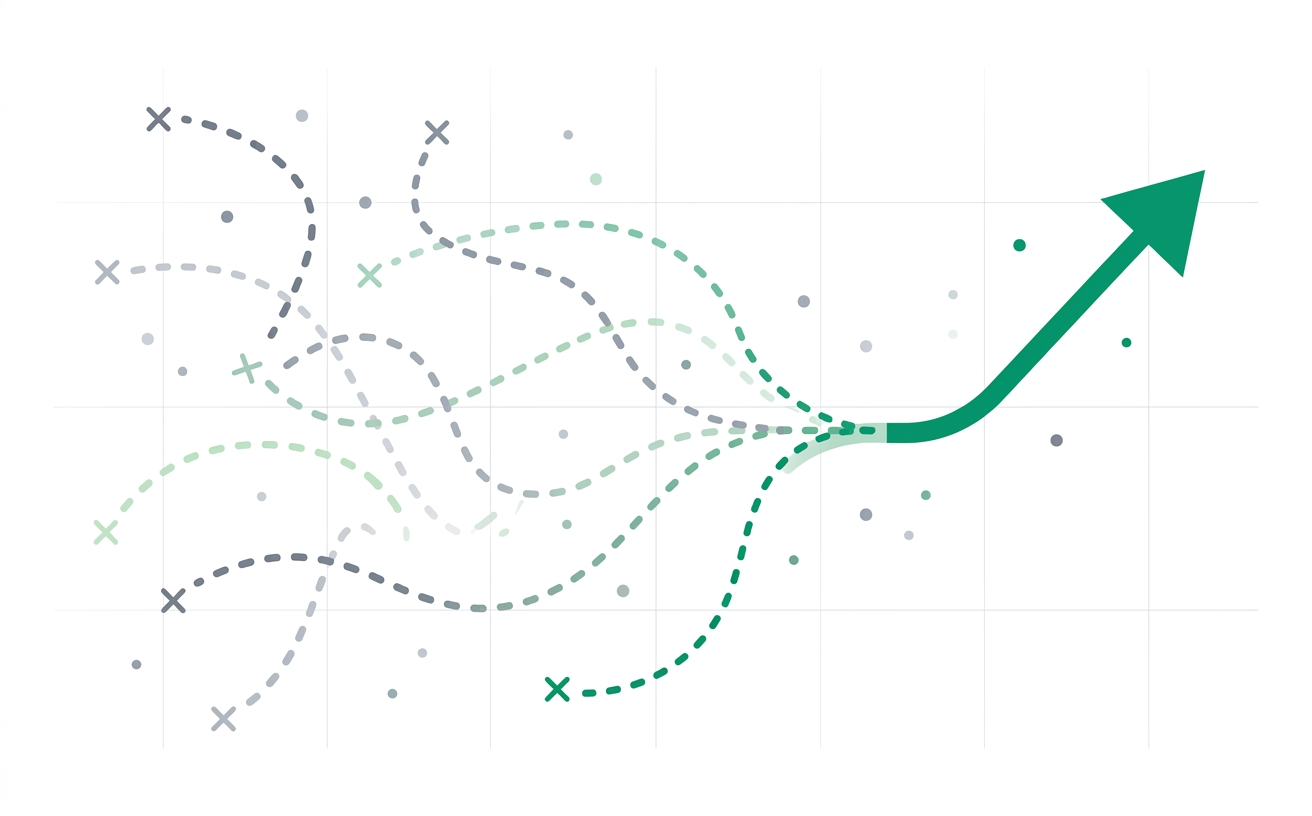
The median is 4-5 failed projects. But the range goes from 1 to over 20. And the founders who failed the most tend to build the biggest businesses when they finally succeed.
Why Is Every Failure Stat You've Seen Wrong?
The 90% failure rate everyone cites? That's from VC-backed startups. Nobody has ever measured how many times a solo founder fails before hitting $10K/month.
The "90% of startups fail" statistic comes from Startup Genome's research, which tracked VC-backed companies. Failory's dataset skews heavily toward funded startups too. These numbers get repeated endlessly, but they describe a world that most bootstrap founders do not inhabit. VC-backed startups fail for reasons that rarely apply to a solo founder building a $10K/month app: they run out of runway, they cannot hit the growth metrics investors demand, or they scale prematurely because the capital is there to burn.
Bootstrap founders face a completely different failure landscape. Their failures are smaller, faster, and cheaper. A solo founder who builds a no-code tool in a weekend and gets zero traction has "failed" — but the cost was a weekend, not $2M in seed funding. The question is not whether they will fail. It is how many times they fail before something works, and what changes on the attempt that finally sticks.
What This Guide Covers
I analyzed 208 founder interviews across four YouTube channels: StarterStory (50 interviews), The Brett Way (69 interviews), Superwall (34 interviews), and Steven Cravotta (55 interviews). These channels interview bootstrap founders, app builders, indie hackers, and solopreneurs — not Series A founders pitching VCs. The data reflects the reality of building without a safety net.
Why this data is different:
Every other failure rate study starts with a cohort of funded companies and measures how many survive. This analysis starts with founders who eventually succeeded and asks: how many times did you fail first? It is survivorship-biased by design — and that is what makes it useful. These are the people who kept going. The question is how many attempts it took.
Startup
The next teardown, without checking back
About one a week from the five companies I run with co-founders, AI agents, and zero hired employees — what I changed, and the part that broke.
One click to unsubscribe.
What Do 208 Founder Interviews Actually Show?
"I failed at probably over 20 different businesses before having two successful businesses." — Will Cannon, Uplead ($30M+ in sales)
Out of approximately 150 founders who were profiled in depth across these 208 interviews, 35 explicitly mentioned prior failures. That is 23% who surfaced failure stories in what are fundamentally success-focused interviews. The remaining 77% either did not fail notably, or — more likely — the interview format did not ask about it.
The 23% figure is almost an undercount. These are YouTube interviews optimized for engagement, not research. The interviewer is there to tell a success story, not catalogue every failed side project. When founders do mention failures, it is usually because the failure count is so dramatic it becomes part of the narrative.
The Founders Who Shared Their Numbers
| Founder | Failed Projects | First Success | Revenue |
|---|---|---|---|
| Will Cannon | 20+ | Uplead | $30M+ total sales |
| Lewis (Audio Pen) | 15-20 | Audio Pen | $15K/mo |
| Louis (Glow Up) | 10 | Glow Up | $15K/mo ($800K total) |
| Loic | 7+ | E-commerce SaaS | $35K+/mo (3 apps) |
| Anton (Letterly) | 6-7 | Letterly | $250K/mo |
| Rob Hallum | 5 | SuperX | $13K/mo |
| Steven Cravotta | 3-4+ | Grid / Wordle app | Millions (Wordle viral) |
| Dustin (Magi) | 3 | Magi | $100K/mo |
| Jimmy (Lots) | 2 (VC startup + banking) | App flipping | $500K+ (4 flips) |
| Aayall & Yali | 1 (full rebuild) | PropGBT | $30K/mo |
| George | 1 (prior dev attempts) | Wrestle AI | $17K/mo |
The pattern that jumps out immediately: the founders with the highest failure counts are not the ones with the smallest businesses. Will Cannon failed 20+ times and built a $30M company. Anton spent 15 years failing at 6-7 startups and now makes $250K per month. Lewis failed with 15-20 projects and Audio Pen earns $15K per month. The failures were not wasted time. They were tuition.
What Steven Cravotta said about his failures:
"I would not be here today without all of the failures. The failed businesses, failed relationships, struggles that I went through in my younger years — they all brought me to this position. Failed apps, failed e-commerce businesses, failed copywriting, SEO, trading, Forex, crypto — you name it, I've probably done it. But because I didn't give up on myself, I'm here."
How Many Projects Before $10K/Month?
"For 15 years, I was trying to create startups and all of them failed. And I've tried like maybe six or seven of them. And this one actually worked." — Anton, Letterly ($250K/mo)
When you line up the failure counts from the founders who shared specific numbers, a distribution emerges. It is not the neat bell curve you might expect. It is lumpy, with clusters at different points — and the outliers on the high end are the ones building the biggest businesses.
The Failure Curve
10+ failures
Will Cannon (20+ failures, $30M+ sales), Lewis (15-20 projects, $15K/mo), Louis (10 apps, $15K/mo with $800K total revenue). These founders spent years cycling through ideas before their breakthrough. Revenue after success: $15K-$250K/mo.
5-9 failures
Rob Hallum (5 products making $0, then SuperX at $13K/mo), Loic (7+ failed SaaS apps over 5 years, now 3 successful apps at $35K+/mo), Anton (6-7 startups over 15 years, Letterly at $250K/mo). Revenue after success: $13K-$250K/mo.
2-4 failures
Steven Cravotta (dropshipping, first app flop, Wordle dormant — then millions in downloads), Dustin (2 failed launches after first exit, then Magi at $100K/mo), Jimmy (failed VC startup, then app flipping to $500K+). Revenue after success: $100K+/mo.
1 failure + pivot
Aayall & Yali (first version stuck at $2K/mo, rebuilt, hit $30K/mo in 10 weeks), George (prior dev attempts failed, Wrestle AI at $17K/mo), Dimmitri (1.5 years of near-zero revenue before $30K/mo). Revenue after success: $17K-$30K/mo.
The median across all founders who shared specific numbers falls at 4-5 failed projects. But the range is 1 to 20+. And the pattern that repeats: founders with 10+ failures tend to hit higher revenue once they succeed. This is not coincidence. It is pattern recognition compounding over many attempts.
The uncomfortable truth:
If you are on your second or third failed project and feeling like something is wrong with you, the data says you are barely getting started. The median founder in this dataset failed 4-5 times. The ones who built the biggest businesses failed 10-20 times. Failure is not the exception — it is the prerequisite.
What Are the Three Types of Founder Failure?
"I've shipped a ton of features, still zero customers, zero MRR for like five years and basically made all of the bad decisions possible." — Loic, 3 successful SaaS apps ($35K+/mo)
Not all failures are the same. When you categorize the specific failures these founders described, three distinct types emerge — and one dominates by a wide margin.
1. Distribution Failure (~56% of cases)
You built something. Nobody found it. This is the most common failure mode by far. Loic spent 5 years building a SaaS app with zero users and zero revenue. He described it as "building in the dark" — shipping features to an empty room. Rob Hallum built and launched five products that made "a whopping zero dollars" over two and a half years. The products were not necessarily bad. They just had no distribution.
Louis experienced this pattern repeatedly before Glow Up. As he put it: "Before, we were just building and building without showing to user what we had and it always failed." The product existed. The distribution did not.
2. Product Failure (~30% of cases)
Wrong problem, wrong market, or bad retention. Aayall and Yali built the first version of PropGBT and got initial downloads — 20 per day right off the bat. But almost nobody stayed after the trial ended. Their conversion was horrible. They were stuck at $2,000 a month. The distribution was working. The product was not retaining users. They had to shut down all marketing and spend 4 months completely rebuilding from scratch.
Will Cannon failed at over 20 businesses, many of which were product failures — wrong markets, wrong timing, wrong execution. But he kept the framework and eventually found the right product-market fit with Uplead by copying an already-validated business model and building a simpler, cheaper version.
3. Commitment Failure (~14% of cases)
Gave up too early or pivoted too fast. Steven Cravotta built a word game called Wordle and set it to the side because "it didn't have the revenue potential" of his previous app. Six years later, the concept went viral through the New York Times version, and his dormant app exploded in downloads. People were searching for "Wordle" in the app store and finding his six-year-old game. He almost missed the opportunity because he had moved on.
Dimmitri spent a year and a half making almost nothing from his app. "Six months before I started monetizing, another year to hit the first thousand dollars, then a year to hit like 10." He stuck with it through the dead zone — and eventually reached $30K per month. Most people would have quit in month six.
The distribution failure trap:
More than half of all failures in this dataset are distribution failures — not product failures. This matters because the default instinct of most technical founders is to "improve the product." But if the product has zero users, improving it is just building in the dark. The fix for distribution failure is not a better product. It is any distribution at all.
When Does "Ship More" Become the Wrong Advice?
"Before, we were just building and building without showing to user what we had and it always failed." — Louis, Glow Up ($15K/mo)
"Ship more" is the default advice in the indie hacker community. And for a lot of founders, it is the right advice — if the problem is perfectionism, fear of shipping, or spending six months polishing something nobody has seen. But the data reveals a paradox: there are two distinct failure modes, and "ship more" only fixes one of them.
Failure Mode A: Not Shipping Enough
This is the perfectionism trap. Loic spent 5 years building a single SaaS with zero users. He was shipping features into a void. The problem was not that his product was bad — it was that he never tested whether anyone wanted it. Five years of building in the dark. The fix: ship faster, get feedback earlier, stop perfecting what nobody has asked for.
Failure Mode B: Shipping Too Much
This is the serial shipper trap. Lewis built 15 to 20 projects before Audio Pen. At some point, building became the comfort zone. Each new project felt productive, but the real issue was that he was avoiding the harder work of distribution and validation. He described the shift that made Audio Pen different: he wanted to "be sure that we could market it" before committing to a full build.
The distinction matters. Lewis's 12-hour build of Audio Pen worked not because he shipped fast — he had always shipped fast. It worked because this time he validated distribution first. He posted about it online and waited for a signal before going deeper. The signal came: 20 paying customers. Then he committed.
How to Tell Which Trap You Are In
- If you have been building the same product for months with zero users: You are in Failure Mode A. Ship something. Anything. Get it in front of people this week.
- If you have shipped 5+ products and none got traction: You are in Failure Mode B. Stop building new things. Pick one and go deep on distribution. Learn one channel well.
- If you are not sure: Look at your last 3 projects. Did you try to distribute them? If not, the problem is not the product. It is the absence of distribution.
What Rob Hallum learned from 5 failures:
"Over the next two and a half years, I built and launched five products that made in total a whopping zero dollars. And while it sucked, it taught me three fundamental things. Firstly, that distribution matters. Secondly, that monetization matters from day one." Rob then built SuperX entirely through Twitter distribution — using the channel he had mastered through those failures.
What Changes on the Attempt That Finally Works?
"I think the biggest problem that founders face is letting their past failures define them. People rejected the products. They didn't reject you." — Dustin, Magi ($100K/mo)
When you compare each founder's failed attempts to the one that succeeded, four patterns emerge repeatedly. It is never just one thing that changes. But these four show up more often than any others.
1. They Validated Distribution Before Building
Lewis built 15-20 projects with a build-first approach. Audio Pen was different: he built the MVP in 12 hours and immediately posted about it online. "I started building at noon and I wanted to know if I could take an idea all the way to revenue before midnight." The build was fast because validation was the priority, not polish.
Louis had the same revelation with Glow Up. Instead of just building another app, he studied TikTok. He found a real problem thousands of people were talking about in the comments. He started making content about it before writing a single line of code. Distribution first, product second.
2. They Picked a Smaller Market
George found wrestling coaching — an specific niche. Wrestle AI is an AI wrestling coach that analyzes match videos. It is not an "AI coaching platform for all sports." It is wrestling, specifically. The niche was small enough that he could reach the entire market through TikTok influencer outreach in the wrestling community. Within months he was at $17K per month.
3. They Shipped Faster
Lewis built Audio Pen in 12 hours. Compare that to the months or years founders spend on projects that fail. Speed was not the cause of success, but it compressed the feedback loop. Instead of spending 5 months building before learning anything (as Aayall and Yali did with their first version), a 12-hour build gets you market signal in 12 hours.
4. They Used a Channel They Had Mastered
Rob Hallum built SuperX specifically for Twitter growth — and grew it using Twitter. He spent two and a half years learning the platform through posting about his five failures. By the time he launched SuperX, he had 34,000 followers and a deep understanding of what the audience needed. He was "living proof the system works."
Loic's breakthrough came when he discovered that YouTube creators could distribute his SaaS apps. His playbook: work with creators as promoters or co-founders. He applied it three times and hit $35K+ MRR with each app within their first month of activity — all bootstrapped.
The common thread:
On the attempt that worked, every founder had a distribution answer before they had a product. Not a vague hope that "people will find it." A specific channel, a specific audience, and a way to reach them. The product was often simpler than their failed attempts. The distribution was always more deliberate.
Does More Failure Lead to Higher Revenue?
"I failed at probably 15, 20 different businesses before I built two that were super successful." — Will Cannon, Uplead ($30M+ in sales)
When you plot failure count against eventual revenue, a pattern emerges that runs counter to what you might expect. More failures do not predict smaller outcomes. If anything, the correlation goes the other way.
Failure Count vs. Revenue After Success
| Failure Count | Founders | Revenue Range After Success |
|---|---|---|
| 10+ failures | Will Cannon, Anton, Lewis, Louis | $15K - $250K/mo |
| 5-9 failures | Rob Hallum, Loic | $13K - $35K/mo |
| 2-4 failures | Steven Cravotta, Dustin, Jimmy | $100K+/mo |
| 1 failure | Aayall & Yali, George, Dimmitri | $17K - $30K/mo |
The 10+ failure group includes Anton at $250K/month and Will Cannon at $30M+ total — two of the highest revenue founders in the entire dataset. The 2-4 failure group includes Dustin at $100K/month and Steven Cravotta's viral success. The 1-failure group clusters around $17K-$30K/month — respectable, but lower than the extremes.
This is not causation. Failing 20 times does not make you better at building products. But there is a plausible mechanism: each failure teaches you something specific — what does not work in a particular market, which distribution channels you are bad at, what kind of product you should not build. By the time you hit attempt 15 or 20, your pattern recognition is far more refined than someone on attempt 2.
What the High-Failure Founders Did Differently
- Will Cannon developed a framework: After 20+ failures, he built a systematic process for identifying markets with existing demand, copying validated business models, and reaching customers through cold email. The framework was the product of every failure.
- Anton learned simplicity: After 15 years and 6-7 failed startups, he obsessed over user experience and simplicity with Letterly. "Simplicity and user experience is quite expensive. You should treat it as a separate feature." That lesson came from 15 years of overcomplicating things.
- Lewis learned speed: After 15-20 failed projects, he compressed everything. "I started building at noon and I wanted to know if I could take an idea all the way to revenue before midnight." The 12-hour build was only possible because he had done it dozens of times before.
The 2-4 failure outlier:
The 2-4 failure group shows high revenue too, but for a different reason. Dustin had a successful first company, then two failures, then Magi at $100K/month. His first success gave him confidence and skills that transferred. Steven Cravotta had a viral hit (Grid app) early, then Wordle sat dormant for 6 years before exploding. Sometimes it is not pattern recognition from failure — it is luck meeting preparation.
Frequently Asked Questions
How many startups does the average founder launch before succeeding?
Based on 208 founder interviews across four YouTube channels, the median is 4 to 5 failed projects before hitting $10K per month. The range is 1 to over 20. Will Cannon failed at 20+ businesses before building Uplead to $30M in sales. Lewis failed with 15-20 no-code projects before Audio Pen succeeded at $15K per month. Anton spent 15 years on 6-7 failed startups before Letterly reached $250K per month.
What percentage of solo founders fail?
The 90% failure rate applies to VC-backed startups, not bootstrap founders. In our dataset of success-focused interviews, 23% of founders explicitly mentioned prior failures while 77% did not bring up failures at all. This does not mean most founders succeed on their first try — it means the interview format does not typically ask about failure history. The real failure rate for any individual project is likely high, but solo founders compensate by launching many projects over time.
Is it better to ship many products or go deep on one?
Both paths can work, but the data shows the key variable is distribution validation, not quantity. Lewis shipped 15-20 projects rapidly but only succeeded when he validated distribution first with Audio Pen. Loic spent 5 years deep on one product with zero users — his success came after switching to a distribution-first approach. If you are shipping many things but never validating distribution, more shipping will not help. If you are going deep on one thing but nobody is using it, depth will not help either.
How long should you work on a product before giving up?
The data suggests focusing on signals rather than timelines. Aayall and Yali saw poor retention after 5 months, rebuilt in 4 months, and hit $30K MRR in 10 weeks. Dimmitri made almost nothing for 18 months before reaching $30K per month. Steven Cravotta's Wordle app sat dormant for 6 years before going viral. If you have active distribution efforts and zero users after 3 to 6 months, that is a strong signal to change something — your distribution channel, your market, or your product. Time alone is not the deciding factor.
What is the most common reason solo founders fail?
Distribution failure accounts for approximately 56% of failures in our dataset. Founders built products but had no way to reach users. Loic spent 5 years building an app with zero users. Louis built 10 apps that all failed because he was "just building and building without showing to users." Product failure (wrong problem, bad retention) accounts for about 30%. Commitment failure (quitting too early or pivoting too fast) accounts for the remaining 14%. The primary fix for most founder failures is not a better product — it is any distribution strategy at all.