Harness Engineering: The Operating System Behind 5 Companies
In early 2026, engineers from OpenAI, Anthropic, IBM, and Google DeepMind independently named the discipline I already run on. Here is the teardown.
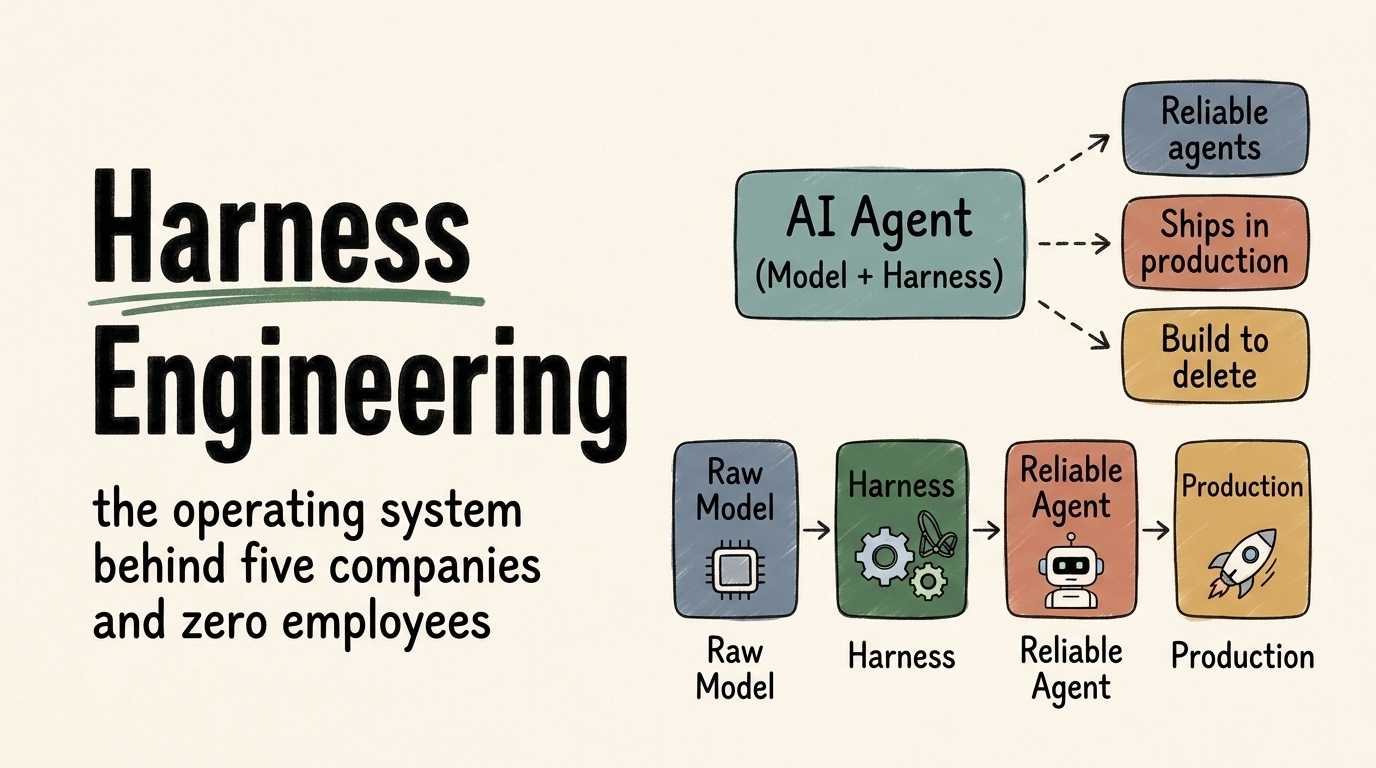
I run five companies with cofounders, AI agents, and zero hired employees. No W2 staff, no contractors. For two years the honest answer to "how" was a shrug: I had built a system around the models, rules, checks, a way for an agent to know where it is in a job and what "done" looks like, but it had no name, so it sounded like a personality trait instead of a method.
It has a name now. I went through 200+ talks from the AI Engineer conference, where engineers from OpenAI, Anthropic, IBM, Google DeepMind, Cursor, Factory, and Cline each walked through how they run agents in production. They had never coordinated. They used different stacks and different words. And they all described the same discipline.
It is called harness engineering. If you run a mid-market company, it is the part you are not building yet. This is the teardown.
5
AI-native companies run on it
0
hired employees
200+
AI Engineer talks reviewed
7
labs that converged on it
What Is a Harness, and Why Is It the Whole Game?
Agent = Model + Harness. The harness is everything that is not the model. The model was never the hard part.
The cleanest definition came from OpenAI's coding-agents team: an agent is made of three parts. "It's a user interface. It has a model. It's a harness." The model is the raw intelligence. The harness is everything else. Tejas Kumar of IBM drew the boundary even more bluntly: "Isn't a harness just the agent loop? No, it's the stuff around the agent loop." The tool registry. The guardrails. The context management. The verification step.
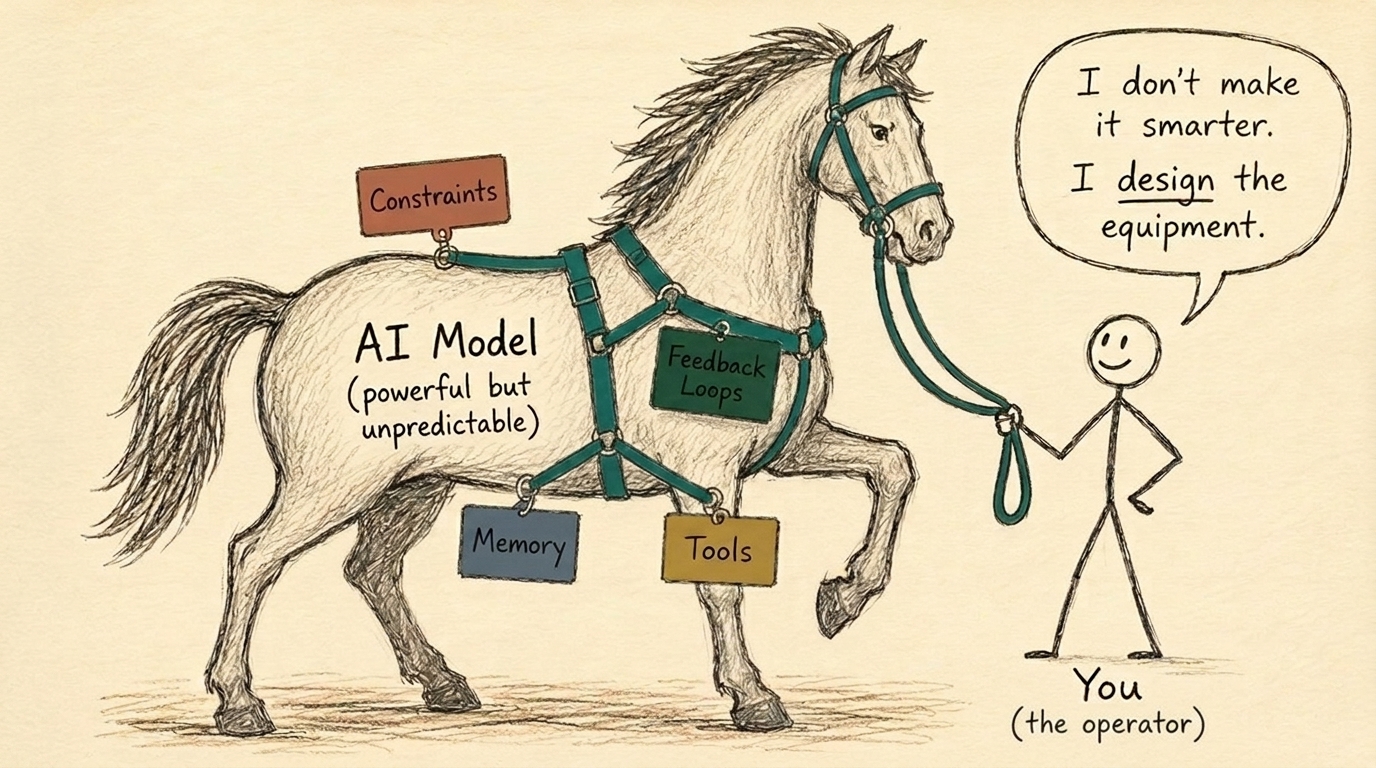
Here is the part most people miss: the labs hand everyone the same frontier model on the same day. The harness is the part you build yourself, and it's what decides whether the agent is a demo or an employee. That "everything around the model" is exactly what I sell to mid-market companies and call the AI Operating System. I just didn't have a conference-approved word for it until now.
AI
The next teardown, without checking back
About one a week from the five companies I run with co-founders, AI agents, and zero hired employees — what I changed, and the part that broke.
One click to unsubscribe.
What Are the 5 Artifacts in My Harness?
Across every team running agents for real, the same five artifacts show up. I run all five. Notice what's not on the list: a smarter model.
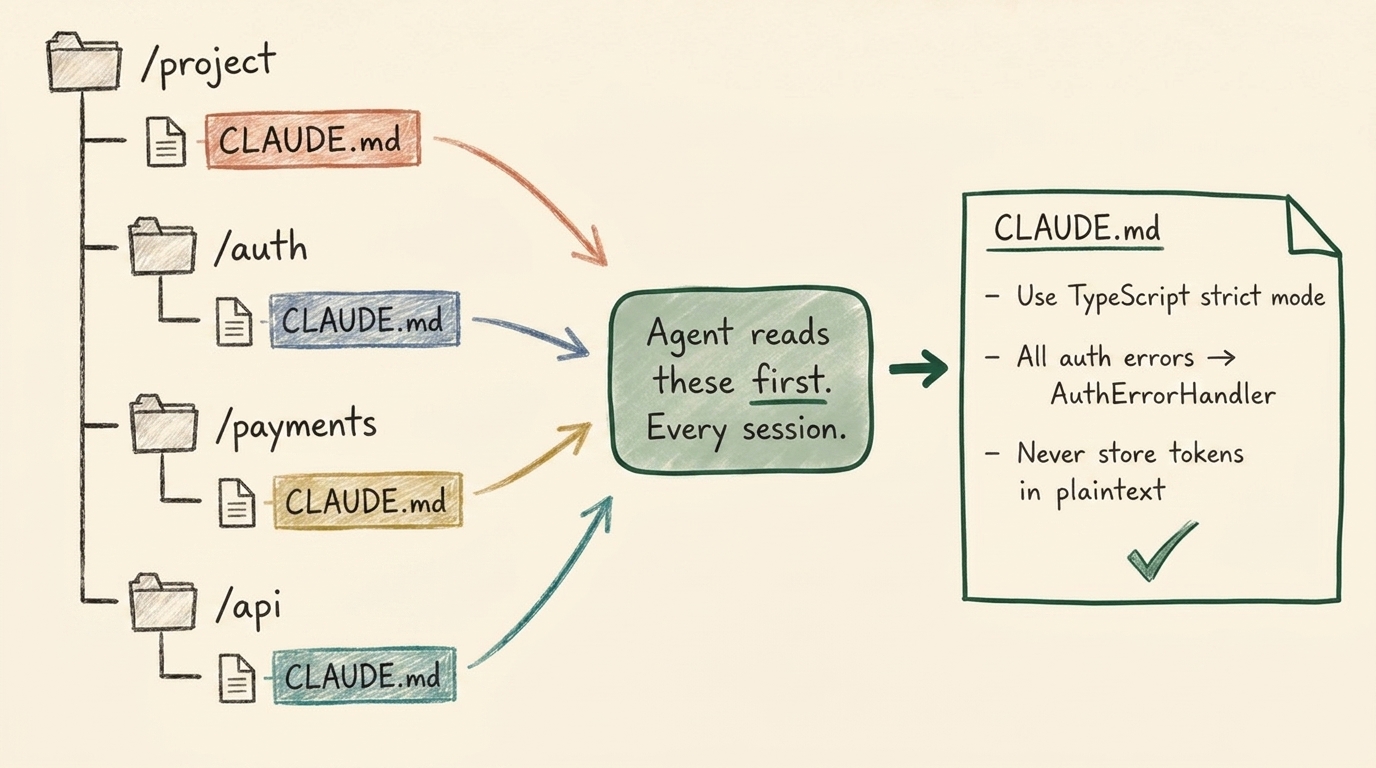
The onboarding doc
A markdown file the agent reads at the start of every job: context, conventions, how we do things, what's in progress. OpenAI calls it AGENT.md, Anthropic CLAUDE.md, Cursor .cursorrules. The agent that starts blind wastes its first twenty minutes rediscovering the company; the one that starts informed goes straight to work.
The progress ledger
A JSON file: each feature, how to verify it, pass or fail. The agent reads it, picks the highest-priority failing item, implements it, marks it passing, commits, repeats. Anthropic's team stores it as JSON, not markdown, "because the models might overwrite markdown files, whereas they're less likely to overwrite JSON." A six-hour run lives or dies on details like that.
The boot sequence
Every session starts the same way: confirm where you are, read the git log and progress file, start the dev server, run a smoke test, then (and only then) pick one thing and do it. Same boot, every time. No improvising the setup.
The doer / judge split
Ask an agent to grade its own work and it gives itself an A. The fix is to separate the worker from the critic: a generator builds, and a separate, skeptical evaluator with no stake in the work grades it, opening the running app with browser automation and clicking around like a real user.
Spec before code
Before the agent writes anything, it works from a grounded spec: real file paths, real symbol names, the existing patterns, concrete acceptance criteria. Not a vibe. Grounded context before execution is the difference between code that fits the codebase and invented APIs that don't.
Five artifacts. That's a harness. You were never going to out-model OpenAI. You were always going to out-harness your competitor.
What Principles Did Every Lab Converge On?
Teams that never referenced each other landed on the same handful of principles. That makes them worth more than any single tactic.
Context beats instructions
Show the agent the real state of the world and it writes code that fits; tell it what to do in the abstract and it invents file paths that don't exist. Give it a map, not a manual.
Planning and execution are separate steps
An agent that plans and builds in one pass produces unreliable work. The plan can be written by an AI, it just has to be its own step, reviewed before the build starts.
Feedback loops are non-negotiable
Wire the agent into tests, CI, and a skeptical evaluator. A harness without feedback is just a prompt with extra steps.
One thing at a time
One feature per sprint, commit, repeat. Agents that try to do too much run out of context and silently drop requirements.
The codebase is the documentation
Nobody keeps a separate knowledge base for the agent. The repo is the source of truth, so the unglamorous work of clean structure and decisions written down is now what makes your agents good. Messy company, messy agents, at scale.
Why Is the Harness Built to Be Deleted?
Every harness component is a workaround for something the model can't do yet. When the model improves, that piece stops helping and starts costing you.
Nik Pash at Cline said it without flinching: "For years we compensated for weak models by building clever scaffolds around them. Now your scaffolding just gets in the way. Capability beats scaffolding. Get out of the model's way and it performs just fine." Philipp Schmid at Google DeepMind gave it the name I now use with clients: build to delete. "Software is disposable. We are going to rebuild the same things many times, with better models."
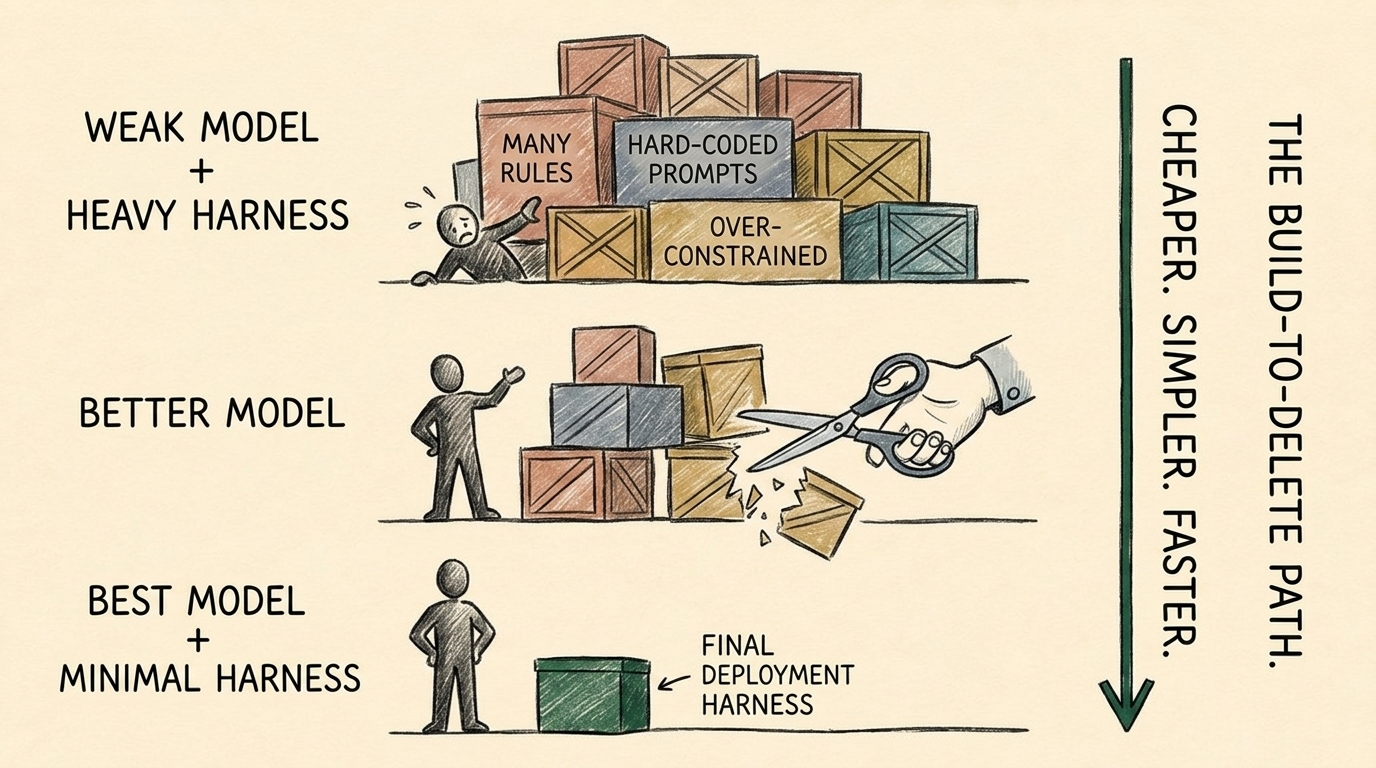
The cost math makes it concrete. Anthropic ran the same task two ways: a bare agent for about twenty minutes, versus the full harness at "200 bucks, 6 hours." The harness run cost far more, and was the only one that worked. Then they upgraded the model, and the harness got cheaper, because the model now did for free what the scaffolding used to do. So what you're paying for is the judgment: what to build, in what order, and when to throw each piece away.
Why Is This the Whole Game for Mid-Market?
"The bottleneck in software engineering is not intelligence anymore. It's human attention." That's true of every business I run.
That line, from Luke Alvoeiro at Factory, is the entire reason I operate five companies with zero employees. The constraint was never how smart the models are. It's how much of my attention each company demands. The harness is what spends the intelligence so it doesn't spend my attention. It's why Sena can run an event concierge, Precis can turn thousands of expert videos into a consensus report, Gavel can produce expert frameworks with real citations, TrueStandard can verify high-stakes decisions, and GameTape can sit quietly and observe coaching sessions, all without a headcount behind them.
And the proof is in your hands: the research behind this guide. I didn't read 200 conference talks. My harness did. It pulled the transcripts, summarized them, ranked what mattered, and handed me the shortlist. I steered; the agents executed. That's not a metaphor for the operating system I build. It's a screenshot of it.
What Would This Find in Your Company?
Your competitors are still running 2022 operations and waiting for a smarter model to save them. The smarter model is already here. What they're missing is the harness around it.
The hard part for an existing company is not the technology. It is that the most valuable context, the constraints and judgment that would go into your harness, lives in the heads of people too busy to write it down and too senior to be asked. The company that should win the AI transition is sitting on the asset and can't get it out of the building.
That gap compounds every quarter you wait. An audit maps where your company overstaffs work a stack of agents could do, which workflows to put an agent on first, and in what order to build your own AI Operating System, the same way I build and run my own.
Frequently Asked Questions
What is harness engineering?
An agent is a model plus a harness. The harness is everything that is not the model: the docs that tell the agent where it is, the constraints that keep it on track, the feedback loops that catch mistakes, and the tools it can use. Harness engineering is designing that scaffolding so a raw model becomes a reliable agent.
Why does the harness matter more than the model?
The labs hand everyone the same frontier model on the same day. The harness is the part you build, the part that's yours, and the part that decides whether the agent is a demo or an employee. Same model plus a better harness beats a better model with no harness.
What are the five harness artifacts?
An onboarding doc (CLAUDE.md / AGENT.md); a JSON progress ledger; a fixed session boot sequence; a doer/judge split with a separate evaluator; and spec-before-code, where the agent works from real file paths and acceptance criteria instead of guessing.
What does "build to delete" mean?
Every harness component is a workaround for something the model can't do yet. When the model improves, that component becomes overhead. So you design each piece to be removable, test it by turning it off, and delete it when it stops earning its keep.
How do I get this built for my company?
Start with an audit: a fixed deliverable mapping where you overstaff work agents could do, and in what order to build your AI Operating System. Apply at agrahri.com.
Want this built for your company?
I take a few audits a month. The audit maps where your company is carrying weight a stack of agents could lift, and the order to build your AI Operating System, harness included.
Apply for an audit