Can You Trust an LLM Judge? 14,000 Bank Cases and My Own Review Panel
A judge needs a measured agreement number with people before it can block a release.
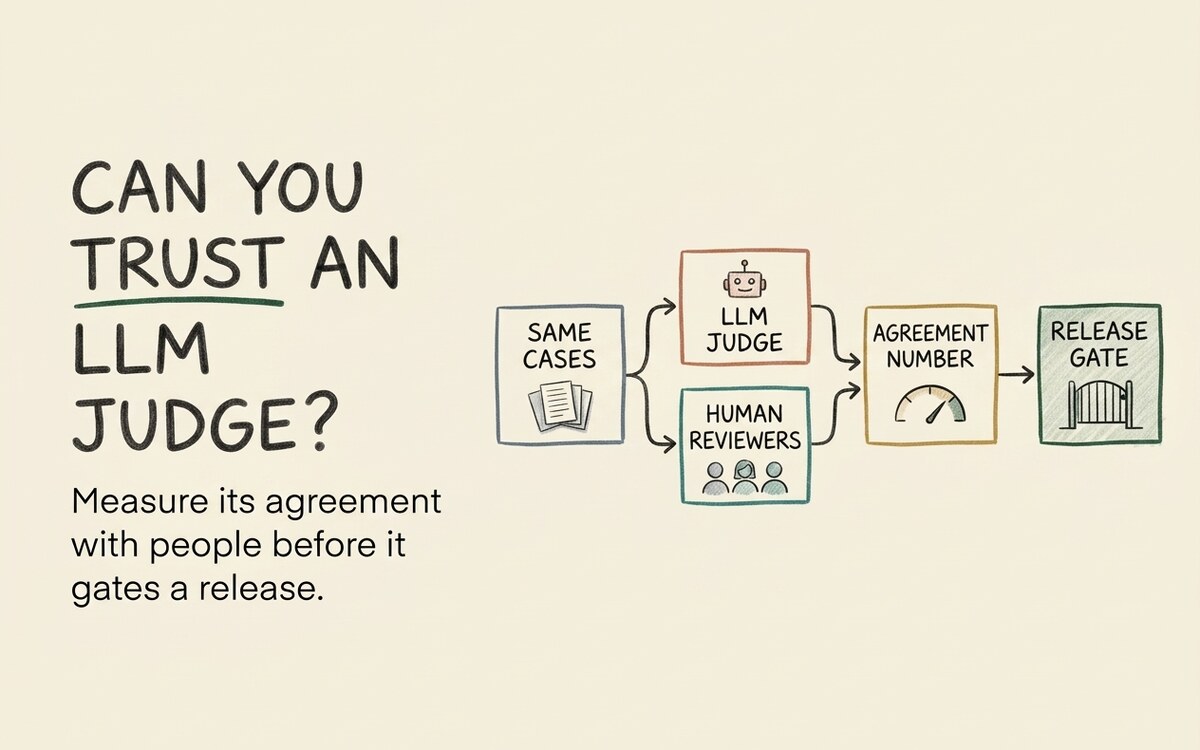
Table of Contents
You cannot trust an LLM judge out of the box because uncalibrated models grade generously, flip verdicts on reruns, and miss bad outputs. Across around 14,000 internal complaint cases at NatWest, an LLM judge averaged .97 against a human mean of 0.83 with almost zero correlation Jonathan Osborne, NatWest 09:39. Before any judge touches a release gate, you need The Agreement Number: the measured rate at which a judge agrees with human reviewers on the same cases, without which it cannot gate anything. Teams are wiring AI judges into release pipelines right now, and a broken judge ships broken agents while reporting green scores.
Why do LLM judges grade generously?
LLM judges grade generously because language models default to positive scores, inherit human confirmation bias, and behave non-deterministically on repeated runs. When you swap a deterministic test for a language model, you add grader noise on top of agent noise.
Jonathan Osborne saw this pattern firsthand at NatWest, a UK retail bank serving 19 million customers Jonathan Osborne, NatWest 00:47. "You don't want your judge to be generous and that is what LLMs want to do by default," Osborne reported Jonathan Osborne, NatWest 10:19. Because models try to be positive, scores pile up near the top of the scale and stop separating good runs from bad ones Jonathan Osborne, NatWest 16:56.
Reliability drops further when you ask the same judge the same question twice. Tariq Shaukat at Sonar called language models unreliable reward-seeking judges and cited a PayPal AI study where between 7 and 17% of verdicts changed on identical replications Tariq Shaukat, Sonar 09:33. He also cited a Meta study where asking "are you sure?" made models change their minds 7 to 34% of the time Tariq Shaukat, Sonar 09:45.
Netflix's Cameron Wolfe described the structural cause. On subjective tasks, "we're taking a component that was previously deterministic, this grader, and we're replacing it with another non-deterministic LM-based component" Cameron Wolfe, Netflix 03:21. You now have a noisy agent graded by a noisy evaluator Cameron Wolfe, Netflix 11:41.
Vishal Srivastava traced another root cause to training data. He cited Peter Wason's confirmation bias experiment, where 79% of people tested wrong, and noted AI models learn from human-generated data Vishal Srivastava 14:44. His rule is direct: "any evaluation that needs to be done has to falsify, not to confirm" Vishal Srivastava 15:05.
Generosity is not the only failure mode. At LinkedIn, an evaluation judge accepted plausible job titles even when the agent omitted an important intent signal Saloni Gandhi, LinkedIn 26:38. Yet on weak outputs, 31 of 37 judgments identified as overly harsh involved outputs assigned a score of one Saloni Gandhi, LinkedIn 27:41.
Human review alone does not automatically fix generosity either. Shaukat cited research on cognitive surrender showing humans agree with AI 93% of the time when it is right Tariq Shaukat, Sonar 06:26. Worse, "four out of five times they agree with it when the AI is wrong" Tariq Shaukat, Sonar 06:26.
AI
The next teardown, without checking back
About one a week from the five companies I run with co-founders, AI agents, and zero hired employees — what I changed, and the part that broke.
One click to unsubscribe.
How far off were judges on production data?
On real banking, lending, and consumer workloads, first-pass LLM judges missed human reviewers by wide margins. Agreement started as low as 33% at Upstart and hit almost zero correlation across around 14,000 cases at NatWest.
| Company | Production Workload | Measured Judge Gap | Source |
|---|---|---|---|
| NatWest | Internal complaints summaries (~14,000 cases) | Judge mean .97 vs human 0.83, almost zero correlation | Jonathan Osborne, NatWest 09:39 |
| Upstart | Loan verification voice calls (compliance) | 33% initial judge-human agreement | Shiv Indap, Upstart 07:38 |
| User understanding agent (~180 to 200 reviews) | ~55% (score 1), ~57% (score 2), ~80% (score 3); ~47% domains | Saloni Gandhi, LinkedIn 25:23 | |
| Sonar (citing PayPal AI) | Identical replication benchmark | 7 to 17% of verdicts changed on reruns | Tariq Shaukat, Sonar 08:41 |
| Air Canada | Supplier contract clause analysis | Judge noise too high to find a workable judge harness | Nathanael Weill, Air Canada 17:01 |
NatWest's complaints evaluation explains why average scores mislead operators. Across around 14,000 cases scored by both people and an LLM judge, the faithfulness judge sat pinned at .97 with tiny spread while human scores averaged 0.83 with much wider spread Jonathan Osborne, NatWest 09:39. Osborne was blunt: "a judge which doesn't discriminate between the actually good cases and the bad cases is basically worthless" Jonathan Osborne, NatWest 10:14.
Averages also hid sharp failure cliffs before NatWest even automated grading. In June validation of its payment agent across 111 conversations, 37 payment flows, 4 brands, and 3 independent human scorers per conversation, the headline pass rate was 83% Jonathan Osborne, NatWest 07:50. That single score hid a 54% spread: 97% on happy paths, 76% on edge cases, and 43% on topic changes Jonathan Osborne, NatWest 08:00.
Human reviewers also disagreed with one another on subjective criteria. At NatWest, human validators agreed 95% of the time on objective bias and fairness Jonathan Osborne, NatWest 08:32. On subjective intent understanding, humans agreed only 64% of the time Jonathan Osborne, NatWest 08:43.
LinkedIn uncovered a second layer of production drift inside its self-improving agent loop. Across about 180 to 200 human reviews of its L1 judge, alignment varied by task: around 47% on domains, around 50% on work type, and weakest on job titles Saloni Gandhi, LinkedIn 25:15 Saloni Gandhi, LinkedIn 26:19. Even more risky, LinkedIn's L2 reflection agent sometimes trusted L1's rationale without checking the output and blamed the rubric when L1 itself was wrong Saloni Gandhi, LinkedIn 30:36.
Air Canada hit a wall with LLM judges on supplier contract reviews. Nathanael Weill reported that judge noise rivaled the noise in the agent itself, making the judge problem almost as hard as the original contract task Nathanael Weill, Air Canada 17:01. His team never found a reliable judge prompt for that project and walked away from LLM grading there Nathanael Weill, Air Canada 17:01.
What made judges agree with people?
Teams raised The Agreement Number by calibrating human reviewers first, writing down unwritten rules into narrow single-criterion rubrics, and shifting objective checks into deterministic code. Model tweaks alone rarely closed the gap.
| Company | Calibration Technique | Measured Result | Source |
|---|---|---|---|
| Upstart | Encoded tribal knowledge, aligned reviewers, tuned judge | 33% to 92% compliance agreement | Shiv Indap, Upstart 07:38 08:43 |
| Fixed formatting penalties, normalized titles, recalibrated 1-3 scale | 57% to 64% alignment; mean error 0.96 to 0.74 | Saloni Gandhi, LinkedIn 28:31 | |
| Air Canada | Planted defects and invariance rules graded in code | 275 tests; feedback cut from 4 weeks to 5 minutes | Nathanael Weill, Air Canada 12:51 15:58 |
| Arize AI | Routed 0.3-0.7 confidence decision-model scores to people | 4.6% to humans; 99.5% accuracy on the rest | Fuad Ali, Arize AI 33:48 |
Compliance agreement climbed from 33% Shiv Indap, Upstart 07:38 to 92% Shiv Indap, Upstart 08:43 through three concrete steps. First, they wrote unwritten tribal knowledge into the agent, then resolved disagreements among human reviewers, and finally updated the judge Shiv Indap, Upstart 07:38.
Upstart's partner Brooke Hopkins at Coval writes evals to define product behavior Brooke Hopkins, Coval 09:47. She advises teams to base judge metrics on human reviewer labels and leave out generic audio metrics like word error rate Brooke Hopkins, Coval 10:12.
On subjective tasks, Cameron Wolfe at Netflix follows the same human-first order. Multiple people rate the same sample, and his team rewrites quality guidelines until raters agree Cameron Wolfe, Netflix 05:26. He targets judge agreement at that human baseline Cameron Wolfe, Netflix 10:39, uses task-specific checklists Cameron Wolfe, Netflix 08:52, and applies resampling and power analysis Cameron Wolfe, Netflix 11:59.
Netflix also checks whether judge scores predict real business behavior. On one Netflix project, Wolfe's team showed their LLM judge outputs were causally correlated with viewer abandonment Cameron Wolfe, Netflix 10:19.
LinkedIn proved how much rubric ambiguity drives disagreement. By stopping penalties for harmless capitalization differences, normalizing job titles, clarifying inference rules, and recalibrating partial credit, LinkedIn raised alignment from 57% to 64% and lowered mean error from 0.96 to 0.74 Saloni Gandhi, LinkedIn 29:17. They also added majority voting on held-out evaluations to cut variance from individual judgments Saloni Gandhi, LinkedIn 32:25.
Narrowing scope helps just as much. Arize AI's SallyAnn DeLucia advises judging one quality per eval because LLM judges do well with only one criterion at a time SallyAnn DeLucia, Arize AI 20:10.
Anthropic's Lance Martin similarly recommends deterministic checks first, and well-structured binary classifiers or pairwise comparisons over arbitrary numerical scales Lance Martin, Anthropic 30:49. Where binary confidence matters at low latency, Arize AI's Fuad Ali tested decision models on spam detection: routing the 4.6% of cases between 0.3 and 0.7 confidence to people left the rest at 99.5% accuracy Fuad Ali, Arize AI 33:48.
To gather human labels without stalling teams, NatWest made feedback a required gate inside its complaints workflow. A complaint handler cannot rerun an investigation until they enter why, which produced 14,000 colleague labels Jonathan Osborne, NatWest 16:09. Langfuse has experts leave quick raw comments on a sample, uses an LLM to cluster failure modes, and starts judges slightly strict with extra false positives before tuning down Doneyli De Jesus, Langfuse 27:38 Langfuse Q&A 53:07.
Finally, the fastest way to remove judge noise is to eliminate the judge where code can grade. Air Canada inverted its contract review problem by generating 275 rule-breaking tests, removing clauses from signed contracts, and testing invariance under supplier renames and clause reordering Nathanael Weill, Air Canada 13:44 13:54 14:57. Pure code checks cut feedback from 4 weeks to 5 minutes, echoing an earlier RAG project that moved from one eval a week to dozens a day Nathanael Weill, Air Canada 06:29 16:23.
Should a model judge its own family's work?
No. Two production teams reported that using the same model family to generate and grade outputs preserves shared blind spots and misses real errors.
Daksh Gupta at Greptile, whose agents review about 1% of all pull requests on GitHub, documented distinct failure patterns across model families Daksh Gupta, Greptile 00:36. Claude models are roughly three times more likely to produce one-off errors than GPT models, while GPT models are significantly more likely to produce auth bypasses Daksh Gupta, Greptile 09:11. When a model reviews code written by its own family, it fails in the same ways during review that it did during generation Daksh Gupta, Greptile 09:37.
Greptile solved this with model inversion: if Claude wrote the code, a GPT model reviews it, and vice versa Daksh Gupta, Greptile 09:37. "We found that there's a 10% higher catch rate if you flip models," Gupta reported Daksh Gupta, Greptile 10:41. Because catastrophic bugs appear in roughly one out of every thousand pull requests, a 10% jump prevents major outages Daksh Gupta, Greptile 07:12 10:41.
Setting up model inversion has one operational catch. Coding agents leave clear fingerprints like codex/ branch names or co-author tags about 80% of the time; catching the last 20% requires telemetry or heuristics Daksh Gupta, Greptile 10:02.
NatWest reached the same cross-family conclusion in banking. Moving its judge to a different model family from the customer agent gave the judge different blind spots and pulled judge and human scores closer together Jonathan Osborne, NatWest 10:48. Arize AI's Laurie Voss also advises using cross-provider judges to limit self-preference bias Laurie Voss, Arize AI 57:53.
Cross-family judging introduces its own risk: every judge model swap can break your thresholds. At NatWest, changing only the judge model on identical inputs and outputs caused a sharp drop in the score's margin above threshold Jonathan Osborne, NatWest 10:42. Your judge model version is part of your release configuration and cannot be swapped silently Jonathan Osborne, NatWest 17:06.
Pamela Fox at Microsoft showed why model swaps change behavior so abruptly across tasks. On an identical RAG test, GPT-5.5 and DeepSeek V4 Flash admitted when sources lacked honeybee data, while Mistral Large 3 answered from its weights and later dropped the final step of an agent tool loop Pamela Fox, Microsoft 09:40 10:54 29:41.
When may a judge block a release?
A judge may block a release in CI/CD only after you measure The Agreement Number against human labels, blend it with deterministic checks, and protect production with shadow runs and feature flags. An uncalibrated judge belongs in monitoring queues, not automated merge gates.
| Company | How They Gate Releases | Key Metric or Control | Source |
|---|---|---|---|
| NatWest | Hard CI/CD regression gate, shadow mode, brand rollout, flags | 5% random + all failure traces scored every 4 hours | Jonathan Osborne, NatWest 10:42 11:43 |
| Upstart | Voice simulation before launch, feature flags, human sign-off | Engineers approve judge edits; compliance approves policy edits | Shiv Indap, Upstart 15:04 |
| Langfuse | Prompt promotion triggers CI with per-score minimums | Blended deterministic code checks (100% consistent) + LLM judges | Doneyli De Jesus, Langfuse 31:52 37:12 |
| Holdout validation + human PR review before production | First loop-optimized PR shipped with human review | Saloni Gandhi, LinkedIn 23:18 | |
| Warp | Judge-only scoring on replayed past tasks for model routing | GLM 5.3 Flash 93% at $2 vs GPT-5.6 95% at 3x cost; no human grading yet | Zach Lloyd, Warp 15:59 20:12 |
| Air Canada | Deterministic code suites for dev speed, not launch sign-off | Test suite is a dev tool, not the final go/no-go | Nathanael Weill, Air Canada 19:10 |
Silent failures make release gating non-negotiable. As Langfuse's Annabell Schäfer warned, "AI agents can fail while the system metrics themselves look green" Annabell Schäfer, Langfuse 02:08. A support agent can promise a refund without ever calling the refund tool, leaving latency and uptime green until customers complain weeks later Annabell Schäfer, Langfuse 02:24.
Arize AI's SallyAnn DeLucia drew the clean line between alerts and gates: "a metric tells you that something might be broken, but evals tell you what the actual failure mode is" SallyAnn DeLucia, Arize AI 34:00. Without calibrated evals in CI, prompt edits break prior fixes while teams ship on vibes SallyAnn DeLucia, Arize AI 02:24.
Regulated operators still refuse to let an LLM judge act as the sole gatekeeper. NatWest runs a hard CI regression gate, then validates in shadow mode while the scripted bot still answers, before rolling out brand by brand behind instant kill switches Jonathan Osborne, NatWest 11:43 13:48 14:50.
Upstart separates technical gates from compliance gates. Changes are re-simulated across accents and interruptions, shipped behind feature flags, signed off by engineers for judge edits, and signed off by compliance for policy changes Brooke Hopkins, Coval 12:56 Shiv Indap, Upstart 15:29. Hopkins warned against one-time launch gates that make later model swaps nearly impossible Brooke Hopkins, Coval 08:43.
Sonar's customer data supports pairing deterministic verification with agentic checks. Across over 1,000 surveyed customers, SonarQube users were 81% more likely to see a very positive impact on code security, 34% on time to market, and 76% on outage frequency Tariq Shaukat, Sonar 14:11.
Speakers disagreed on how much autonomy a judge earns. Warp uses LLM-as-a-judge scores without human grading yet to replay tasks and compare model cost versus quality Zach Lloyd, Warp 20:45. Air Canada refuses to treat even deterministic tests as a launch gate Nathanael Weill, Air Canada 19:10, and Arize AI warns that chaining judges without ground truth leaves you "just vibing with the agent's output" Fuad Ali, Arize AI 48:06.
Co-presenter Tanmay Sah noted that because judges miss errors, you must govern the evaluator as part of the deployment system Srivastava & Sah 13:17, and Cisco's Al Chen warned that judges can even leak PII or material non-public information in their reasoning outputs unless inputs are redacted Al Chen, Cisco 10:28.
From the Operator's Desk: what my own review panel showed
When I decomposed one completed run of my landing-page review panel, 47% of the scorecard's variance came from the grader, and switching to one scorer for all personas cut grader variance from 0.975 to 0.210.
I run five companies (Sena, Precis, Gavel, TrueStandard, and GameTape) with co-founders and AI agents and zero hired employees: no W2 staff and no recurring contractors. Because we do not have a QA team reading every output, our automated graders carry real operational weight.
I built a landing-page review skill that grades a page using a panel of 8 lanes across 4 model vendors scoring 12 sections. When I decomposed one completed run, 47% of the scorecard's variance came from the grader itself. Only 22% came from the persona-by-section signal the skill exists to find.
Three conference lessons hold up in production. NatWest treats each judge model as a pinned dependency because a generous judge with no spread is worthless Jonathan Osborne, NatWest 10:11 10:42. Upstart and LinkedIn cut misses by encoding tribal knowledge and tightening rubrics Shiv Indap, Upstart 07:38 Saloni Gandhi, LinkedIn 28:31, while Air Canada and Langfuse moved verifiable rules into code Nathanael Weill, Air Canada 14:57 Doneyli De Jesus, Langfuse 31:52.
Where the conference is incomplete matters directly for mid-market operators. First, cross-family judging works when you compare one generator against a different judge family Daksh Gupta, Greptile 09:37.
Second, a $2M to $50M company does not have 14,000 labeled bank cases or a simulation engineering team. You still cannot skip human calibration and copy Warp's judge-only benchmarks Zach Lloyd, Warp 20:12.
A mid-market operation can calibrate its first judge in four weeks:
- Week 1: Build a 20-case human baseline. Pull 20 real production traces on one failure dimension, as Arize AI advises SallyAnn DeLucia, Arize AI 33:47. Have two domain experts grade pass/fail independently and rewrite the rubric until they agree, following Netflix Cameron Wolfe, Netflix 05:26.
- Week 2: Move objective checks into code. Turn every schema check, policy cap, required citation, or tool-call check into deterministic code that returns the same result 100% of the time Doneyli De Jesus, Langfuse 32:28.
- Week 3: Measure The Agreement Number with one cross-family scorer. Pick one judge model from a different family than your production agent Daksh Gupta, Greptile 09:37. Use that single scorer across every lane you compare so you avoid the 0.975-to-0.210 variance penalty I hit, and record its agreement with your Week 1 labels.
- Week 4: Shadow before you gate. Keep any judge below your human-agreement baseline in monitoring mode, routing uncertain cases to humans and requiring a short feedback note before reruns Jonathan Osborne, NatWest 15:53. Only wire a judge into a hard CI block after its Agreement Number holds steady and its model version is pinned Jonathan Osborne, NatWest 10:42.
Frequently asked questions
How many human-labeled examples do I need to calibrate an LLM judge?
Start with 20 production traces on one dimension to build your first rubric SallyAnn DeLucia, Arize AI 34:17. Arize AI recommends 20 traces and one judge so you can read explanations and iterate quickly SallyAnn DeLucia, Arize AI 34:17. Before automating updates, LinkedIn analyzed about 180 to 200 human reviews to expose weak dimensions in its self-improvement loop Saloni Gandhi, LinkedIn 25:15.
What is a good Agreement Number for an LLM judge?
A good Agreement Number matches how often calibrated human reviewers agree with each other on that exact task. Netflix sets human-to-human agreement as the baseline target because subjective criteria naturally cap agreement lower than objective rules Cameron Wolfe, Netflix 10:50. At NatWest, human scorers agreed 95% of the time on bias and fairness Jonathan Osborne, NatWest 08:32, yet only 64% on subjective intent understanding Jonathan Osborne, NatWest 08:43.
Can I use a panel of different LLM vendors to make judging more reliable?
Switching to one scorer for all personas cut grader variance from 0.975 to 0.210.
When should I replace an LLM judge with deterministic code checks?
Replace an LLM judge with code whenever you can check a rule, schema, tool call, or planted defect directly. Air Canada skipped noisy LLM judges on supplier contracts by generating 275 rule-breaking tests and running invariance checks graded purely in code Nathanael Weill, Air Canada 13:44 14:57. That approach cut evaluation cycles from 4 weeks down to 5 minutes Nathanael Weill, Air Canada 16:23.
What happens when I upgrade the model behind my LLM judge?
Upgrading a judge model can silently break your release thresholds even when your production agent never changed. At NatWest, changing only the judge model on identical inputs and outputs caused a sharp drop in the score's margin above threshold Jonathan Osborne, NatWest 10:42. Pin your judge model version inside your release configuration and re-measure agreement against human labels after every upgrade Jonathan Osborne, NatWest 17:06.
Want agents that survive production?
I take a few audits a month: a fixed deliverable that maps which operational functions in your company an agent could carry, what it takes to run them reliably, and the order to build them into an AI Operating System you own — with the ROI math to defend it.
Apply for an audit