What 26,000 Operators Are Actually Asking About AI
I mined ~26,000 comments from the people building AI in public. They aren't my buyers — but their loudest frustrations are exactly what stalls AI inside mid-market companies, seen from the other side of the table. This is the demand map: the ten questions that dominate, and the operator's answer to each.
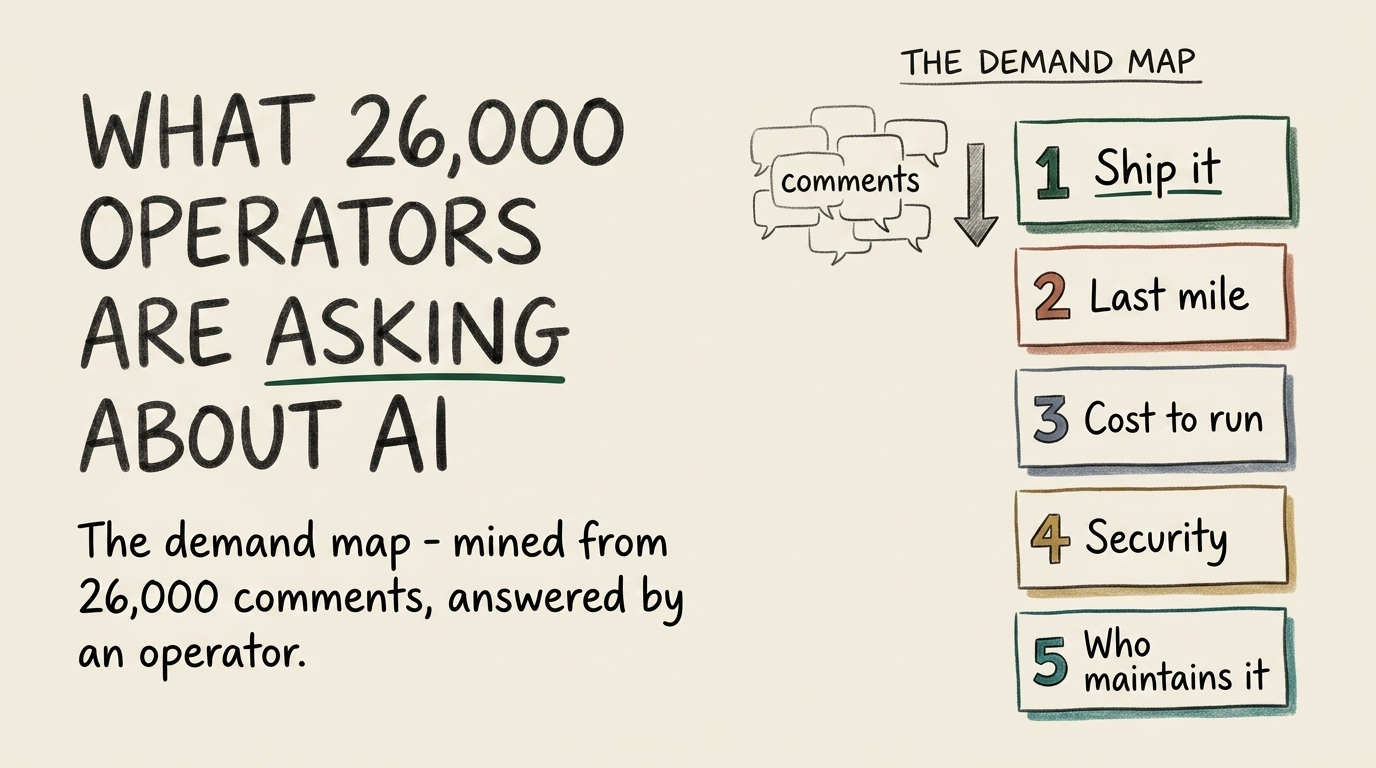
I went through about 26,000 comments across five channels where people building AI in public show up — senior engineers and CTOs, automation-agency builders and freelancers, founders and operators. Each comment carries a like-count, so I could rank what the room cares about instead of what I assumed it did. I stripped out the bot and book-spam clusters and kept only substantive, traceable comments.
Here's the honest catch: most of these commenters aren't my buyer. They're builders trying to sell AI, not mid-market operators trying to run it. I almost dropped the whole dataset for that reason. Then I saw the pattern that makes it the most useful demand signal I have: the loudest builder pain is the buyer's pain, expressed from the other side of the same transaction. A builder says "I can build the workflow, I just can't ship it, host it, price it, or hand it off." A COO says "every pilot gets 95% done and nothing runs in production, and nobody owns it after." Same gap. Two ends of one deal.
So read this as a demand map with two layers. On the surface, it's what builders ask. Underneath, it's what your AI projects will run straight into — because the thing a builder can't deliver is the exact thing your vendor won't be able to deliver either. I run five companies on the answers — Sena, Precis, Gavel, TrueStandard, and GameTape — with co-founders, AI agents, and zero hired employees. No prompts here, just the map.
26,000
comments mined across 5 channels
10
questions that dominate the demand
508
likes on the question every demo skips
0
hired employees behind the answers
Where Do These Questions Come From?
The people asking these questions are builders, not buyers. That's the point: their loudest frustration is your buyer's pain, stated from the other side of the table.
The five channels span the whole AI-building spectrum: senior engineers and agent-infra builders, the wave of automation-agency builders and freelancers, and a more skeptical layer of founders and operators. Ranking by likes matters because it strips out my opinion. I'm not telling you what I think the market wants — I'm reading what thousands of people upvoted as the thing they're stuck on. The same themes recur across channels, which is how I know they're structural, not one creator's audience.
And the structure is consistent: the questions that get the most likes are almost never "which model is best." They're "how do I actually ship this," "what does it cost to run," "how do I make it safe," and "who keeps it alive after I leave." Those are not curiosity questions. They're the questions you ask when you've already built something and hit the wall between a demo and a system a business can run.
That wall is the whole game. A mid-market company doesn't fail at AI because the model isn't smart enough — the models are already good enough. It fails in the gap the builders are screaming about: the last mile, the run-cost, the security review, the maintenance. The rest of this guide is that gap, ranked.
AI
The next teardown, without checking back
About one a week from the five companies I run with co-founders, AI agents, and zero hired employees — what I changed, and the part that broke.
One click to unsubscribe.
The Demand Map: The 10 Questions
Ranked by how often each came up, weighted by likes. For each: what they're asking, and the one-line operator answer.
Delivery · Loudest demand
"How do I actually deliver this so it ships and sticks?"
Packaging a workflow as something a business runs, not a demo you hand over and hope sticks.
Operator answer: ship a fixed-scope system into production with a daily demo, not a file dump.
▲ 47 "We need a video on how to really deliver this workflows to clients."
Last mile
"How do I get an agent into production and keep it alive?"
The last mile: hosting, orchestration, where the thing actually runs.
Operator answer: the last mile is the deliverable, not an afterthought.
▲ 23 "Most videos ignore the 'last mile' of delivery… how do I host the entire workflow?"
Cost
"What does this actually cost to run — per month?"
Variable token cost that finance can't approve.
Operator answer: budget agents against a fixed monthly number; cost becomes a budget line, not a meter.
▲ 168 "Code is free… eyeing my blown out claude bill as eyes tear up."
Security
"How do I make this safe — security, PII, compliance?"
The wall Legal raises after the build.
Operator answer: security is step one, built inside your environment.
▲ 508 "It is shocking… that not once the security concern was raised."
Proof
"Is this a real system, or just another demo?"
Demo fatigue, burned by impressive things that never run.
Operator answer: every claim ties to a number from a company I actually operate.
▲ 90 "show me the MRR or show me the door."
Architecture
"Who owns the architecture so it doesn't rot?"
AI-built code that compounds into chaos nobody understands.
Operator answer: the operator designs the system, agents execute; discipline goes up, not down.
▲ 151 "If we just let AI add code at 10x speed… 10x chaos."
Credibility
"Does anyone actually build this, or just teach frameworks?"
Exhaustion with talk.
Operator answer: this is the wedge — I build and run five companies, not slide decks.
▲ 95 "'Talk is cheap' sums up this video for sure."
Maintenance
"Who maintains it after the builder leaves?"
No AI team in-house to keep it running.
Operator answer: the recurring tier is the offer — operated month over month.
▲ 15 "a successful agency is paid for Reliability (the maintenance)."
Adoption
"Why do our AI projects stall — the model or us?"
The owner is the real bottleneck.
Operator answer: the audit does the organizing the rollout actually needs.
▲ 38 "the BUSINESS OWNER has to… be willing to take the time."
Moat
"Where's the moat if the tools are commoditized?"
Everyone's building the same thing.
Operator answer: the operating layer for one specific company is the moat; the tools inside it aren't.
▲ 67 "if 80% of apps go away and models are commoditized, where will the value be in software?"
Notice what's missing from the top of the list: hype. Nobody with likes is asking "what's the newest model." They're asking how to make the boring thing run reliably, safely, and at a predictable cost. That's the demand. The next section pulls out the four that don't just shape the project — they decide whether it happens at all.
The 4 Questions That Kill the Deal
Four of the ten aren't curiosity — they're procurement blockers. If you can't answer cost, security, the last mile, and maintenance, the project dies after the demo no matter how good it looked.
Cost
Variable, usage-based billing finance can't approve.
Answer: Fixed-scope build + a predictable monthly run-cost.
Security
GDPR, PII, SOC 2 — the wall Legal raises after the build.
Answer: Step one, built inside your environment.
The last mile
Builders can demo; few can host, hand off, and keep it alive.
Answer: Ends in production, with a daily demo.
Maintenance
Month two, when it needs operating and there's no AI team.
Answer: The recurring tier: operated month over month.
Cost. Variable, usage-based billing is a hard procurement blocker, not a footnote. The room is full of "unjustifiable bills" and "blown out" budgets — and a COO can't take "depends on usage" to finance. The operator move is to price the build as a fixed-scope deliverable and the run as a predictable monthly number you budget against, so cost reads like a line item, not a meter.
Security. The single most-liked comment in 26,000 was "It is shocking in this conversation that not once the security concern was raised" (508 likes), trailed by a 251-like agreement. GDPR, PII, SOC 2, credential handling — this is the wall that kills deployment after the fact. So it's step one, not a final-week scramble: built inside your environment, with data handling and a safe-handoff checklist as part of the deliverable.
The last mile. "The building problem is basically solved. What's still broken is the execution side" (17 likes) is the most quietly important line in the dataset. Builders can demo; almost none can host, hand off, and keep an agent alive in production. For a buyer, that's the difference between a pilot and a system. The implementation tier ends in production, with a daily demo in a shared channel — the last mile is the offer.
Maintenance. "Not maintainable… a nightmare to support" and "a successful agency is paid for Reliability (the maintenance)" (15 likes) name the part nobody budgets. The expensive moment isn't the build; it's month two, when the thing needs operating and there's no AI team. That's exactly why the recurring tier exists — operated and improved month over month, not handed over and abandoned.
Nobody Builds the Thing — They Teach It
The most-liked sentiment across the founder channels is exhaustion with people who teach AI without operating anything. That isn't a content niche. It's the whole positioning, handed over verbatim.
Watch what the crowd upvotes when someone presents AI strategy without having run it. On a marquee "how to build a company with AI" talk, the top comment was "Is yc trying to convince others or themselves?" (353 likes). Right behind it: "'Talk is cheap' sums up this video" (95 likes), and "Sometimes I wonder if anyone from YC has ever run a company that isn't selling software or digital fluff" (4 likes), and the blunt "It is not based on actual experience."
You can't buy this positioning; the market is handing it to you. The thing it's starved for isn't another framework or another deck — it's someone who has built and operated the system talking about how it runs, with the parts that break left in. The credible proof gets massively upvoted; the theory gets dunked on.
That's the entire reason the Operator Method leads with operation, not instruction. I don't teach AI. I run five AI-native companies with co-founders, AI agents, and zero hired employees, and everything I'd install in your company is already running in one of mine. Architecture you can inspect, not slideware. When the loudest demand in the room is "show me someone who's actually done it," the answer is to be that someone.
How Do You Read Your Own Demand?
You don't need 26,000 comments. You need the questions your own team and market repeat — ranked by frequency × value, then pointed at the highest one.
The method that produced this map is the same one I use to decide what to build inside a company, just pointed at a different corpus. You can run it on your own demand this week:
Collect the real questions
Support tickets, sales-call objections, the Slack question asked every week.
Rank by frequency × value × fit
How often, how valuable, how automatable. The loudest, most automatable one wins.
Point AI at the top function
The boring repeated workflow, not the impressive strategy bot. Frequency compounds.
Answer with a system, not a demo
Ship a fixed-scope thing into production, then operate it so it improves.
One commenter put the conclusion better than I could: "the boring stuff is where the money actually is. i spent months trying to sell fancy ai agents when the businesses just wanted their invoices processed automatically" (60 likes). The highest-frequency, lowest-glamour function is almost always the right first build.
Going deeper on selection:
The full scoring rubric — industry × function × size, the frequency × value grid, and how I score a workflow before I build it — is in Where to Point AI First. This guide tells you what the market is asking; that one tells you which question to answer first inside your company.
How I Answer These Across Five Companies
These aren't slides. Each of the five companies I run is a standing answer to one of the questions above — running in production, not waiting in a demo.
The reason I trust this map is that I live on the answers. Categories only — the architecture, not the prompts:
- Sena (event concierge) answers the last-mile question — intake, routing, and follow-up running in production over chat, no human in the loop.
- Precis (expert-health consensus) answers "is it real, at scale?" — scoring agreement and disagreement across thousands of expert sources, not a one-off demo.
- TrueStandard (verification) answers the security and trust question — a council of models that flags fabricated claims before they ship; governance, not blind autonomy.
- Gavel (cited frameworks) answers "frameworks vs. real" — output grounded in real citations with explicit tradeoffs, the opposite of a confident guess.
- GameTape (executive coaching) answers the maintenance question — ambient capture turned into daily debriefs, a long-running system operated continuously rather than handed off.
And the cost question gets answered the same way across all five: I run them on deliberately high API spend — token-maxing, not headcount-maxing — because every dollar of tokens replaces several dollars of the team I'd otherwise have to hire. Zero hired employees behind all of it. The bill is the cheapest line item I have.
If you want the architecture in depth, the teardown is here: How I Run 5 Companies with Zero Hired Employees — the build order and the operating primitives behind each one.
Where to Start in Your Company
The demand map points almost every mid-market company at the same first move: take the highest-frequency, highest-value function that's stuck in the last mile, and build a system that ships.
You now have the two halves of the picture. The map tells you what the market is stuck on — shipping, cost, security, maintenance — and the method tells you how to find the one question worth answering first inside your own walls. What's left is to answer it with a system instead of a demo, the way the whole dataset is begging someone to.
That's the work I do: take the function that's bleeding the most time, build the operating system that runs it, and operate it so it compounds. If you want to see how that gets scoped and built, start with the teardown below, or apply for an audit.
Frequently Asked Questions
Where does the 26,000-comment number come from?
Roughly 26,000 substantive YouTube comments across five AI channels — aiDotEngineer, nateherk, nicksaraev, Y Combinator, and YC Root Access — mined against each video's summary, with every comment carrying a like-count so the demand could be ranked by what the room cares about. Bot and book-spam clusters were filtered out. Every quote in this guide is verbatim and traceable to a real comment and video.
The commenters are builders, not buyers — why does that matter to an operator?
Because builder pain is the buyer's pain from the other side of the same transaction. A builder saying "I can build the workflow, I just can't ship it, host it, price it, or hand it off" is the same gap a COO feels as "every pilot gets 95% done and nothing runs in production, and nobody owns it after." The builders are a high-resolution proxy for exactly what kills mid-market AI projects.
What is the single thing that kills most mid-market AI projects?
The last mile. The building problem is largely solved; getting an agent into production and keeping it alive — hosting, handoff, observability, and a predictable monthly run-cost — is where projects die. In the Operator Method the last mile is the deliverable, not an afterthought, and the recurring tier is operating it month over month.
Will you share the prompts and code behind your answers?
Architecture yes, IP no. You get the maps, the categories, and the build order. The prompts, configs, and agent code are the moat — yours get built for you and they stay yours.
How do I get this built for my company?
It starts with an audit: a fixed deliverable that maps where to point AI first and in what order to build your own AI Operating System, with the ROI math. Apply at agrahri.com.
Want this built for your company?
The demand map says the same thing for most mid-market companies: there's a high-frequency function stuck in the last mile. I take a few audits a month — a fixed deliverable that maps which one to build first, and the order to build your own AI Operating System.
Apply for an audit