What Should a Mid-Market Company Fund in AI? 190 Talks Say: Not the Tool
The tool explains under 1% of output change. The org decides the rest.
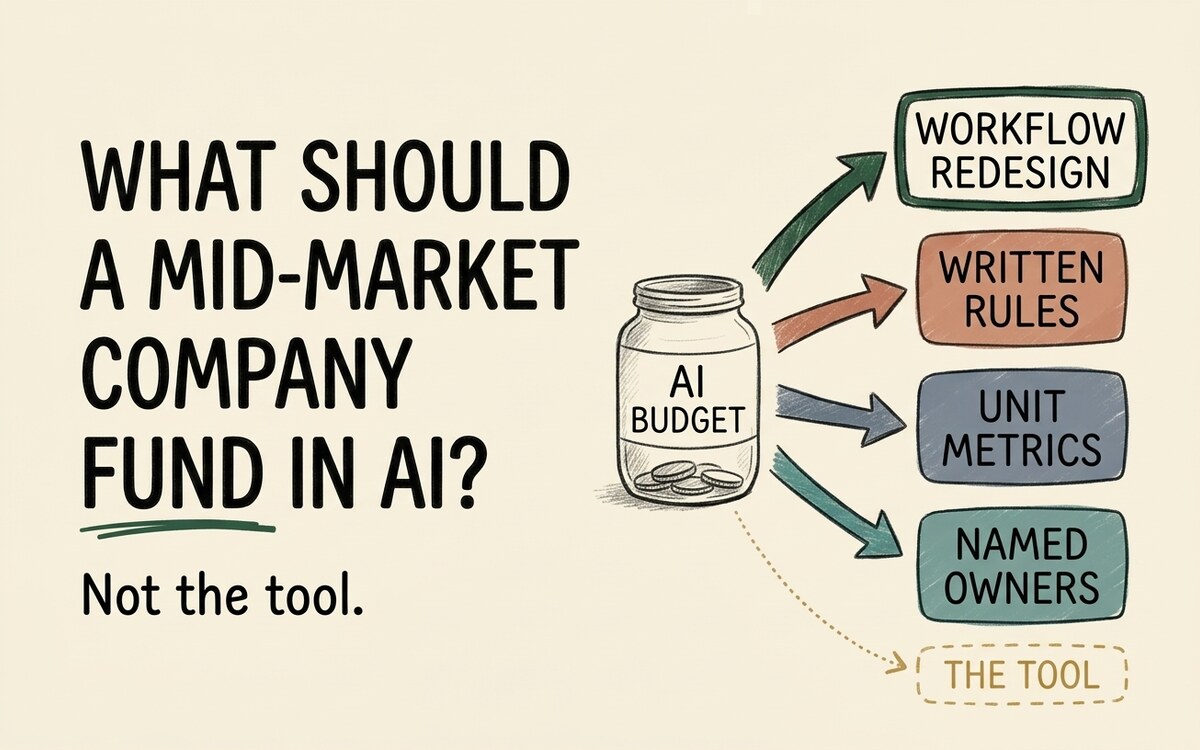
Table of Contents
If you hold an AI budget this quarter, stop funding model swaps or extra copilot seats. Jellyfish analyzed about 50,000 engineers across 447 companies Nicholas Arcolano, Jellyfish 05:07 and found the AI tool explains less than 1% of PR throughput change Nicholas Arcolano, Jellyfish 06:26. I call this The 1% Rule: the AI tool explains under 1% of output change, while org design, encoded procedures, and value metrics decide the rest. Almost 90% of businesses use AI, yet only 6% report significant EBIT impact, so this quarter's budget split decides which group you join Adam Nahari, Apollo 01:38.
What actually moves output when a team adopts AI?
Individual craft, company processes, and encoded workflow rules move output far more than which model or harness you buy. Jellyfish's telemetry puts the tool dead last among five measurable drivers Nicholas Arcolano, Jellyfish 05:28 Nicholas Arcolano, Jellyfish 06:34.
Nicholas Arcolano tested model impact using a natural experiment inside Jellyfish's dataset. When Cursor promoted Grok in its interface, Grok share surged fast across developers Nicholas Arcolano, Jellyfish 03:23. Merged pull requests per engineer showed zero statistical correlation with that switch Nicholas Arcolano, Jellyfish 04:26.
Self-directed tool changes looked the same. Engineers switching between Opus, Sonnet, and ChatGPT, or moving from Cursor to Claude Code, produced what Arcolano calls "kind of a nothingburger" Nicholas Arcolano, Jellyfish 08:06.
| Productivity driver | Share of PR throughput change | What it covers | Source |
|---|---|---|---|
| The tool (harness and model) | Less than 1% | Model family and coding harness | Nicholas Arcolano, Jellyfish 05:28 |
| How well you use it | About 3% | Skill use, rules, and harness setup | Nicholas Arcolano, Jellyfish 06:34 |
| How much you use it | 9% | Raw token spend and active usage days | Nicholas Arcolano, Jellyfish 06:34 |
| Where you work | 12% | Company codebase, review flow, and team | Nicholas Arcolano, Jellyfish 06:34 |
| You, the individual | Three quarters | Craft carried by each engineer | Nicholas Arcolano, Jellyfish 11:52 |
Skills sit at 3% overall only because most teams ignore them. Almost half of engineer weeks in Jellyfish's sample had essentially no skill use, and only 12% hit high skill usage Nicholas Arcolano, Jellyfish 09:10. Engineers reaching 30 plus skill runs per week saw a 30% throughput bump holding other factors constant Nicholas Arcolano, Jellyfish 09:53.
Environment matters just as much at fixed spend. Holding token consumption constant, Jellyfish measured a 2x spread between top 10% and bottom 10% companies Nicholas Arcolano, Jellyfish 12:04. About two-thirds of that environment factor belongs to the company and one-third to the team Nicholas Arcolano, Jellyfish 11:20.
Individual spread reaches 3.5x between bottom 10% and top 10% engineers Nicholas Arcolano, Jellyfish 13:25. AI did not scramble talent rankings: "best engineers before AI by and large are still your best engineers." Nicholas Arcolano, Jellyfish 13:59.
Arcolano adds one caveat: this model measures PR throughput with no quality metric Nicholas Arcolano, Jellyfish 06:34.
AI
The next teardown, without checking back
About one a week from the five companies I run with co-founders, AI agents, and zero hired employees — what I changed, and the part that broke.
One click to unsubscribe.
Why don't personal 100x gains reach company output?
Personal speed gains stall at company handoffs because human review capacity, missing process rules, and downstream merge queues absorb the extra drafts. Writing plausible output became cheap while knowing whether to trust it stayed expensive Laurie Voss, Arize AI 04:17.
Laurie Voss at Arize AI quantifies the gap directly. Developers using autonomous coding agents write 741% more code, eight times as much, yet ship only 30% faster Laurie Voss, Arize AI 03:02. Human review accuracy drops sharply past about 450 lines of code per hour, so massive diffs pile up Laurie Voss, Arize AI 03:50.
Telemetry across broader teams confirms that bottleneck. Faros observational data covering more than 10,000 developers in 1,255 teams showed high AI adoption teams merged 98% more pull requests, while review time jumped 91% and PR size grew 154% Soukaïna Abelhad 01:15. McKinsey also sees defect and incident trends worsening on a per-PR basis when generation outruns review standards Martin Harrysson & Prakhar Dixit, McKinsey 11:55.
Dropping human review breaks production. Dex Horthy spent 6 months advocating no code review before reversing course after having to rip and replace systems, and Amazon now requires senior engineer sign-off after agent-related outages Laurie Voss, Arize AI 06:11. On Cognition's benchmark, pass rates dropped from 87% on unit tests to 54% when asking whether a maintainer would merge the PR Laurie Voss, Arize AI 07:14.
Even after fixing code review, the next queue fills up. At Harvey, after 10,000 agent-written PRs Joey Wang, Harvey 00:20, PR volume jumped around 60% in one month and merge times stretched from 15 to 30 minutes to over an hour Joey Wang, Harvey 10:15. Eugene Cheah calls unverified agent dumps "slop grenades" because downstream reviewers spend hours untangling or rebuilding bloated drafts Eugene Cheah, Featherless AI 38:10 Eugene Cheah, Featherless AI 41:20.
The same ceiling hits non-engineering work. Basis co-founder Mitchell Troyanovsky says his own productivity rose "maybe 100x" while enterprise output barely moved Mitchell Troyanovsky, Basis 01:07. He names two blockers: a competency gap that forces regular staff to manage agent memory, and a process gap that lets each person invent ad-hoc methods Mitchell Troyanovsky, Basis 03:21 Mitchell Troyanovsky, Basis 04:24.
Companies scale through repeatable procedures, not individual heroics. As Troyanovsky puts it, "Nobody wants their agent to move 37 their tax return." Mitchell Troyanovsky, Basis 18:28. Meanwhile, Apollo notes that individual time savings equal about 2% of total US working hours Adam Nahari, Apollo 02:00, yet general copilot gains get competed away in price rather than staying in margin Adam Nahari, Apollo 03:41.
Which one or two workflows do you redesign first?
Pick one or two repeatable, high-cost workflows with a named owner and an agreed baseline, then redesign the full process end-to-end. Businesses seeing material EBIT impact are three times as likely to redesign an entire workflow as to adopt a standalone tool Adam Nahari, Apollo 04:53.
Three layers make up enterprise AI: general copilots, domain retrieval, and core operational AI embedded in defining workflows Adam Nahari, Apollo 03:30 Adam Nahari, Apollo 04:26. As Adam Nahari explains, margin stays in layer three because competitors cannot buy your process change off the shelf Adam Nahari, Apollo 04:42.
Nahari filters candidates down to one or two problems, not 40 Adam Nahari, Apollo 05:30. A qualifying workflow moves a line the CFO recognizes, has an upfront baseline, uses company-owned data, has one named champion, and sits in the CEO's top five priorities Adam Nahari, Apollo 06:42.
| Organization | Workflow redesigned | Reported outcome | Source |
|---|---|---|---|
| Cargo airline (Apollo case) | Consolidated flight, crew, and maintenance data into a cost-ranking re-crewing engine | Cut re-crewing from 15 minutes to less than a minute | Adam Nahari, Apollo 15:06 |
| Fortune 200 asset manager (Nori Agentic) | Event-triggered cloud agent checks changed security-master cells across PDFs, Bloomberg, and email | Cut an hour of manual checks to 5 minutes of human work | Amol Kapoor & Clifford Ressel, Nori Agentic 13:54 |
| GEICO claims tech | AI war room mapped legacy rentals systems and shipped an agent-callable API | Identified a change saving eight and a half thousand calls per month | Ford Prior, GEICO 06:31 |
| Range wealth management | Certified planners encoded cash flow and insurance reviews into drafting skills | Built 24 skills in six months, 17 in planning, with zero coding | Matthew Ragone, Range 06:22 |
| Top enterprise software teams (McKinsey) | Rebuilt engineering flow and team structure around agent loops | Top 20 to 25% of surveyed firms see 2x end-to-end gains | Martin Harrysson & Prakhar Dixit, McKinsey 02:18 |
Notice the pattern across every case above. GEICO used a one-day war room with a thousand dollars in tokens because engineers previously had "only 25% on a good day or less" for major upgrades Ford Prior, GEICO 03:02 Ford Prior, GEICO 05:35. Top McKinsey clients replaced two-week scrums with one-day to two-day agent loops and shrank teams into "Pods of two to four" Martin Harrysson & Prakhar Dixit, McKinsey 05:26 Martin Harrysson & Prakhar Dixit, McKinsey 07:26.
In back-office operations, avoid chasing the hardest or flashiest workflow first. Range planner Matthew Ragone recommends picking manual work you repeat every week where an expert can spot a bad draft at a glance Matthew Ragone, Range 03:45 Matthew Ragone, Range 04:15. At Nori Agentic, Amol Kapoor advises aiming for 95% automation with a human review step, because chasing 100% end-to-end autonomy fails in finance Amol Kapoor & Clifford Ressel, Nori Agentic 17:52.
Before writing code, do Paden Gayle's week-one discovery. Shadow the operator, draft the smallest useful spec, and name the owners of data, model risk, third-party risk, and audit by Friday Paden Gayle, Applied AI Engineers 01:02 Paden Gayle, Applied AI Engineers 05:15 Paden Gayle, Applied AI Engineers 06:18. Otherwise you hit the wall Gayle warns about: "The demo worked. The model was fine. It still did not ship." Paden Gayle, Applied AI Engineers 14:33.
What do you measure instead of usage?
Stop tracking seat logins, lines of code, or raw token bills as success metrics. Track fully loaded unit cost per accepted output alongside quality counterweights and pre-agreed kill gates Steve Jamison, Jellyfish 15:45 Adam Nahari, Apollo 12:58.
Raw usage creates false confidence. Vals AI reports 90% regular AI use across enterprises yet only 7% with established ROI Rayan Krishnan, Vals AI 02:47. As Arize AI's Laurie Voss puts it, "741% more code was never the point." Laurie Voss, Arize AI 26:07.
Jellyfish's Steve Jamison shows how to reconcile rising token bills for a CFO. Across Jellyfish's platform, AI spend jumped 60x year over year while merged PRs per engineer climbed 43% Steve Jamison, Jellyfish 00:22. Combining engineer salary and AI spend into one bucket revealed that AI accounts for about 2 and 1/2% of a merged PR's cost while salary is 97 and 1/2% Steve Jamison, Jellyfish 03:37.
In that combined bucket, dollar cost per merged PR fell 26% over the year Steve Jamison, Jellyfish 04:15, dropping at 83% of studied companies Steve Jamison, Jellyfish 04:38. The heaviest-spending fifth of companies posted a 67% throughput gain and a 32% drop in cost per PR, compared to around 40% throughput and about a 25% cost drop for peers Steve Jamison, Jellyfish 06:05 Steve Jamison, Jellyfish 06:43. Revert rates did not spike, though PRs carried more lines of code Steve Jamison, Jellyfish 10:27 Steve Jamison, Jellyfish 10:52.
Jamison sums up the reporting shift: "The bill tells you what you spent. Cost per PR tells you whether it worked." Steve Jamison, Jellyfish 16:24. Per-token pricing also misleads without task-level measurement. On Vals AI's tax benchmark, Opus 5.5 listed at $4 and $20 versus Fable 5.1 at $10 and $50, yet Opus 5.5 cost more per task with a 3% lower score because "the less intelligent model is trying to expend more tokens" Rayan Krishnan, Vals AI 03:56.
For vendor decks or internal automation claims, Soukaïna Abelhad applies three checks. First, compare workload volume against fully loaded human labor including reviewers, trainers, and rework Soukaïna Abelhad 01:41. Second, separate "AI attributed" from straight-through completion inside a named boundary because "AI attributed and autonomous are two different claims." Soukaïna Abelhad 03:00.
Third, audit how quality is graded. Meta found a 24% point gap between automated graders and human merge decisions across 296 AI-generated PRs Soukaïna Abelhad 03:12. Abelhad's target metric is cost per accepted autonomous task, charging failed, escalated, and reworked tasks directly to the cost side Soukaïna Abelhad 05:20.
Outside engineering, tie measurement to live baselines and kill gates. Contour Asset Management, a 15 to 20 person fund with 6 billion AUM Hari Kumar, Contour Asset Management 00:12, runs live A/B tests against no-AI earnings cycles Hari Kumar, Contour Asset Management 03:25. They track "cost per useful insight" Hari Kumar, Contour Asset Management 11:21 while subtracting hours lost fixing connectors that break every couple days Hari Kumar, Contour Asset Management 16:48.
Apollo enforces three upfront kill gates on every pilot: a 90-day time gate, an A/B metric gate against an agreed baseline, and an adoption gate above 50% of target users Adam Nahari, Apollo 13:25. The CFO tests whether full scale costs stay well below projected impact Adam Nahari, Apollo 13:25.
Should you buy agents or build them?
Buy models, document parsing, and agent runtimes from vendors, and build your own company context, workflow skills, and task evals. Spending engineering time on shared tooling takes hours away from work that adds revenue.
Datasite learned that lesson on document extraction. The platform handles 60% of transactions over $100 million Adit Abraham, Reducto & Raj Bakhru, Datasite 00:43 and 55,000 data rooms a year Adit Abraham, Reducto & Raj Bakhru, Datasite 03:43. Early on, CTO Raj Bakhru's team built its own parsing pipeline, then drowned in edge cases like chart legend colors, merged Excel cells, and macro-enabled files Adit Abraham, Reducto & Raj Bakhru, Datasite 05:37 Adit Abraham, Reducto & Raj Bakhru, Datasite 06:57.
Datasite replaced its homemade parser with Reducto and measured recall improving 22% on its internal VDR bench Adit Abraham, Reducto & Raj Bakhru, Datasite 19:22. Bakhru notes that "most of the work actually is on the extraction side." Adit Abraham, Reducto & Raj Bakhru, Datasite 19:22. Outsourcing parsing freed his 250 engineers to focus on five revenue-generating projects Adit Abraham, Reducto & Raj Bakhru, Datasite 15:20.
| Stack layer | Default move | Evidence from talks | Source |
|---|---|---|---|
| Frontier models and document parsing | Buy | Datasite cut homemade parsing for Reducto and saw recall improving 22% | Adit Abraham, Reducto & Raj Bakhru, Datasite 19:13 |
| Company context, skills, and approval gates | Build in-house | GEICO keeps context, methods, and judgment gates in two internal repos | Ford Prior, GEICO 08:39 |
GEICO drew the exact same boundary. Ford Prior treated the vendor harness, model, and modernization plugin as replaceable parts, while keeping GEICO's context, software standards, methods, and decision gates inside two internal repositories Ford Prior, GEICO 08:47. Under that setup, "developing software looks less like playing in a canvas and more like working in a factory." Ford Prior, GEICO 11:22.
Nori Agentic recommends the same split for back-office automation. Run generic coding or cloud agents on one vendor-managed orchestration and security layer, while your company owns the natural-language markdown instructions, tools, and triggers Amol Kapoor & Clifford Ressel, Nori Agentic 14:56 Amol Kapoor & Clifford Ressel, Nori Agentic 17:02. Prathik Naidu at Long Lake notes that external vendors rarely capture tacit operational judgment from the outside, which makes internal ownership of workflow rules essential Prathik Naidu, Long Lake 02:05.
Because laptops cap at five to 10 agents Joey Wang, Harvey 01:04, Harvey built its cloud platform Spectre so about 460 employees could share one environment Joey Wang, Harvey 00:42. Heavy operational overhead showed up fast: git checkouts took over a minute Joey Wang, Harvey 06:27, and one engineer queued about 950 tasks from a laptop Joey Wang, Harvey 08:38. An alert storm also launched around 900 agents in about four hours Joey Wang, Harvey 08:07.
Unless you operate at Harvey's concurrency, building a custom harness from scratch is wasted effort Eugene Cheah, Featherless AI 49:44. Put your build hours into internal benchmarks and workflow context instead.
Who owns each agent?
Every production agent needs one named human sponsor who owns its job description, budget, permissions, and errors, backed by a separate reviewer. Treating agents as unowned software leaves companies blind to fleets running on shared credentials Tim Tyler, Gravitee 00:13 Aiden Sochowski, Runlayer 00:12.
Runlayer discovered how fast agent sprawl grows when it audited itself. At 50 to 60 people, Runlayer found over 300 agents running every day across chatbots, triggers, and SaaS apps Aiden Sochowski, Runlayer 01:42. Most firms have zero central visibility into what those agents read or write Aiden Sochowski, Runlayer 00:28.
Unowned agents break budgets and security fast. At Runlayer, a recruiting team vibe-coded an untested MCP server that burned tokens looping on formatting errors, and switching a workflow from GPT-5.6 Luna to Fable 5.1 pushed costs up over 100x within a week Aiden Sochowski, Runlayer 14:24. Runlayer now logs every tool call through a gateway, restricts writes tightly so one poisoned agent cannot contaminate others, and scores calls with classifiers for intent drift Aiden Sochowski, Runlayer 00:12 Aiden Sochowski, Runlayer 08:02 Aiden Sochowski, Runlayer 11:10.
Employee-style governance fits agents better than static software rules, as Tim Tyler at Gravitee argues Tim Tyler, Gravitee 01:15. Each agent under his Agent Accountability Framework gets a unique registry ID Tim Tyler, Gravitee 03:14 and a named human sponsor for spend and incident calls Tim Tyler, Gravitee 04:35. Its authority also stays bounded to the narrowest scope in its delegation chain Tim Tyler, Gravitee 08:48.
Quarterly human reviews cannot keep up with agent speed. As Tyler warns, waiting for a quarterly check leaves you "about 40,000, 400,000, 4 million decisions too late to have that discussion." Tim Tyler, Gravitee 14:13. Automated guardian checks must enforce rules continuously, such as suspending access after five violations in a day Tim Tyler, Gravitee 16:03. Kim Maida at Keycard adds that teams should replace static API keys with OAuth token exchange so every call traces back to a verified user with narrowed scopes Kim Maida, Keycard & Mason Egger, Temporal 01:59.
Ownership splits cleanly across three levels:
- Executive P&L sponsor: Apollo will not fund an initiative without public CEO commitment, and pairs technical leaders with the business P&L owner Adam Nahari, Apollo 09:07 Adam Nahari, Apollo 10:13.
- Domain skill owner and separate reviewer: At Range, planners, marketers, and salespeople own and update their skills because "a skill that was right in March can be wrong by December." Matthew Ragone, Range 06:36 Matthew Ragone, Range 07:27. A second peer always reviews changes before rollout Matthew Ragone, Range 06:22.
- Shared factory or guardrail owner: Patrick Debois sees larger teams forming a factory team to maintain shared skills and logs Patrick Debois, Tessl 19:43, while Harvey puts day-one circuit breakers on scheduled agents so five consecutive failures shut an automation off automatically Joey Wang, Harvey 10:45.
What can a $2M-$50M company copy now, and what can wait?
A $2M-$50M company can copy written markdown skills, split API keys, draft-only autonomy, and unit-cost tracking this month. Skip self-hosted GPU clusters, custom foundation models, and complex inference routing until your scale forces them Eugene Cheah, Featherless AI 02:21.
Five practices from these talks work immediately with a small team:
- Split API keys by department and workflow. Between 30 and 40% of Featherless AI's incoming customers ran on one shared API key Eugene Cheah, Featherless AI 03:52. Separate keys show spend by team, and giving staff functional labels like "fast" or "finance agent" instead of raw model names lets you swap models centrally Eugene Cheah, Featherless AI 19:25.
- Encode domain skills in plain English. Use Range's five-step method: pick a frequent manual task, narrate your judgment across real cases, pack the required questions and limits into a skill, test it five to 10 times, and ship it with an owner and reviewer Matthew Ragone, Range 03:38 Matthew Ragone, Range 04:26 Matthew Ragone, Range 05:30.
- Start at the draft rung of autonomy. Paden Gayle's autonomy ladder runs from suggest, to draft, to acts with approval, to full action Paden Gayle, Applied AI Engineers 09:26. Keep humans checking source evidence and clicking submit until live error logs justify more authority Paden Gayle, Applied AI Engineers 10:29.
- Write a one-page behavior spec and simulate cheaply. Basis defines its top opinions in a short behavior spec Mitchell Troyanovsky, Basis 12:01. Before building cloud replay infrastructure, ask a coding agent to role-play your production agent and test context edits in minutes Mitchell Troyanovsky, Basis 15:39 Mitchell Troyanovsky, Basis 15:56.
- Put leadership hands on the tools. Leaders cannot redesign workflows they have never tested.
Four investments can safely wait:
- Token optimization below 10K a month. Featherless AI advises teams spending less than 10K a month to focus on strong use cases rather than shaving token rates Eugene Cheah, Featherless AI 02:33.
- Self-hosted open models and custom training. On Vals AI's internal eval, hosted GPT-5.6 Soul beat self-hosted Kimiko 3 by 2% Rayan Krishnan, Vals AI 12:35 at $2.50 versus $11 and in half the time Rayan Krishnan, Vals AI 12:43. Fine-tuning at AT&T call-center scale Eugene Cheah, Featherless AI 24:15 or pre-training a transaction foundation model at Wells Fargo Freddy Lecue, Wells Fargo 10:01 requires enterprise volume.
- Custom cloud agent clusters and speculative merge trains. Harvey built Spectre for hundreds of staff and 10,000 PRs Joey Wang, Harvey 00:20, and Patrick Debois admits multiplayer factories are still early: "We're not there yet." Patrick Debois, Tessl 20:52.
- Recursive self-improving agent loops. LinkedIn and Arize both stress that automated prompt-editing loops require calibrated, human-aligned evaluation infrastructure first Saloni Gandhi & Ziwei Guo, LinkedIn 33:43 Fuad Ali, Arize AI 05:38.
One honest gap stands out across these talks. None of the talks published audited P&L numbers from a $2M-$50M traditional operations company running non-engineering agents.
From the Operator's Desk: how my companies encode judgment
I run five companies (Sena, Precis, Gavel, TrueStandard, and GameTape) with co-founders and AI agents and zero hired employees: no W2 staff and no recurring contractors. Operating with zero payroll tests The 1% Rule every single day. Better models help on the margins, while written judgment, deterministic checks, and clear authority limits carry the actual workload.
Across eight of my repos there are 1,058 written lesson files, one per gotcha an agent or I hit, and every one of those repos has a one-command verifier (bin/verify) that my agents run before they commit.
My companies run on standing approvals where Rails deploys are pre-approved and paid model spend is capped at $5 per run. When an automated permission check blocks an agent's command, a decision model gives its verdict before the question reaches me. Production data writes, anything sent or posted, and spending above the cap still need my explicit go.
The conference talks get the core diagnosis right. Output follows org design, clear specifications, and automated verification, while raw code volume or model shopping distracts leadership Nicholas Arcolano, Jellyfish 15:04 Laurie Voss, Arize AI 25:32. Range's written firm skills Matthew Ragone, Range 02:07 and Gravitee's hard deterministic boundaries Tim Tyler, Gravitee 10:44 match how my repos work in practice.
Where the conference falls short is scale bias. Plain markdown lesson files, a one-command verifier (bin/verify) that agents run before they commit, a $5 run cap, and a short list of human-only actions deliver control immediately.
Here is what I would execute this month in a $2M-$50M company:
- Choose one workflow and write its kill gates. Pick one repeatable operational process that moves a line your CFO tracks, name one business owner, and set 90-day time, baseline, and adoption gates Adam Nahari, Apollo 06:34 Adam Nahari, Apollo 12:58.
- Turn tacit judgment into files. Have your best operator narrate real cases into a written skill, test it five to 10 times, and add a new lesson file after every miss Matthew Ragone, Range 04:26 Matthew Ragone, Range 05:42.
- Write standing approvals on one page. Cap spend per run, pre-approve low-risk drafts, and require explicit human approval for production data writes and anything sent or posted externally.
- Track unit cost, not seats. Issue separate API keys per department Eugene Cheah, Featherless AI 03:26 and review fully loaded labor plus token cost per accepted output every month Steve Jamison, Jellyfish 15:09.
Frequently asked questions
When should a mid-market company start optimizing its AI token bill?
Wait until your monthly AI spend crosses 10K a month before optimizing inference costs. Featherless AI advises teams below 10K a month to focus on high-value workflows instead of squeezing token prices Eugene Cheah, Featherless AI 02:21. Jellyfish data supports that priority: AI tokens average about 2 and 1/2% of total merged PR cost compared to 97 and 1/2% for salary Steve Jamison, Jellyfish 03:37.
Should non-engineers build AI agents for their own departments?
Yes, when they encode repeatable workflows and pair every skill with a separate reviewer. At Range, certified financial planners, marketers, and salespeople wrote and maintained 24 skills in six months without writing code Matthew Ragone, Range 07:02 Matthew Ragone, Range 07:27. Keep engineers reviewing custom API connectors so untested servers do not trigger expensive error loops like Runlayer saw Aiden Sochowski, Runlayer 13:20.
Can AI code reviewers replace human sign-off on production changes?
No, automated reviewers miss bugs and cannot replace human sign-off on high-risk code today. Arize AI reports that four AI reviewers tested on the same code found real bugs with zero agreement on any individual bug Laurie Voss, Arize AI 05:19. Amazon mandates senior engineer sign-off after agent outages, so reserve human review for high-blast-radius changes Laurie Voss, Arize AI 06:23 Laurie Voss, Arize AI 25:07.
How do you audit a vendor claiming "70% automated" workflows?
Apply Soukaïna Abelhad's three technical due-diligence checks before signing a contract. First, compare workload volume against fully loaded human labor including reviewers and rework Soukaïna Abelhad 01:41. Second, ask for the straight-through rate with zero human intervention inside a named boundary Soukaïna Abelhad 02:33. Third, check whether human reviewers match the vendor's automated grader Soukaïna Abelhad 03:12.
What guardrails stop an autonomous agent from burning budget or breaking production?
Combine per-run spend caps, failure circuit breakers, and explicit human approval for irreversible actions. Across my five companies, paid model spend is capped at $5 per run, while production data writes and anything sent or posted require my explicit go.
Want agents that survive production?
I take a few audits a month: a fixed deliverable that maps which operational functions in your company an agent could carry, what it takes to run them reliably, and the order to build them into an AI Operating System you own — with the ROI math to defend it.
Apply for an audit