The Agent Operator: The Only AI Job That Compounds
"Learn AI" is the wrong instruction. When anyone can run an agent, the value moves to the person who runs the system around it. This is the operating manual for that role — what an Agent Operator does all day, the five-job Operator Stack that makes you hard to replace, and how it runs across five companies I operate with zero hired employees.
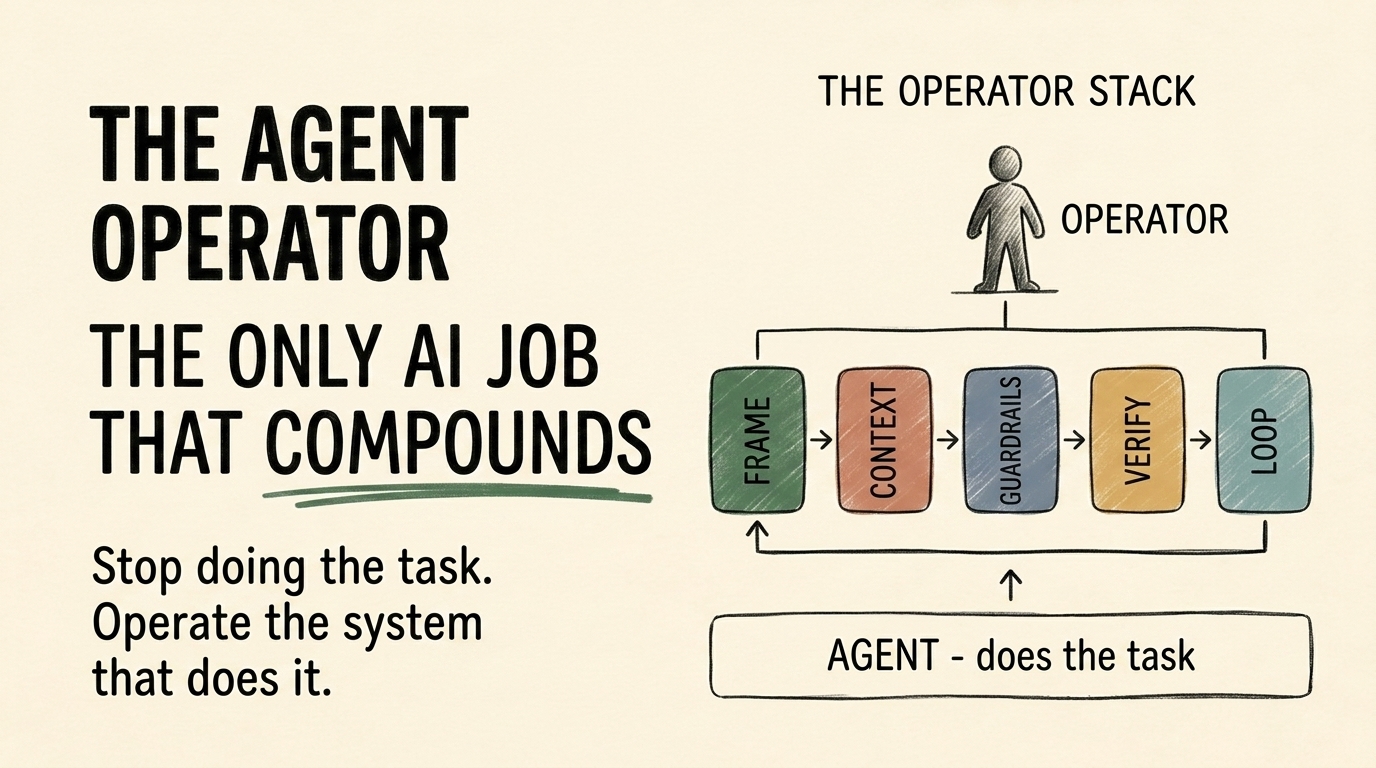
Table of Contents
I keep a cache of YouTube comments from the channels where people build AI in public — roughly 26,000 of them across six channels, each carrying a like-count so I can rank what the room is anxious about instead of what I assume. When I read that cache for one thing — what people are asking about themselves, not the tools — the same cluster dominates. Not "which model is best." The questions are about the person: "learn" shows up in about 201 comments, "skill" in 174, "job" in 109, and "replace" in 81. People aren't asking what AI can do. They're asking what they should become.
The most-upvoted version of the fear says it cleanly. One comment, 87 likes: "they are so nicely asking for all knowledge workers to pack their skill which is their own IP, and give it to Claude in a markdown file so you are no longer needed." Another, 150 likes: "I knew if I followed you long enough technology would surpass my inability to learn." That's the dread under the whole AI conversation — that the work you know how to do is being packed into a file, and then so are you.
Here's the part that fear gets half-right. The doing — the task — really does get packed into a file and automated. But somebody still has to decide what to pack, what the agent is allowed to touch, how you know its output is right, and how it gets better next week. That somebody is the Agent Operator. The fear describes a doer's job disappearing. It also, accidentally, describes an operator's job appearing. I run five AI-native companies — Sena, Precis, Gavel, TrueStandard, and GameTape — with co-founders, AI agents, and zero hired employees, on that second job. This is the manual.
201
cache mentions of "learn" — the loudest human question
81
mentions of being "replaced" — the fear
5
companies run on the Operator Stack
0
hired employees behind it
What Is an Agent Operator, and Why Is It the Only Role That Compounds?
An Agent Operator designs, governs, verifies, and improves the system that does the work — instead of doing the work. It's the only role that gets more valuable as models improve, because better models automate the task and leave the operating.
Start with what the role is not. It isn't "someone who's good with ChatGPT," and it isn't a prompt engineer — typing a clever input is one tiny slice of the job, and it was the first slice better models ate. An Agent Operator owns the whole system around a task: the spec, the company knowledge, the permissions, the proof it worked, and the way it improves. The doer asks "how do I do this work?" The operator asks "how do I build something that does this work reliably, forever, without me watching?"
I call the operator's job the Operator Stack — five moves that, unlike the task itself, don't pack neatly into a markdown file: Frame (turn intent into a spec), Context (encode the company's judgment), Guardrails (set permissions and approval gates), Verify (build the check you trust), and Loop (read failures, improve the system). Sections 3 and 4 are that stack in detail. The reason it compounds is structural: each move is judgment about your business, not capability in the model — so a smarter model makes the doing cheaper and the operating more leveraged at the same time.
One clarification before we go deeper, because the words are close. This is not a labor-market forecast — the macro math on which jobs shrink and which appear is its own piece: the real math on AI and jobs, drawn from 100 a16z videos. This guide is the other altitude entirely: the first-person operating manual for the one role that sits on the right side of that math, written from running it across five companies rather than predicting it.
AI
The next teardown, without checking back
About one a week from the five companies I run with co-founders, AI agents, and zero hired employees — what I changed, and the part that broke.
One click to unsubscribe.
Why Does "Doing the Work" Get Automated but "Operating It" Doesn't?
The task is the commodity. The judgment about the task — what "good" means here, what the agent may touch, how you trust the output — is the moat. Models supply the first and never the second.
The cache has a comment that, whether or not its number is right, gives away the whole game. 24 likes: "YC says that one manager can replace 400 engineers with a few Silicon Valley tokens that cost a few bucks." Look at the survivor in that sentence. The thing that scaled to 400× wasn't the doing — it was the operating. The manager didn't get replaced; the manager got leveraged. Every honest version of the "AI replaces work" story has the same shape: the task collapses in cost, and the person who directs and checks the task becomes the constraint.
Why does doing collapse? Because a task is a function from input to output, and that is exactly what a model is built to absorb. The better the model, the more of that function it eats. Prompt engineering went first because it's the thinnest layer of operating — one input, one task. The deeper layers don't go, and it's worth being precise about why. Four things a model cannot get from being smarter:
- Your definition of "good." A Sena follow-up that sounds like us; a TrueStandard claim that's safe to ship. The model can write a thousand; it can't know which one is right for you without being told.
- Permission. What the agent may read, write, and send — and where it must stop and ask a human. That's a business decision about risk, not a capability.
- Verification. A check the agent isn't grading itself on. An agent that grades its own homework isn't a worker; it's a confident guess.
- The loop. Reading what broke yesterday and changing the system. The model doesn't know your failures matter until someone wires that feedback in.
Each of those is judgment about your business. None of them improves when the model does. So the asymmetry is the whole point: a better model is bad news if your value is doing, and good news if your value is operating. The fear in the cache — "pack your skill into a file and you're no longer needed" — is true for the doer and exactly backwards for the operator, who is the one doing the packing, the gating, the checking, and the improving.
What Does an Agent Operator Actually Do All Day?
Not the task. Five jobs that sit above it — the Operator Stack: Frame, Context, Guardrails, Verify, Loop. Run all five and the agent does the work; skip one and you get a demo that breaks in week two.
Frame
Intent → an executable spec: inputs, definition of done, out of scope.
Context
Encode the company judgment the model can't infer.
Guardrails
Permissions + approval gates. Human at the edge.
Verify
A check you trust on output you didn't watch.
Loop
Read failures, improve the system every cycle.
Frame. You take a fuzzy goal — "keep our event attendees warm" — and turn it into something an agent can execute: the inputs it gets, what "done" looks like, what's explicitly out of scope. You keep the what and the why; you hand over the how. Most failed agents fail here, not in the model — a vague frame produces confident nonsense at scale.
Context. You hand the agent the company-specific judgment it can't infer — the pricing exception, the tone, the "we don't do it that way because we got burned in 2023." This is the exact thing the 87-like comment was afraid of: your IP, packed into a file. The difference between dread and leverage is who holds the pen. The doer packs it once and becomes redundant; the operator curates it forever, because the exceptions never stop changing. Encoding context is not a one-time export — it's the job.
Guardrails. You decide what the agent may read, write, and send, and where it has to stop and wait for a person. Human at the edge, not in the loop — you're not approving every step, you're approving the few that carry real risk. Get this wrong in either direction and the system is useless: too tight and it can't act, too loose and it sends the thing it shouldn't.
Verify. This is the one most "build an agent" advice stops right before. You build the check that lets you trust output you never looked at. A senior engineer in the cache described it without naming it (55 likes): "when it doesn't [work] we ask it to learn from the mistakes and improve the skill for next use. Compound engineering at work." The verify step — a test the agent doesn't get to grade itself on — is the entire difference between a worker and a hallucination wearing a worker's clothes.
Loop. You read what broke and change the system so next week is better. The operator's real output isn't any single task — it's a thing that does the task a little better every cycle. That compounding is why one operator can run what used to take a department.
Don't confuse the two "stacks":
The Operator Stack here is the five things the human does. The Agent Operating Stack — AGENTS.md, skills, MCP, A2A, sub-agents — is the five machine components those jobs wire together. If you want the plumbing layer, that's a separate teardown: the 5 AI agent terms every operator should know.
Which Skills Actually Make You Hard to Replace?
Each layer of the Operator Stack replaces a role a company used to hire for — and each gets more valuable, not less, as the agent gets stronger. Stack one and you're useful; stack three and you're the person every team wants.
Frame
Replaces the spec-writer who turned intent into tickets.
Why it compounds: As the agent does more, clear intent is the bottleneck — and only a human holds it.
Context
Replaces tribal knowledge locked in senior heads.
Why it compounds: The model never learns your exceptions on its own. Curating them is permanent work.
Guardrails
Replaces the manager who decided who's allowed to do what.
Why it compounds: More autonomy means more need for someone who sets the edges and the stop points.
Verify
Replaces QA and the reviewer.
Why it compounds: The more the agent produces, the more the trust-check becomes the constraint.
Loop
Replaces the ops lead who improved the process.
Why it compounds: Compounding only happens if someone closes the loop. The model won't do it unprompted.
The leverage comes from stacking. One layer makes you useful inside a team. Two gives you real independence. Three and you can run an entire function alone — which is the threshold where you stop being an employee and start being an operator. The cache says this out loud, 22 likes: "When you learn how to do this, do NOT use it to work for another company. BUILD YOUR OWN. Stop trying to work for someone else and start working for yourself."
That's not motivation — it's just the math of the stack. The same five skills that make you hard to replace inside someone else's company are the complete operating system for running your own. I know because that's the whole trick behind the next section: five companies, all five jobs, none of these roles hired.
How Does This Run Across Five Companies, Zero Employees?
I'm not describing a role I read about. I run the Operator Stack across five companies — Sena, Precis, Gavel, TrueStandard, GameTape — with co-founders, AI agents, and zero hired employees.
The proof that this is a real job and not a LinkedIn title is that my whole week is the five jobs and none of the task. Concretely, the system I operate runs on 52 playbooks built, none by hand; 15 cron jobs that run the loop on a schedule; 59 automated tests that gate what ships; roughly 40 posts a week the stack drafts; and 5,969 lines of self-audit the system keeps on itself. Every one of those is Frame, Context, Guardrails, Verify, or Loop made concrete. None of it is me doing the underlying work.
Two of the companies are a layer of the stack turned into a product, which is the clearest way to show the job is real:
- TrueStandard is the Verify layer, productized — a council of models that flags fabricated claims before they ship. I built a business out of the exact step most agent advice skips.
- GameTape is the Loop layer, productized — ambient capture turned into daily debriefs, a system that improves continuously instead of being handed off and left to rot.
- Sena (event concierge) is Frame plus Guardrails in production — intake, routing, and follow-up running over chat, with the edges set so it never sends the wrong thing to the wrong person.
And the cost question answers itself the same way each time: I run deliberately high API spend — token-maxing, not headcount-maxing — because a dollar of tokens replaces several dollars of the team I'd otherwise hire to do the task. The reason one person can operate five companies isn't more hours. It's that every hour goes into operating and none goes into doing. The doing is tokens.
The full architecture is its own teardown — the build order and primitives are in how I run five companies with zero hired employees, and the production-grade Verify and Loop patterns are in every agentic engineering hack I know, with the seven-layer reliability architecture broken out in The 7-Layer Reliable Agent.
Where Do You Start? Your First Rep as an Operator
One small project trains all five jobs at once: a daily briefing agent you come to depend on. Build the small reliable thing, not the all-knowing one.
Here's the rep I'd hand anyone trying to become an operator. Build a daily briefing agent for yourself. Give it three sources — your calendar, a folder of notes, a few saved links — and one job: tell you what matters today, what decisions are waiting on you, and what follow-ups you owe people. Then add a single rule: it must show its sources and ask for approval before it sends anything.
It sounds small. It is the entire Operator Stack at desk scale. You Frame when you define what "matters today" means. You wire Context when you choose the three sources. You set a Guardrail with the approval-before-send rule. You build Verify by forcing it to cite sources. And you Loop every morning when you correct it and it gets sharper. The mistake almost everyone makes is reaching for the all-knowing mega-agent first; it collapses, and they conclude the technology isn't ready. The technology is ready. The operating discipline is what they skipped.
And the rep does something the demos can't: it dissolves the fear. A comment I keep coming back to, 20 likes: "I was genuinely afraid of losing my job over AI. But watching your videos helped me understand the true power of these tools." Understanding doesn't come from watching — it comes from running one small loop until you trust it. The fear is a doer's fear. The rep is the thing that turns you into an operator, who has the opposite problem: not enough hours to point the leverage everywhere it could go.
The best part is the input you're worried you lack, you already own. The scarce ingredient isn't the model — it's the judgment about your own work, and that's the one thing the model will never have and you can't lose. More on that idea here: what it means to be AI-native — the people, agents, and context layers underneath all of this.
What If You're a Company, Not an Individual?
If the most valuable individual skill is operating agents, the most valuable thing a company can buy is the operating system — because you can't hire an Agent Operator who already knows your business. You have to build one on your context.
Most mid-market companies read all of the above and reasonably ask: great, where do I find this person? The honest answer is you mostly can't, and not because they're rare. The role barely has a title yet, and the part that creates the value — your pricing exceptions, your tone, your guardrails, your definition of "good" — isn't on anyone's résumé. It's in your senior people's heads. A new hire can bring the five skills; they can't bring your Context, and that's the half that matters.
So the company version of "become an Agent Operator" is "install the Operator Stack on your own context." Take the function bleeding the most time, capture the judgment that's trapped in heads, set the guardrails, build the verification, and close the loop — until that function runs as a system instead of a person. That's exactly the work I do: not teaching your team to prompt, but standing up the operating layer and running it until it compounds. Which function to point it at first is its own decision — the rubric is in where to point AI first.
The skill that makes an individual hard to replace is the same system that makes a company hard to compete with. I built it for my own five companies first. Now I build it for mid-market operators who'd rather own the operating system than rent the doing.
Frequently Asked Questions
What is an Agent Operator?
An Agent Operator is the person who designs, governs, verifies, and improves the system that does the work — instead of doing the work themselves. The job is five repeatable moves, the Operator Stack: Frame (intent into a spec), Context (encode the company's judgment), Guardrails (permissions and approval gates), Verify (a check you trust on output you didn't watch), and Loop (read failures, improve the system). It's the one role that gets more valuable as models improve, because better models automate the task and leave the operating.
Is an Agent Operator just a prompt engineer with a new name?
No. Prompt engineering is one input to one task — the thinnest slice of operating, and the first thing better models ate. An Agent Operator owns the whole system around the task: the spec, the company context, the permissions, the verification, and the improvement loop. A prompt is a sentence; the Operator Stack is a standing system that keeps producing trustworthy work without you watching it.
Do I need to know how to code to become an Agent Operator?
No. The scarce inputs are judgment about the work and the discipline to run the five jobs — what "good" means for this business, what the agent may touch, how you know the output is right. The model writes the code. I run five AI-native companies on this, and the binding constraint has never been typing speed; it's how clearly the work is framed and how well it's verified.
Won't better AI models make the Agent Operator unnecessary?
It's the opposite. A better model absorbs more of the task — the doing — which is exactly why doing stops being valuable. It does not supply your company's definition of good, your permission boundaries, or a check it isn't grading itself on. Those are judgment about your business, not capability in the model. So every model improvement raises the operator's leverage and lowers the doer's value. "Better AI" is bad news if your value is doing and good news if your value is operating.
I run a company and can't hire an Agent Operator. What do I do?
You can't hire one off a résumé, because the part that matters — your company's judgment, exceptions, and guardrails — lives in your senior people's heads, not on anyone's CV. So you install the Operator Stack on your own context: capture the judgment, set the guardrails, build the verification, and close the loop on the function bleeding the most time. That's the audit and the build. Apply at agrahri.com.
Want the Operator Stack built into your company?
You can't hire an operator who already knows your business — so you build one on your own context. I take a few audits a month: a fixed deliverable that maps the function to point AI at first, and the order to install the Operator Stack on it.
Apply for an audit