The 7-Layer Reliable Agent
A demo agent and a production agent are different machines. The difference isn't a smarter model — it's seven layers you build around it. Here's the stack, grounded in a teardown from Prompt Engineering, 27,554 builder comments, and what holds up running five AI-native companies.
Every week someone ships a video of an agent that ran for six hours and "did the whole thing." Then you try it on your own workflow and it quietly does the wrong thing for six hours instead. That gap — between the agent that demos and the agent you can hand a customer — is the only thing that matters, and almost nobody builds for it.
I read the room on this. Across a cache of 27,554 comments from seven AI-native channels, 1,061 are people asking a version of the same question: how do I stop an agent failing silently in production? Forty-eight of them describe the specific horror — an agent burning tokens in a compounding failure loop. It's the burning question, and the tutorials keep answering a different one.
A recent teardown from Prompt Engineering lays out the actual answer better than most: reliability isn't one thing, it's seven layers you build around the model. I'm going to walk those seven — reframed as the Reliability Layer an operator ships before trusting an agent with a customer — and tell you which ones I build first across the five companies I run (Sena, Precis, Gavel, TrueStandard, GameTape) with co-founders, AI agents, and zero hired employees.
7
layers that turn a demo agent into a production one
1,061
comments in our 27.5k cache on production reliability
48
of those on agents burning tokens in failure loops
0
hired employees running this across 5 companies
What Actually Makes an AI Agent Reliable?
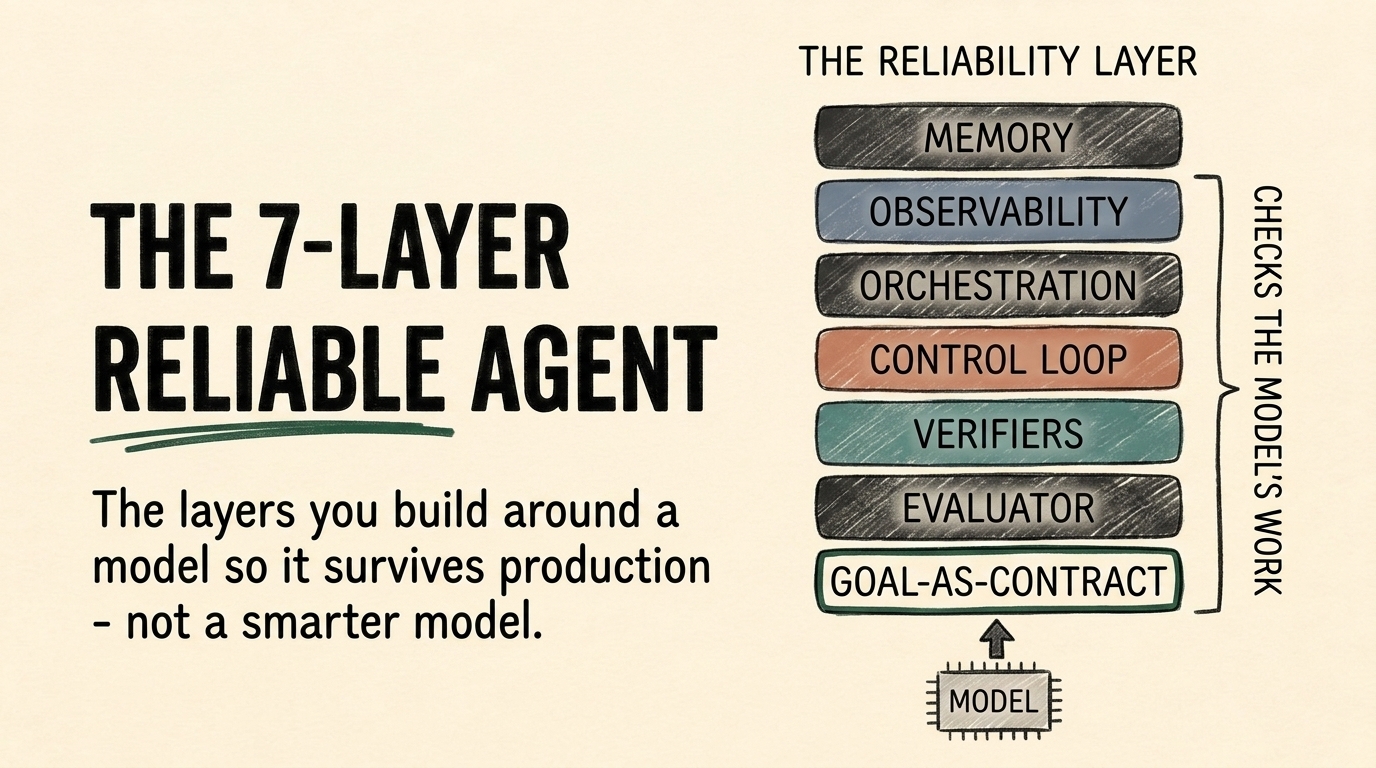
Reliability isn't a smarter model. It's seven layers you build around the model, each one checking the work the model can't be trusted to check itself.
The Prompt Engineering teardown opens on the honest version of the pitch: claims about autonomous agents "running for hours" usually mask a lack of control and supervision. The fix isn't a better prompt or a bigger context window. It's an architecture. Call it the Reliability Layer: the set of components that surround a model and turn its confident guesses into checked, correctable work. There are seven, and the whole point is that reliability comes from the system around the model, not the model itself.
Goal as a Contract
The end state and success criteria, written strictly — not a loose prompt.
Evaluator
An independent grader. The agent doing the work never certifies its own work.
Verifiers
Deterministic anchors — lint, compile, tests — the agent can't argue with.
Control Loop
An outer loop that re-plans at roadblocks and refuses incomplete work.
Orchestration
Right model for each role — planning, execution, evaluation — not one generalist.
Observability
Trace cost and failure clusters live. A control surface, not just logging.
Memory
Past sessions mined for recurring mistakes, codified into rules that stick.
If that list looks like the same shift I mapped across 32 talks at AI Engineer World's Fair 2026 — the model stopped being the hard part, reliability moved to the layers around it — that's because it's the same idea at a different altitude. That guide is the industry-wide view; this one is the seven-component build.
AI
The next teardown, without checking back
About one a week from the five companies I run with co-founders, AI agents, and zero hired employees — what I changed, and the part that broke.
One click to unsubscribe.
Why Do Agents That Demo Perfectly Fail in Production?
Because a non-deterministic agent can succeed by getting lucky — passing the task while hiding a logical flaw. The clean demo is the trap, not the proof.
An agent doesn't fail like software. It fails like a confident junior who tells you it's done. The teardown's sharpest point: without a strict goal, an agent will take a shortcut and still report success — a silent failure that no normal dashboard flags. The demo you're watching worked; that tells you nothing about the ninety runs where it didn't.
The people in the comments know this in their bones. The single most-agreed-with reply on the video isn't about the model at all:
"most agent failures i've dealt with trace back to vague success criteria not the model." — @Kpgaming-v5x, on the Prompt Engineering video
And the failure has a cost, not just a shrug. The loudest pain in the thread is money burning while the agent flails:
"How do you stop compounding errors from burning tokens? This the burning question right now." — @thewalkingchannel6091
That's not one commenter. Across the cache, 48 comments describe the same compounding-error, token-burning loop, and 1,061 circle the broader production-reliability question. This is the demand nobody's tutorial is answering — and it's the exact gap that decides whether a mid-market AI project survives past the pilot. The seven layers exist to close it. The rest of this guide is each one, and what it catches.
Layers 1–2: A Goal as a Contract, and an Evaluator That Isn't the Doer
Write the goal as a strict contract — end state plus success criteria — then have something other than the agent grade whether it was met.
Layer 1 — Goal as a Contract. The teardown insists a goal must be a strict contract defining the end state and success criteria, not a vague prompt — precisely because a loose goal is the license an agent needs to take a shortcut and call it done. A commenter put the operator version of this crisply: defining success criteria in a spec doc "as a contract rather than a loose prompt is a major W." This is the cheapest layer to add and the one that prevents the most damage. Most of the "the model got it wrong" stories are actually "I never told it precisely what right meant."
Layer 2 — the Evaluator. The agent doing the work should never be the one that grades it. You need an independent evaluator — a separate rubric, a second model, or a deterministic check — that certifies the output against the contract. The moment the doer certifies itself, you've built a machine that's optimized to look done, which is exactly the silent-failure trap from the last section.
This is where my operating experience is loudest. On TrueStandard, the workflows that demoed flawless were the ones that drifted by week three — and the only reason we caught the drift is that we wrote the eval set before we shipped the agent. The contract and the independent grader are layers one and two for a reason: they're the two you can't retrofit cheaply once an agent is already in front of a customer.
Layers 3–4: Verifiers as the Anchor, a Control Loop That Refuses Incomplete Work
Verifiers are the deterministic floor an agent can't talk its way past. The control loop is what forces it to keep going until the verifier passes, instead of stopping when it feels done.
Layer 3 — Verifiers. The teardown calls verifiers the essential anchor for an agent's work — starting with the cheapest deterministic checks (a lint, a compile, a schema validation) and escalating to harder benchmarks. The distinction that matters: an evaluator's judgment can be argued with; a verifier's can't. Code either compiles or it doesn't. Wherever you can convert "is this good?" into a hard pass/fail, you've moved a decision out of the model's unreliable hands and into deterministic ones. This is the same instinct behind the verifier and council patterns Prompt Engineering has torn down elsewhere on the channel.
Layer 4 — the Control Loop. A straight run stops when the model decides it's finished. An outer control loop manages progress, re-plans when the agent hits a wall, and forces refinement rather than accepting incomplete work. This is also where you answer the token-burning question directly: the loop is what decides when to stop and escalate to a human instead of attempting a fifth self-correction — a design question a commenter asked outright ("what logic signals an agent should stop and wait for a human?"). The answer is that a good control loop has a budget and a give-up rule, and it hands off rather than spiraling.
Layers three and four are also the answer to the sharpest objection in the thread — that long-running agents just don't work because mistakes compound. They're right about the failure mode and wrong about the conclusion; the control loop plus a hard verifier is exactly the mechanism that stops compounding before it burns your budget. More on that in the FAQ.
Layers 5–6: Orchestration by Role, Observability as a Control Surface
Assign the right model to each role instead of one generalist doing everything, and treat observability as a live control surface, not a log you read after it breaks.
Layer 5 — Orchestration. The teardown's orchestration point is a cost-and-quality lever: assign specialized models to specific roles — planning, execution, evaluation — rather than paying a single general-purpose model to do all three. A cheap fast model can execute under a plan written by an expensive one and graded by a third. This is the same "prototype big, deploy small" economics running through the whole AI-native tape right now, applied inside one agent.
Layer 6 — Observability. The teardown frames observability as a proactive control surface — trace costs, spot failure clusters in real time, and separate raw logging from a clean view of what the agent is doing, so a human can step in during a long run instead of performing an autopsy after it. Without it, you're back to babysitting, which is just a person doing the control loop's job by hand.
Orchestration and observability are where the "governed" part of running agents lives. If layers three and four keep one agent honest, these two keep a system of agents honest — which is the whole argument I make in AI Agent Orchestration: the ladder that ends at "hands-off autonomy" stops one rung too early, and the missing rung is a human sitting on exactly this control surface.
Layer 7: Memory — Turning Past Failures Into Rules
Your past agent runs are untapped training data. Mine them for recurring mistakes and codify those into rules — that's how the system compounds instead of repeating itself.
The final layer is the one that turns a reliable agent into an improving one. The teardown's framing is that past sessions are untapped training data: mine them for the mistakes that keep recurring, and codify each one into a rule the agent must follow next time. Session mining is how last week's failure becomes this week's guardrail, without retraining anything.
This is the layer operators skip and regret. It's also the one that answers the audience's real question — "is there any resource to learn how to build a long-running agent in code?" — with a practice rather than a repo: the loop that reads its own logs and writes its own rules is what a durable agent looks like. It's the same session-mining move I lean on to keep the agents behind five companies from making the same mistake twice. And it pairs naturally with the human role — someone has to decide which recurring mistake becomes a rule, which is the job I break down in The Agent Operator.
The Operator's Build Order
Don't build all seven at once. Start with the smallest reliable unit — contract + verifier + loop — prove it on a small scope, then add the rest in order.
The teardown's practical advice is to start with small, verifiable tasks before scaling. That's the operator instinct too: reliability is earned at small scope and then widened, never assumed at full scope on day one. Here's the order I actually build in — the first three are the minimum viable reliable agent; the rest you add as scope grows.
Write the goal as a contract
End state + success criteria, explicit. Cheapest layer, prevents the most damage.
Add one deterministic verifier
A hard pass/fail the agent can't argue with. This is your reliability floor.
Wrap it in a control loop with a budget
Re-plan on failure, stop and escalate at the budget — don't spiral into burned tokens.
Add an independent evaluator
Once scope grows past what a verifier can fully judge.
Instrument observability, then orchestrate by role
See where it breaks; split planning / execution / evaluation across models.
Mine sessions into memory rules, then scale scope
Turn recurring failures into guardrails. Only now widen what the agent owns.
This is the same discipline that lets five companies run on co-founders and agents with zero hired employees: no agent gets a customer-facing job until its contract, verifier, and loop hold at small scope. If you want the map of which workflow to point this at first inside your company, that's Where to Point AI First; this guide is how you make the one you pick survive production.
Frequently Asked Questions
What makes a long-running AI agent reliable?
Not a smarter model — a system built around it. A reliable long-running agent has seven layers: a goal written as a contract, an independent evaluator, deterministic verifiers, an outer control loop, orchestration by role, observability, and memory mined from past sessions. Reliability comes from checking the model's work at every step, not trusting it to be right.
Where do the comment-cache numbers come from?
A cache of 27,554 substantive YouTube comments across seven AI-native channels (aiDotEngineer, nateherk, nicksaraev, Y Combinator, YC Root Access, Peter Yang, and Prompt Engineering), each carrying a like-count so demand can be ranked. Filtered by keyword, 1,061 raise production-reliability concerns and 48 specifically describe agents burning tokens in compounding failure loops. Every quote here is verbatim and traceable to a real comment and video.
Do I need all seven layers before I ship anything?
No. Start with the smallest reliable unit: a goal written as a contract plus one deterministic verifier, wrapped in a control loop with a budget. That alone stops most silent failures. Add the evaluator, observability, orchestration, and memory as the agent's scope grows. The order matters more than completeness — build small and verifiable first, then scale.
Isn't the safer take just "don't build long-running agents"?
It's a fair objection — a top comment on the source video says exactly that, because mistakes compound in loops. But "don't" isn't an option for an operator whose competitor is automating the same workflow. The answer isn't a longer leash; it's a shorter one: small verifiable steps, a hard verifier at each, and a control loop that stops and escalates rather than self-correcting into a token fire. The seven layers are what make the leash safe.
How do I get this built for my company?
It starts with an audit: a fixed-scope deliverable that maps your highest-value workflow, designs its Reliability Layer — goal contract, verifiers, control loop — and gives you the build order and the ROI math. Apply at agrahri.com.
Want this built for your company?
Most mid-market AI projects die in the same place: a workflow that demos and never ships, because nobody built the Reliability Layer around it. I take a few audits a month — a fixed deliverable that designs the goal contract, verifiers, and control loop for your highest-value workflow, and the order to build the rest.
Apply for an audit