What It Actually Means to Be AI-Native
Everyone says "AI-native." Almost nobody means it. The real bar — people manage agents, agents read and write to the company, the company gets smarter — broken into the three layers and the two live workflows behind it, from an operator who runs five companies on it with zero hired employees.
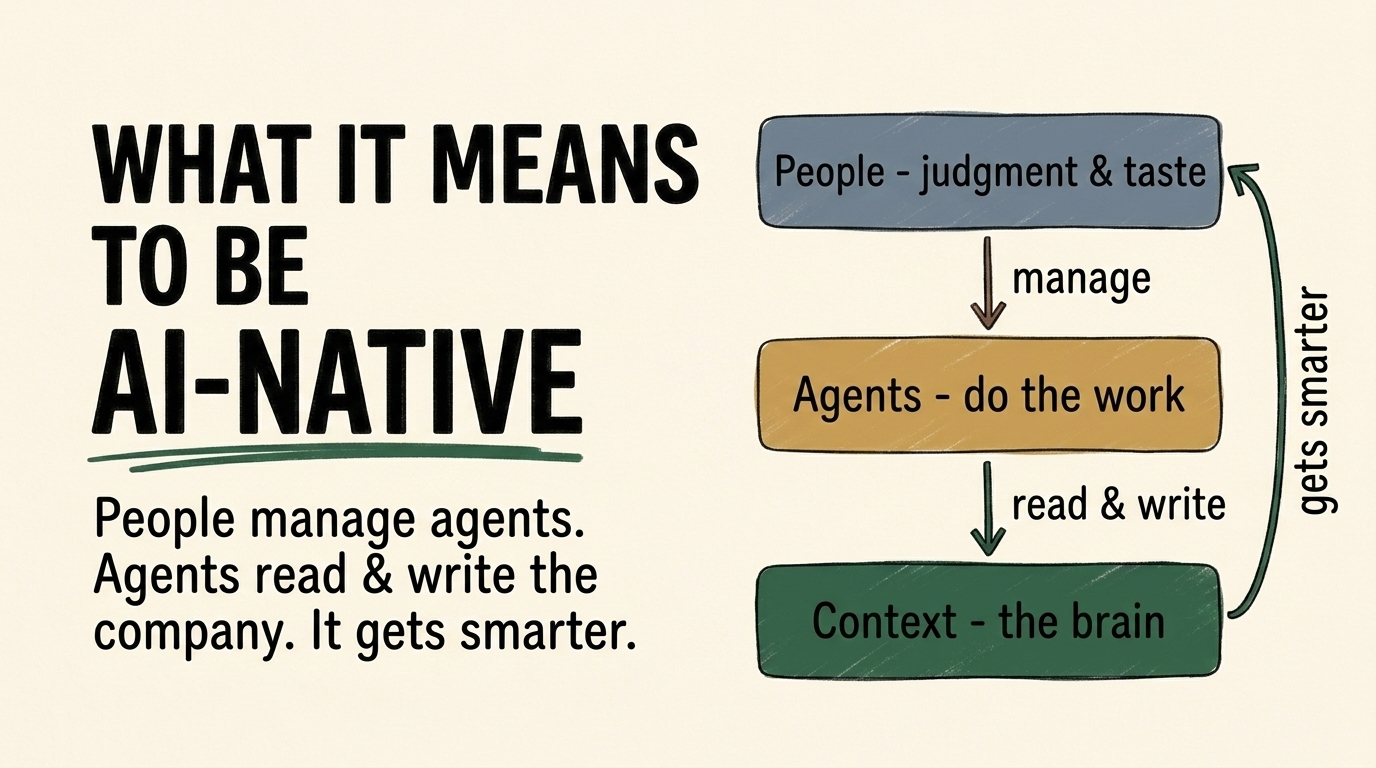
Table of Contents
"AI-native" has become one of those phrases everyone uses and almost nobody defines. I'll talk to a company that calls itself AI-native, look at how the work gets done, and find a few people pasting things into a chatbot. That's not nothing — but it isn't this.
Here's the definition I operate by: an AI-native organization is one where people manage agents, agents can read and write to the company, and the company gets smarter over time. It's built from three layers — people, agents, and context — and you feel it as speed to signal: you can produce almost anything in minutes, hear from the market fast, and feed that back so the system improves on its own.
I run five companies this way — Sena, Precis, Gavel, TrueStandard, and GameTape — with co-founders, AI agents, and zero hired employees. This is the linear version of what that means: the three layers, what each one does, and two real workflows that show the system turning into speed. No prompts, just the map.
3
layers that make a company AI-native
5
AI-native companies run on it
0
hired employees
95%
of AI pilots never reach production
AI-Native Is Not Using ChatGPT
Using a chatbot and calling yourself AI-native is like having a website and calling yourself a tech company. The gap between the two is the whole subject of this guide.
Let me be clear up front: using ChatGPT or Claude is good. If your team is doing it, that's a real start and I wouldn't talk anyone out of it. But it is the floor, not the bar. A person pasting a prompt into a chat window is using a tool. An AI-native company is something structurally different — the organization itself has been rebuilt so agents can operate inside it.
The tell is what happens when nobody's typing. In a company that "uses AI," nothing happens — the AI sits idle until a human prompts it. In an AI-native company, work is happening while you sleep: agents are reading new information, doing tasks, checking each other, and writing what they learned back into the company so tomorrow's run is better. The difference isn't how advanced the model is. It's whether the company is built for the model to act inside.
That structure is what the rest of this guide describes. It comes down to three layers stacked on top of each other — people, agents, and context — and a loop that ties them together. Get the three layers right and "AI-native" stops being a slogan and starts being how the work moves.
AI
The next teardown, without checking back
About one a week from the five companies I run with co-founders, AI agents, and zero hired employees — what I changed, and the part that broke.
One click to unsubscribe.
The Three Layers: People, Agents, and Context
People sit on top for strategy, taste, judgment, and trust. Agents do the work. Context is the company made readable to agents. The whole system is those three layers and the loop between them.
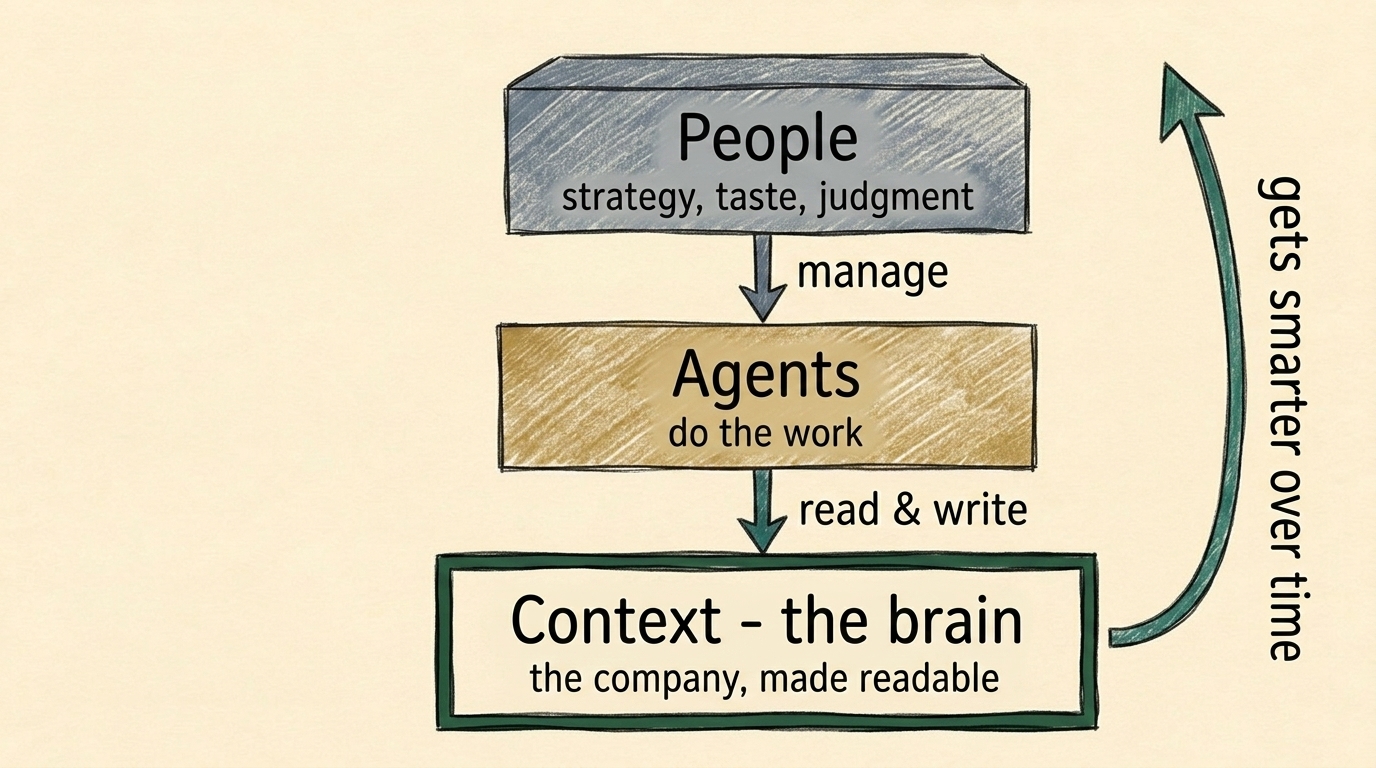
Picture three layers. At the top, people — for strategy, taste, judgment, and the trust that has to sit with a human. In the middle, agents — interfacing with the company's information on the people's behalf, doing the actual work. At the bottom, context — the shared layer that makes your company legible to those agents, so they have something close to perfect vision of what the company is and how it works.
Read the definition through those layers and it clicks. People manage agents — that's the top layer doing its job. Agents can read and write to the company — that's the middle layer reaching into the bottom one. The company gets smarter over time — that's the loop: every time an agent acts, the result flows back into the context layer, and the next agent that reads it is a little sharper. Three layers, one loop.
The rest of this guide is one section per layer — people, agents, context — then two workflows that show all three working together, and finally what it looks like when it's running a company. Let's start at the top, because there is no AI-native company without AI-native people.
People: Why AI Eats the Middle
Most of your people's work used to be execution in the middle. AI eats the middle. What's left — and what becomes more valuable — are the bookends: judgment up front, review at the end. Everyone becomes a manager.
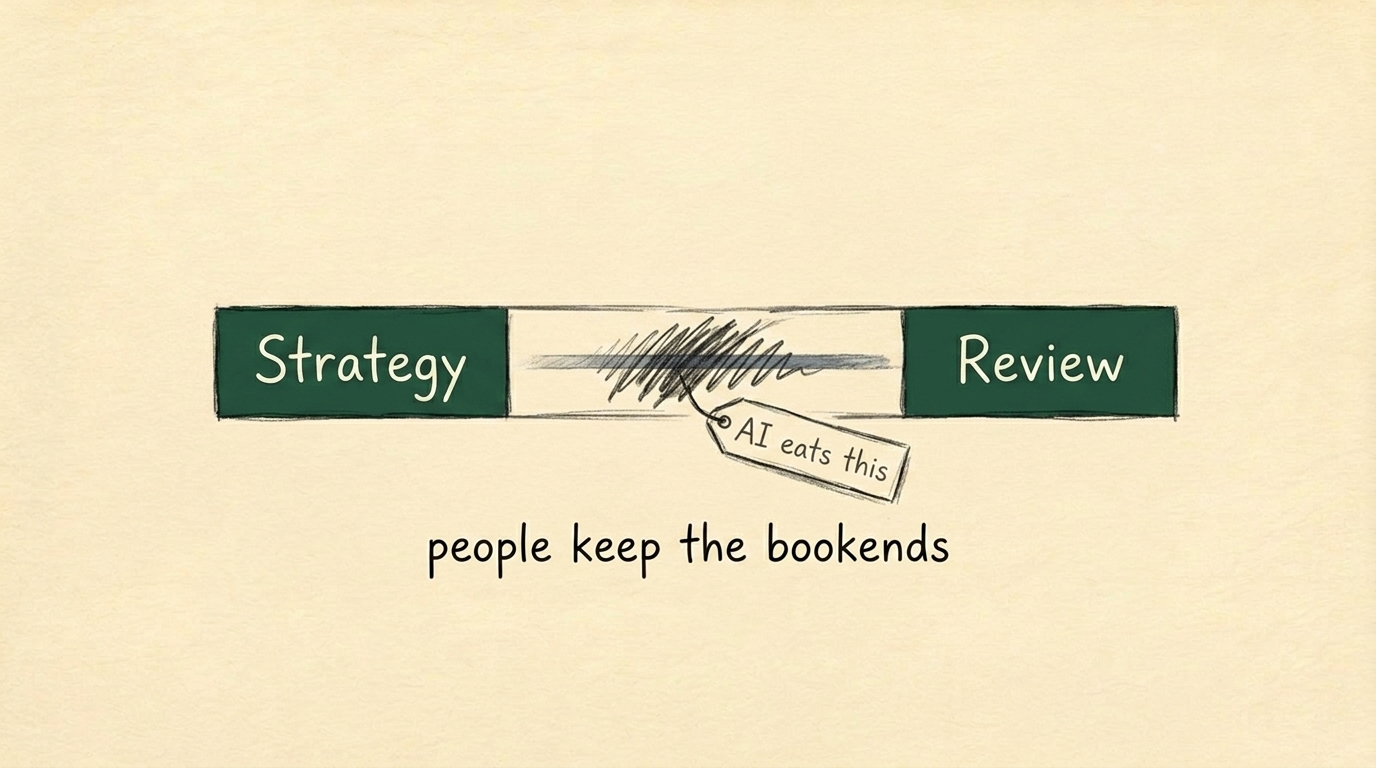
Think about how a piece of work used to flow. A little time up front figuring out what to do — the strategy. A lot of time in the middle doing it — the execution, the research, the drafting, the grind. And a little time at the end reviewing it — is this good enough, who needs to see it, what changes. Most of the hours lived in the middle.
AI eats the middle. The execution that used to take the bulk of the time now happens on an agent's behalf, fast. What's left are the bookends — and the bookends were always the valuable part. Deciding what's worth doing takes taste. Deciding whether the output is good takes judgment and accrued knowledge. Those are exactly the things that make a senior person senior, and they're what people get freed up to spend all their time on once the middle is handled.
So the reframe is simple and total: everyone becomes a manager. Not of people — of agents. Your job is to set agents up for success the way a good manager sets up a team: a clear goal, the right resources, a way to check the work. Andy Grove, who wrote the book on management, said a manager's output is the output of their team. In an AI-native company that's true, except the team is a stack of agents, and a strong operator can direct an enormous amount of work without it routing through their own two hands.
This is also why the people layer comes first. You can buy every tool and stand up every agent, but if your people don't understand how to manage agents, none of it matters. The technology isn't the unlock. The reframe is.
Agents: Goal, Skills, Tools, Context
An agent is a model using tools in a loop. To run autonomously it needs four things — a clear goal, the right skills, the right tools, and the right context. Treat a missing one like sending a new hire in blind.
Strip away the mystique and an agent is simple: a model using tools in a loop. You give it an environment, some tools, and a goal, and it works toward that goal, calling tools and checking results until it's done. Most teams live at the first of three levels with these. Level one: you're chatting with a model, one question at a time. Level two: you've got agents running but you're babysitting — approve, approve, approve, waiting to grant the next permission. Level three: autonomy — the agent runs for hours or days, comes to you with finished work, and you're guiding rather than clicking.
The whole game is getting from level two to level three, and an agent needs four things to make that jump:
Goal
A clear goal.
Fuzzy goal, fuzzy output. It defines what success looks like and when it's done.
Skills
The right skills.
The how — the playbooks and standards for doing the work to your bar.
Tools
The right tools.
Access to the systems and data it needs to actually act, not just talk.
Context
The right context.
What's going on in your company — the thing the model knows nothing about out of the box.
Picture your own first day at a job: asked to build a board deck for next week with no manager, no idea where anything is, no context on the company. You'd fail — not because you're not capable, but because none of the four things were in place. People get impatient with AI for the same reason: they hand it a one-line prompt with none of this baked in and conclude the model is dumb. The model is new, not dumb. Bake in the four things and it stops failing.
Two ideas make this reliable at scale. Evals are your visibility into an agent's output — not just what it produced but how good it is against a desired standard, an 8 out of 10 versus a 10 out of 10. If you can't see quality, you can't trust autonomy. Skill chains are playbooks that fire back-to-back: a macro skill made of smaller skills, where one finishes and calls the next, so the output gets checked and refined instead of shipped raw. Most people stop at a single skill and miss the chain — which is exactly where reliable quality comes from.
Going deeper on the craft:
I keep this section at an operator's altitude on purpose — you don't need to hand-build evals or skill chains to run an AI-native company, any more than a COO writes the accounting software. If you do want the engineering-level detail, I wrote it all down in Every Agentic Engineering Hack I Know — context engineering, evals as the unit of progress, subagents, and self-correcting loops, each backed by a builder who landed on the same pattern.
Context: The Brain Is the Moat
The context layer — the "brain" — is the foundation that makes agents useful. Capture, curate, store, leverage, and feed the signal back. This is where the durable advantage lives, because the model is commodity and your context isn't.
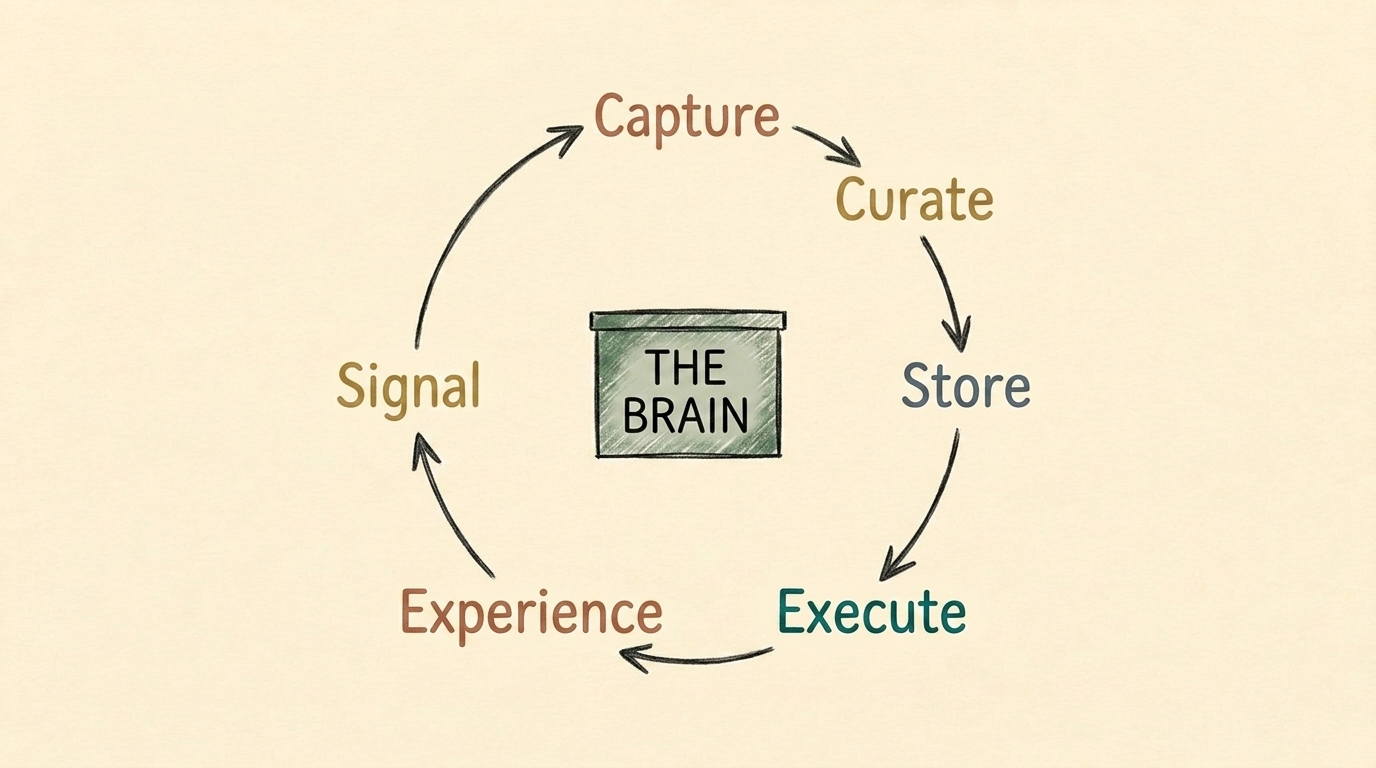
This is the layer that powers everything above it, and it's the one most people skip. The model already knows everything public and nothing about your company. The context layer — call it the brain — is how the company itself becomes something an agent can see. Done right, it gives agents near-perfect vision of what your business is, so they stop making confident, plausible, wrong calls and start acting like they've worked there for years.
It runs as a loop with a few stages:
- Capture. A routine pulls in what's happening across the company — messages, meeting recordings, emails, tickets — on a schedule, into an inbox for the brain. A simple recurring job, not magic.
- Curate. You don't want everything piling up forever. A librarian step reads what came in, keeps what matters, files it, and flags some of it as triggers worth acting on.
- Store. The brain is, concretely, a set of folders and files organized so agents can search them, retrieve what they need, and write back improvements over time. Not a black box — a structure you can open and read.
- Leverage. Agents pull from the brain to do the work — draft the thing, run the skill, check the output, ship it.
- Signal. What happens next — a customer reacts, a number moves — flows back into the brain, and the system updates. The loop closes.
There's a subtle, valuable part most companies throw away: the decisions made along the way. Why you priced that exception, why the obvious move blew up last time, the reasoning behind a call. That exhaust normally rots in a graveyard of files nobody reopens. Captured into the brain, it's what lets an agent reason like a senior operator instead of a well-read intern.
And this is why context, not the model, is the moat. Anyone can rent the same model you do. Nobody else has your company's captured judgment, made legible and improving on a loop. Make your company queryable and you've built the one thing competitors can't copy by swiping a credit card.
Speed to Signal: Two Workflows in Action
The point of the three layers isn't elegance. It's speed to signal: produce something real in minutes, get a reaction, feed it back. Here are two workflows that show the system doing exactly that.
Theory is cheap, so here's the system as motion. Both of these are skill chains — a sequence of skills firing one after another — running on top of the context brain. The shape is what matters; you can map it onto whatever your company produces.
Workflow one: a proposal, from request to live link, in minutes
Normally this fires on a trigger — the brain notices a request for a proposal in a meeting transcript or an inbox and kicks off on its own, without me lifting a finger. The chain runs three skills back to back. The first builds a proposal as a clean micro-site, not a raw email. The second is a copy skill that makes it sound like me and like the conversations we've had — pulling the personal details out of past-call transcripts in the brain, the offhand thing someone said months ago that I'd never remember at the keyboard. The third is a QA skill that checks nothing is overpromised and nothing is fabricated that isn't grounded in the real record. Then it deploys live on a link and pings me to review.
What used to be days — review the notes, draft it, coordinate, send — collapses to minutes, and the speed itself is the edge. In sales, striking while the iron is hot wins deals; a proposal that lands while the conversation is still warm, personalized with details the prospect forgot they mentioned, is a different experience than one that shows up next week. That's speed to signal: the work is produced fast enough to get a real reaction while it still matters.
Workflow two: an idea to a tested prototype, in one session
The second one turns an idea into evidence. I describe a feature or an internal tool out loud — the goal, what it should do, the standard it has to hit. A skill chain takes it from there: state the hypothesis being tested, build a working prototype (not a slide, not a Figma mockup — something you can click), stand up a usability test around it, synthesize the feedback that comes back, and plan a V2. In a single session you go from "what if" to a functional thing real people have reacted to, with the lessons already pulled out and the next version scoped.
That's the whole game of product, compressed. Instead of writing a long spec and slowly building toward a launch over weeks, you build the smallest real thing, put it in front of people, and let their reaction tell you what to do next — fast enough to do it again tomorrow. The context layer is what makes the prototype good on the first try: it already knows your design standards, your users, your prior decisions, so the agent isn't starting from a blank page.
Why both of these are only possible with all three layers:
A person (the people layer) sets the goal and reviews the output. Agents in a skill chain (the agents layer) do the work. And the brain (the context layer) supplies the voice, the past-call details, the design standards, the prior decisions that make the output good rather than generic. Pull any layer out and the workflow falls back to a clever demo. Together, they're a company moving at speed.
You Already Have the Context
The honest objection: "you have a big team and years of context; I'm starting from scratch." If you're a mid-market operator, you have the opposite problem — you already own the context. The job is making it legible, not inventing it.
Whenever I walk through this, someone says: that's fine for you, you've got a deep bench and years of accumulated context — I don't have that. For a brand-new AI studio with no proprietary data, that's a fair point, and the answer is to borrow: pull from public design libraries, plug into existing component sets, load context slowly over time until you've built some of your own.
But if you run an established mid-market company, you have the reverse situation, and it's a gift. You are not starting from zero. You have years of operational data. You have a team that knows the edge cases cold. You have pricing exceptions and hard-won rules and "we don't do it that way because…" judgments that live nowhere a competitor could ever copy them. You were never short on context. It's just been locked in your senior people's heads instead of sitting in a layer agents can read.
So becoming AI-native, for you, is not an act of invention. It's an act of translation — getting the context you already own out of heads and inboxes and into the brain. That's a meaningfully easier and more defensible starting point than any startup has. The companies that move first on it turn a pile of tribal knowledge into a system that compounds. The ones that wait watch that knowledge keep walking out the door every time someone leaves.
What It Looks Like Running
The three layers aren't a theory I'm pitching. They're how I run five companies with co-founders, AI agents, and zero hired employees. Each one replaced a role you'd normally hire for.
I run this stack across five companies in five different industries, and the simplest proof is to name the one role each one replaced — categories only, the architecture not the prompts:
- Sena (event concierge) runs the operations coordinator — intake, routing, and follow-up over chat.
- Precis (expert-health consensus) runs the research team — scoring agreement and disagreement across thousands of expert sources.
- Gavel (cited frameworks) runs the strategist — answers grounded in real citations with explicit tradeoffs.
- TrueStandard (verification) runs the fact-checker — a council of models flagging fabricated claims before they ship.
- GameTape (executive coaching) runs the coach — watching how a founder works and turning it into debriefs and longitudinal patterns.
None of those is a chatbot bolted onto a company. Each is people managing agents, agents reading and writing to a context brain, and the whole thing getting smarter every week. That's the definition, running. If you want the architecture in more depth, I've written it out:
- Service-as-a-Software — the business model on top of these three layers: why selling outcomes through software beats selling hours, with the five companies as five worked examples.
- How I Run 5 Companies with Zero Hired Employees — the build order and the five operating primitives, each company torn down to the role it replaced.
- Where to Point AI First — once you understand the system, this is how to choose which function to make AI-native first.
- AI Agent Orchestration — the rung above agents: many agents running as one system, and the governance gate the popular ladder skips.
- The Locked-Context Audit — score your own company on how much of it lives in a few people's heads.
- 5 AI Agent Terms Every Operator Should Know — the five primitives these layers are built from (AGENTS.md, skills, MCP, A2A, sub-agents), in plain English and ranked by what moves the needle.
- The Agent Operator: The Only AI Job That Compounds — the human side of the "people" layer: what an operator does all day (Frame, Context, Guardrails, Verify, Loop) when the agents do the work.
- AI Engineer World's Fair 2026: An Operator's Field Notes — what 32 conference talks reveal about the layers around the model (the Reliability Stack), with every takeaway deep-linked to the source talk.
The reason I can run five this way isn't that I'm a bigger team. It's that the team is a stack of agents on a context brain, and a few people at the top doing the judgment. That's all "AI-native" means. The only real question left is whether your company is built for it yet.
Frequently Asked Questions
What does it mean to be AI-native?
An AI-native organization is one where people manage agents, agents can read and write to the company, and the company gets smarter over time. It's built from three layers — people, agents, and context — and you feel it as speed to signal: produce almost anything in minutes, get a reaction from the market fast, and feed that back so the system improves. Using a chatbot is not it.
Isn't using ChatGPT being AI-native?
No. Using ChatGPT is good, but it's like having a website and calling yourself a tech company. AI-native means the company itself is legible to agents — your data and your team's judgment live in a layer agents can read and write — and the agents do real work in a loop that improves over time, not just answer questions in a chat window.
Do I need a big engineering team to become AI-native?
No. I run five AI-native companies with co-founders, AI agents, and zero hired employees. The reframe is that everyone becomes a manager of agents: set the goal, give the agent the skills, tools, and context it needs, and review the output. The work shifts from doing the middle to owning the bookends — strategy and judgment.
Will you share the actual prompts and code?
No, by design. This explains the system — the three layers, what an agent needs, and how the context loop works — at the level of categories and architecture. The prompts, skills, and configs are the moat. You get the map, not the IP.
How do I get this built for my company?
It starts with an audit: a fixed deliverable that maps where your company is overstaffing work a stack of agents could do, and in what order to build your own AI Operating System. Apply at agrahri.com.
Want this built for your company?
The three layers are how the work gets done. I take a few audits a month: a fixed deliverable that maps where your company is carrying weight a stack of agents could lift, and the order to build your own AI Operating System.
Apply for an audit