Generative & Agentic AI Implementation
Generative AI writes and answers. Agentic AI acts — it runs workflows, calls tools, and checks its own work. The jump from one to the other is where real leverage lives, and where most pilots fail. Here's the difference that matters, what agentic implementation involves, why demo agents die in production, and the operator's stack for making them reliable.
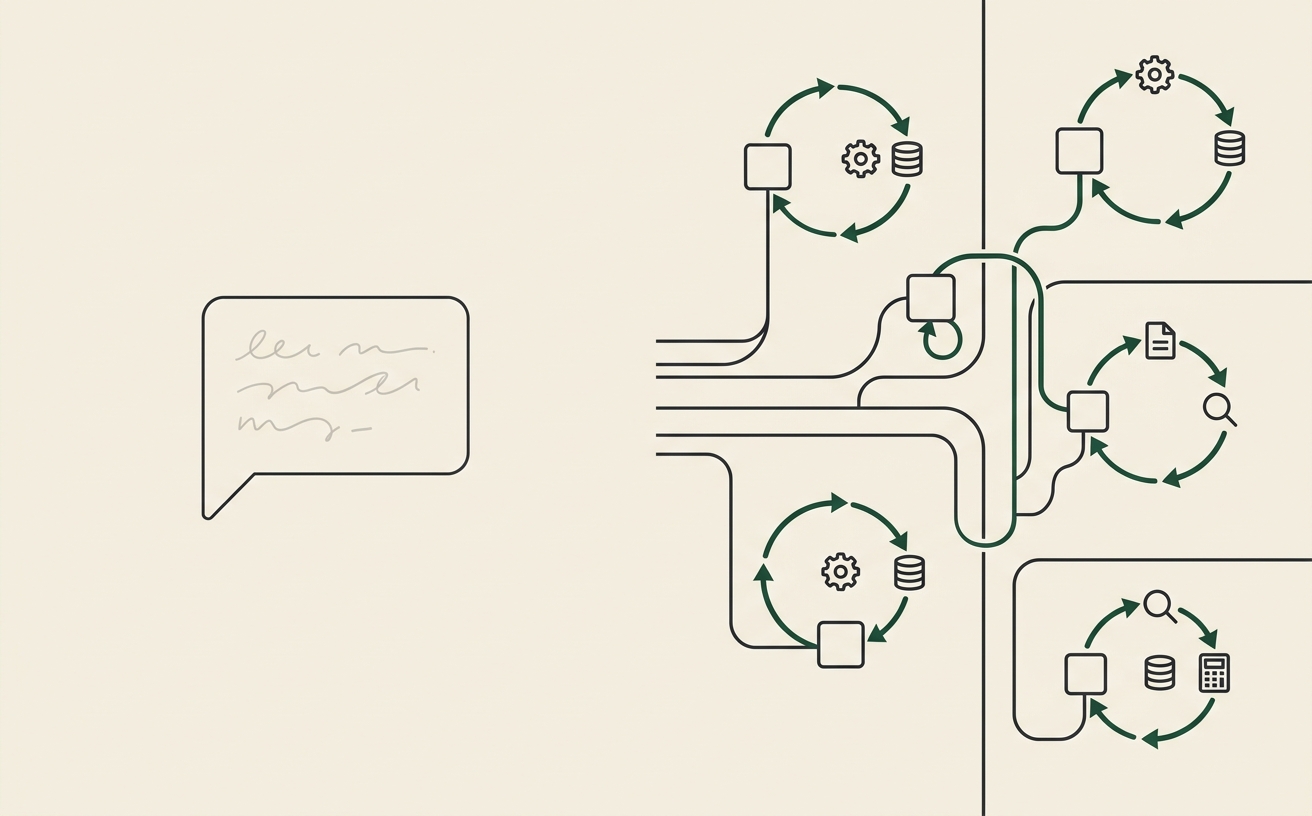
"Generative AI" and "agentic AI" get used interchangeably, and they shouldn't be. One produces content when you ask. The other does work on its own. The gap between them is exactly the gap between a company that uses AI and a company that runs on it — and it's where the implementation gets hard.
I run five companies on agents that act, not just generate, with zero hired employees. That means I've paid the reliability tax that agentic implementation charges. Here's the honest version: the distinction, what it takes to make agents work in production, and why the model is the easy part.
7
layers that make an agent production-safe
95%
of AI pilots never reach production
5
companies run on agents that act
0
hired employees
Generative vs Agentic AI
Generative AI produces content when prompted — it writes, answers, and drafts. Agentic AI acts — it runs multi-step workflows, calls tools, and checks its own work toward a goal, without a human prompting each step. Generative is an assistant; agentic is a system that does the work.
The cleanest test is what happens between prompts. Generative AI waits: you ask, it produces, it stops. Useful, but a human is always in the loop driving each step. Agentic AI keeps going: given a goal, it plans, calls tools, checks results, and adjusts until the work is done — the human sets the goal and reviews the outcome, not every move.
That's why agentic is the bigger prize and the bigger challenge. A generative feature makes your people faster. An agentic system takes a whole workflow off their plate. But autonomy is only worth having if it's reliable, and reliability is where the real implementation work lives.
AI
The next teardown, without checking back
About one a week from the five companies I run with co-founders, AI agents, and zero hired employees — what I changed, and the part that broke.
One click to unsubscribe.
What Agentic Implementation Involves
An agent needs four things to run on its own — a clear goal, the right skills, the right tools, and legible context — plus the reliability layers that keep it from failing silently. The model is the easy part.
Strip away the hype and an agent is a model using tools in a loop toward a goal. To run autonomously it needs four things in place: a clear goal (fuzzy goal, fuzzy output), the right skills (the playbooks for doing the work to your standard), the right tools (access to act, not just talk), and the right context (a legible company to reason over). Miss one and it fails like a new hire sent in blind — which is what people mistake for the model being dumb.
Then comes the part that separates a demo from production: the reliability layers. An evaluator that scores output against a standard. Verifiers that check work before it ships. A control loop that refuses to accept incomplete results. Observability so you can see what the agent did and why. That's the actual engineering of agentic implementation — I wrote the full version in The 7-Layer Reliable Agent.
Why Most Agentic Pilots Fail
A demo agent and a production agent are different machines. Agents that dazzle on a curated example fail on real edge cases with no evaluator, no verifier, no control loop. Reliability, not capability, is what kills them.
The failure is almost always the same story. The agent nails the demo — a clean example, a happy path, everyone impressed. Then it meets the real world: an edge case it hasn't seen, an ambiguous input, a tool that returns something unexpected. With nothing checking its work, it does what models do under uncertainty — produces a confident, plausible, wrong answer — and because no verifier caught it, that answer ships. Once burned, trust evaporates and the pilot dies.
Notice what didn't cause the failure: the model. A better model would have made the same unchecked mistake on a different edge case. The fix isn't more intelligence, it's the machinery around the intelligence — the layers that catch a wrong step before a customer sees it. That machinery is unglamorous, which is exactly why most pilots skip it and most pilots fail.
The Operator's Agentic Stack
Reliable agents are built from a small set of primitives — instruction layer, skills, tools, and orchestration — wired together with a human at the edge. The model is commodity; the stack is the moat.
Across five companies, the stack that makes agents dependable is surprisingly consistent: an instruction layer that tells the agent how your company works, skills that encode your playbooks, tools it can act with, and orchestration that coordinates multiple agents without a human stitching every handoff. On top sits the governance edge — a person reviewing the decisions that matter, so autonomy never means "no one is watching the important ones."
The point isn't to hand-build all of this yourself; you don't write the accounting software to run finance. But you should know it exists, because it's the difference between agents that survive contact with your business and agents that embarrass you. The primitives, in plain English and ranked by what moves the needle, are in 5 AI Agent Terms Every Operator Should Know, and the coordination layer in AI Agent Orchestration.
Generative or Agentic: What to Build First
Start generative where a human stays in the loop and stakes are low. Go agentic once a workflow is well understood, worth automating end to end, and you can put the reliability layers in place.
The sequencing is a judgment call, and getting it wrong is expensive both ways — automate too early and you ship an unreliable agent; wait too long and you leave leverage on the table. The rule I use: keep it generative while a human is reviewing every output and the cost of a mistake is low. Move to agentic when the workflow is understood well enough to specify a goal and a quality bar, the volume justifies the reliability work, and you're ready to build the checks that make autonomy safe.
That decision is the same "where to point AI first" question, applied to the generative-vs-agentic axis. The full framework — scoring workflows by frequency and value — is in Where to Point AI First, and the architecture it all runs on is the AI operating system.
Frequently Asked Questions
What's the difference between generative AI and agentic AI?
Generative AI produces content — it writes, answers, and drafts when prompted. Agentic AI acts — it runs multi-step workflows, calls tools, and checks its own work toward a goal, without a human prompting each step. Generative is a capable assistant; agentic is a system that does the work. Implementing agentic AI is the harder, more valuable jump.
What does agentic AI implementation involve?
Giving an agent what it needs to run autonomously: a clear goal, the right skills and tools, legible context to reason over, and the reliability layers around the model (evaluators, verifiers, a control loop, observability) that keep it from failing silently in production. The model is the easy part; the layers around it are the work.
Why do most agentic AI pilots fail?
Because a demo agent and a production agent are different machines. Agents that impress in a demo fail in production when they hit real edge cases with no evaluator, no verifier, and no control loop to catch a wrong step before it ships. Roughly 95% of AI pilots never reach production, and agentic pilots fail most often on reliability, not capability.
Should a mid-market company start with generative or agentic AI?
Start generative where a human is in the loop and stakes are low — drafting, summarizing, answering. Move to agentic once a workflow is well understood and worth automating end to end, and only with the reliability layers in place. The jump from generative to agentic is where real leverage lives, but it's also where reliability has to be engineered, not assumed.
Want agents that survive production?
I take a few audits a month: a fixed deliverable that maps which workflow to make agentic first and what reliability layers it needs, so you build agents that hold up in production instead of a pilot that demos and dies.
Apply for an audit