AI Agent Orchestration: The Rung Every AI-Native Map Skips
The ladder going around — skills, loops, agents, orchestration — is mostly right, and it stops one rung too early. Its endgame is hands-off autonomy: "no human stitching the handoffs, you set goals and step out of it." That's exactly how a wrong number reaches a customer. Here's the fifth rung, from inside five companies I keep running in production.
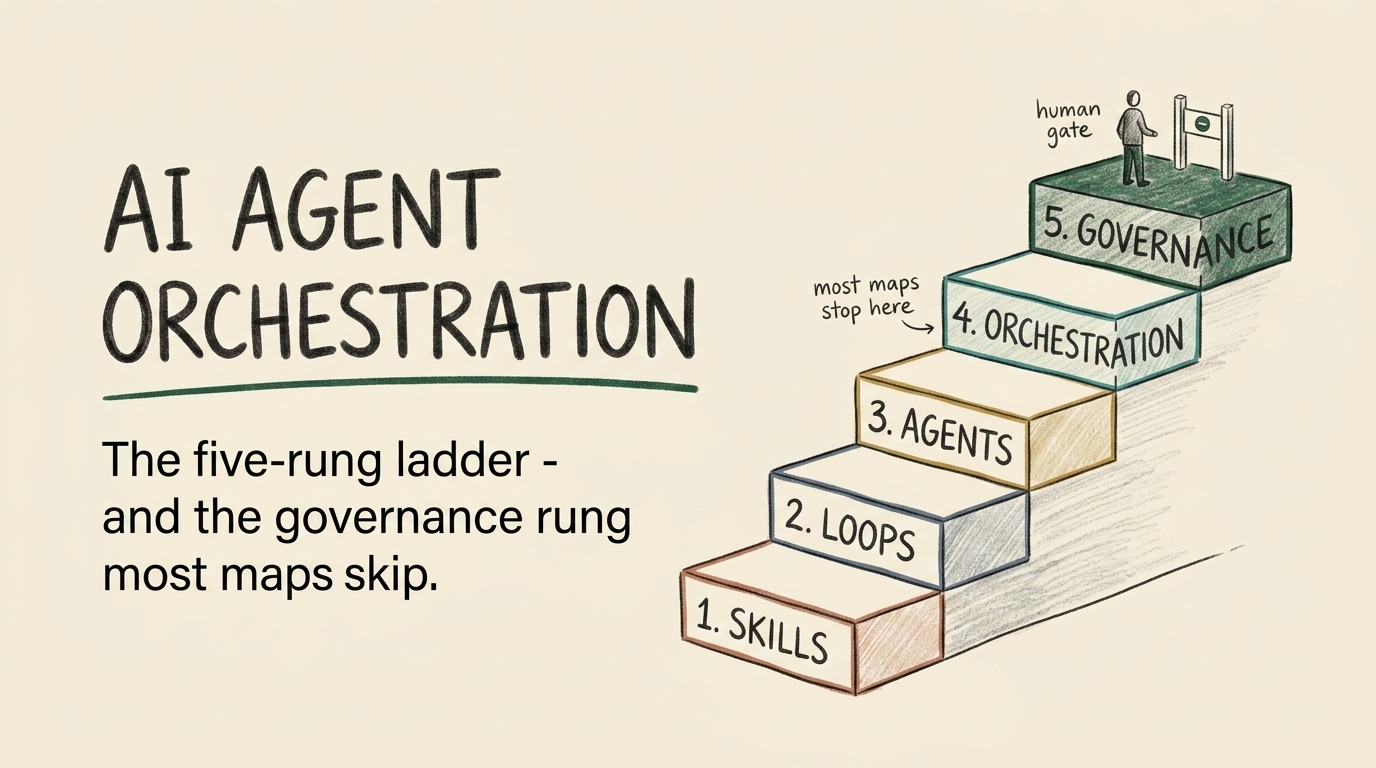
Table of Contents
There's a clean little infographic going around: the AI-native agency in four building blocks — skills, loops, agents, orchestration — with the playbook "build skills, then agents, then orchestration." Most of it is right. I'd hand the first three rungs to any operator as a starting map. The problem is the fourth, and what it implies the finish line is.
The map calls orchestration the place "where the best are," and describes the endgame like this: "many agents running as one system… no human stitching the handoffs. You set goals, watch numbers, step out of it." Stepping out of it is the promise. It's also, word for word, how a wrong number reaches a customer with nobody between the model and the invoice.
I run five companies this way — Sena, Precis, Gavel, TrueStandard, and GameTape — with co-founders, AI agents, and zero hired employees. Orchestration is real and I live on it. But the rung that decides whether an orchestrated system survives contact with a real customer isn't on the map. It's the one after orchestration: governed orchestration — where a human sits at exactly the points that can't be undone, and nowhere else. This guide is that fifth rung, anchored on the ~26,000-comment demand cache I track and on what's running in production across the five.
198
demand score — orchestration is the #1 topic in 26k comments
95%
of enterprise AI pilots never reach production (MIT)
5
rungs on the real ladder, not four
0
hired employees across the five companies
What Is AI Agent Orchestration?
AI agent orchestration is many agents running as one system — sales → onboarding → fulfillment → reporting — with no human manually stitching the handoffs between them. It's the stage above a single agent: not one worker you delegate a task to, but a set of workers coordinating to run a whole process end to end.
Put plainly: a skill does one job. An agent chains skills in a loop to reach a goal you hand it. Orchestration is the next step up — several agents handing work to each other so an entire business process runs without a person carrying the baton between stages. The new bottleneck stops being "can the model do the task" and becomes "do the agents stay aligned as the work moves between them."
Rung 3 — a single agent
One worker. You hand it a goal, it loops over its skills, it returns a result.
Rung 4 — orchestration
Many agents, one process. Each hands off to the next, with no person carrying the baton.
This is where the frontier is, and the demand data agrees. In the ~26,000-comment cache I keep from the channels where people build and sell this work, the loudest single theme is the orchestration / last-mile layer — it scores about 198, the top of the whole corpus. The most common question, almost verbatim, is the one an old-school dev left in a comment section: "I cannot understand where the orchestration layer lives. Is it called with Claude API? How does this thing actually work?" People can see orchestration is the prize. They can't see where it runs or what holds it together.
So far, no argument with the popular map. The disagreement starts at the word it uses for the top of the ladder — and what it tells you to do once you get there.
AI
The next teardown, without checking back
About one a week from the five companies I run with co-founders, AI agents, and zero hired employees — what I changed, and the part that broke.
One click to unsubscribe.
The Four-Rung Ladder Everyone's Sharing
Skills → Loops → Agents → Orchestration. As a way to see where you are, it's good — most companies are stuck on the first rung. I've written the deep version of each, so here's the ladder in one screen, with where to go for each rung.
Skills
One job done right every time. Judgment made reusable.
Loops
The engine inside an agent: run, check, decide, repeat.
Agents
A worker you hand a goal to, not a tool you operate.
Orchestration
Many agents running as one system, no human stitching handoffs.
Skills are where 90% of companies live — a tool you pick up and put down. The demand for this rung is louder than people expect: the single most-liked comment in that whole theme of the cache, at 1,487 likes, was just someone marveling that "two guys giving a 16 minute talk about markdown files" drew a packed audience. The talk was Anthropic's "Don't Build Agents, Build Skills Instead." Underneath it, the operative line: "Codify everything you would do manually, your new value is your ability to document and write down your specific workflows." That's the skills rung in one sentence. I go deep on it in What It Actually Means to Be AI-Native.
Loops are not a stage — they're the engine inside every agent: run the skill, check the result against a real signal, decide what's next, go again. The engineering of loops that self-correct instead of spinning is its own subject; it's in Every Agentic Engineering Hack I Know, and the seven-layer reliability build around a single long-running agent is in The 7-Layer Reliable Agent. Agents are the shift from handing over tasks to handing over goals — the deployment patterns, the agent types, and the human-oversight phases are in the AI Agent Deployment Playbook.
And orchestration — the fourth rung — is where the map says "the best" live. I agree it's where the value is. What I don't agree with is the sentence the map writes underneath it.
Why the Ladder Ends One Rung Too Early
The map's endgame is "no human stitching the handoffs — you step out of it." Stepping out of it isn't the finish line. It's the failure mode. The thing that ships a wrong number to a customer is precisely the absence of a human at the one step that can't be undone.
Read the fourth rung's bullets again: "many agents running as one system… no human stitching the handoffs… you set goals, watch numbers, step out of it." Every clause is true except the conclusion. Yes, agents should run the volume. Yes, no human should hand-carry routine work between stages. But "step out of it" quietly converts a productivity win into an accountability hole. When the reporting agent posts a margin number to a client and it's wrong, "you set goals and watched numbers" is not a defense — it's the description of how nobody caught it.
Agent
qualifies, drafts.
Agent
fulfills, produces the number.
Report
agent sends it, unreviewed.
Customer
acts on a wrong number.
The people doing this work feel it before they can name it. From the cache, a rental-ops builder: "are people really allowing auto-deploy of the ai generated code in high stakes use cases? We do rental ops automation, and id just be nervous about directly deploying the modified workflows… I've not seen a lot of playbooks on this and am keen to learn more." (15 likes). That comment is the whole governance rung trying to surface. The same theme runs through the corpus as "compounding slop," "code we don't understand," and "who reviews the code the agent is self-improving?" The market isn't asking for more autonomy. It's asking who's accountable when autonomy is wrong.
And the macro number says the hands-off pitch isn't even working yet. MIT put it bluntly this year: about 95% of enterprise AI pilots never reach production. They don't die because the model is dumb. They die because nobody can answer "what happens when it's wrong, and who sees it before the customer does." A map whose finish line is "step out of it" is selling the exact thing that's keeping that 95% stuck.
So the ladder needs one more rung. Not "more human everywhere" — that throws away the speed you built the agents for. The fifth rung is governed orchestration: agents run the system, and a human sits at the handful of points where being wrong is irreversible. That's the rung that gets you out of the 95%.
The Fifth Rung: Where a Human Sits So a Wrong Number Never Ships
Governed orchestration isn't "review everything" — that kills the speed you bought. It's one gate at the last point before an output becomes irreversible. Agents do the volume; a human approves the irreversible.
The mistake both extremes make is treating the human as a dial — more oversight or less. It isn't a dial; it's a placement problem. Most steps in an orchestrated process are reversible and low-blast-radius: drafting, summarizing, internal prep, anything a person reviews before it leaves the building. Let agents run those unattended. A small number of steps are irreversible the moment they fire: a financial number a client acts on, a contract clause, a deploy to production, an email sent under your name. Those — and only those — get a human gate.
Sales
agent qualifies + drafts.
Onboard
agent provisions + preps.
Fulfill
agent produces the work.
Human gate
review before the client-facing number ships.
Report
agent sends the approved output.
The cost of skipping that gate has a name: verification debt — the unpaid bill for every agent output you let through unverified. Like any debt, it's invisible until it comes due, and it comes due as the one wrong number that reaches a customer, the one auto-deployed workflow that breaks a live system. The "step out of it" map is a machine for accruing verification debt at full speed. Governed orchestration pays it down at the only place it matters: the last step before irreversible.
This is what I mean by governed autonomy: autonomy with a gate, not autonomy with a blindfold. The owner doesn't watch every run — they own the goals and they see the irreversible outputs. That's the difference between an AI system a mid-market company can put its name on and a demo that impresses in a meeting and never gets signed off for production.
Skills vs Agents vs Orchestration: What Actually Compounds
"Don't build agents, build skills" went viral for a reason — people conflate these rungs. Here's the clean distinction, and which one is the asset you own.
The confusion is understandable: the rungs sound interchangeable in a pitch. They're not. Each one answers a different question — what gets done, how it gets done, how it scales, and who's accountable when it's wrong. Read them side by side and the "which do I build first" argument dissolves: you build them bottom-up, and the thing that compounds is the bottom rung, not the top.
Skills
One job done right, every time — judgment made reusable.
What it gets you: The asset you keep: a private skill library that encodes your team's standards.
Agents
A worker you hand a goal to; it loops over skills to reach it.
What it gets you: Leverage: one agent replaces the repeated execution of a task.
Orchestration
Many agents coordinating as one system, no human carrying the baton.
What it gets you: Scale: a whole process runs end to end, not one task.
Governance
A human gate at the irreversible steps; the rest runs unattended.
What it gets you: Trust: the rung that lets you put the company's name on the output.
Notice where the durable value sits. Agents and orchestration are leverage and scale, but they're built on whatever skills you've encoded — and they get rebuilt every time the tooling changes. The skill library doesn't. Your skills are the asset that compounds, because they're your company's judgment written down once and run forever. That's why I tell operators the orchestration is not the moat; the private skill library underneath it is — and unlike an agency's playbook, it's yours to keep, not the vendor's to rent back to you.
Which reframes "skills vs agents" entirely. It was never a versus. Skills are what you own, agents are what runs them, orchestration is how they run together, and governance is what makes the whole thing safe to scale. Build bottom-up, and don't mistake the impressive top rung for the one that holds the value.
The Orchestration Stack Underneath
"Where does the orchestration layer actually live?" is the #1 question in the cache. It's a stack of five layers — and the top one, observability, is where governance plugs in.
The reason orchestration feels like a black box is that nobody draws the stack. From the cache, the most-liked version of this confusion: "Most videos on agentic workflows ignore the 'last mile' of delivery. If I build a professional agentic system, how do I host the entire workflow — not just the underlying scripts?" (23 likes). Here's the answer, bottom to top — five layers that turn a script into a system that runs with nobody in the chair.
Observability
Reports every run and pages a human when one fails. This is where the governance gate lives.
Skills
Act in your real tools — send, write, update — not just return text.
Runtime
Executes the workflow and handles retries when a step fails.
State store
Every run starts with full context instead of from zero.
Trigger / schedule
Starts a run with nobody in the chair — a cron, a webhook, an event.
The detail that the "step out of it" crowd skips is the top layer. Observability isn't a dashboard you check when you're bored — it's the thing that makes governed orchestration mechanically possible. A run that fails or returns low-confidence output doesn't pass its result quietly downstream; it pages a human. That's how one gate covers a whole orchestrated system without a person babysitting every stage: the system fails loud, and the human shows up only when it does.
The full teardown of this stack — hosting choices, the five-part handoff, the recovery paths — is its own guide: The Last Mile Is the Offer. This guide stays on the rung above it: once the stack runs, governance is what makes it safe to trust.
How I Run Governed Orchestration Across Five Companies
This isn't a thought experiment. Five companies, co-founders and AI agents, zero hired employees — all running orchestration with a human gate at the irreversible steps, not "stepped out of."
The reason I'll argue this rung so hard is that I operate on it daily. Agents do nearly all the doing across the five companies. What I never removed is the gate in front of the irreversible — and one of the companies exists because of this rung:
TrueStandard
A council of models that flags fabricated or unsupported claims before they ship.
The gate: The governance rung turned into a company — a trust gate for agent output.
Sena
Event concierge: orchestrates intake → routing → follow-up over chat.
The gate: The gate sits before anything a guest acts on goes out.
Precis
Expert-health consensus: scores agreement across thousands of sources.
The gate: The "here's the consensus" output is reviewed, not auto-published.
Gavel
Cited frameworks: orchestrates retrieval → synthesis → citation.
The gate: Gated so a claim ships with its source attached, or not at all.
GameTape
Executive coaching: ambient capture → daily debrief, run continuously.
The gate: Operated, not handed off and forgotten.
The operating discipline underneath all five is the same three habits: a daily demo in a shared channel so the owner sees what the agents did, weekly evals against a golden set so quality is measured not assumed, and idempotent, self-healing re-runs so a failed step recovers instead of corrupting state. None of that is "step out of it." It's stay in the loop at exactly the points that matter, and nowhere else — which is the only version of hands-off that survives a real customer.
If you want the architecture in depth — the build order and the operating primitives behind each company — that teardown is How I Run 5 Companies with Zero Hired Employees. The takeaway here is narrower: orchestration is rung four, and it's not the finish line. The finish line is the rung that lets you trust it in front of a customer.
Frequently Asked Questions
What is AI agent orchestration?
AI agent orchestration is many agents running as one system — sales → onboarding → fulfillment → reporting — with no human manually stitching the handoffs between them. It's the stage above a single agent: instead of one worker you delegate a goal to, you have a set of workers coordinating to run a whole business process end to end. The popular four-stage map puts this at the top of the ladder; in production it isn't the top — governance is, because orchestration with no human gate is how a wrong number reaches a customer unreviewed.
What is the difference between skills, agents, and orchestration?
A skill is one job done right every time — judgment made reusable. A loop is the engine inside an agent: run a skill, check the result, decide what's next, repeat until the goal is done. An agent is a worker you hand a goal to; it runs its own loop and picks the right skill off its shelf. Orchestration is many agents coordinating as one system with no human stitching the handoffs. They stack: skills are what agents run, loops are how agents run them, orchestration is how agents run together — and governance is the rung that makes it safe to scale.
Can you fully automate a business with AI agents and no humans?
No — not safely, and that's the trap in the popular "step out of it" framing. You can automate the work; you cannot remove the accountability. Across five companies I run with zero hired employees, agents do nearly all the doing, but a human review path sits in front of anything irreversible or customer-facing: a number a client sees, a contract clause, a deploy. The endgame isn't absent humans — it's governed orchestration, where humans set the goals and review the high-stakes outputs while agents do the volume.
Where should a human stay in the loop with AI agents?
In front of anything irreversible, customer-facing, or high-stakes: a financial number a client will act on, anything legal or compliance-bound, a deploy to production, an email sent under your name. Let agents run unattended on reversible, low-blast-radius work — drafting, summarizing, internal prep. The rule isn't "review everything," which kills the speed you bought; it's place one gate at the last point before an output becomes irreversible. The observability layer makes this real: it pages a human when a run fails instead of failing silently.
Why do most AI agent projects fail to reach production?
MIT found about 95% of enterprise AI pilots never reach production, and the loudest demand across the ~26,000-comment cache I track isn't "make the model smarter" — it's "how do I get this thing to actually run, and hand it off so it keeps running." Pilots die in the last mile: no host, no owner, no recovery path, and no governance layer that lets a non-engineer trust the output. Crossing the gap takes an orchestration stack to run on and a governance gate so a wrong result never ships unreviewed.
Want governed orchestration built for your company?
Most mid-market companies don't need more autonomy — they need the gate that makes autonomy safe to ship. I take a few audits a month: a fixed deliverable that maps where to point AI first, the orchestration to run it, and where the human gate belongs.
Apply for an audit