AI Automation Agency Alternative: Own the System, Not the Automations
An AI automation agency will bolt point automations onto your business, tool by tool. For a few isolated tasks, that's fast and cheap. But automations don't compound into a system, and when the agency leaves they often leave with it. Here's what an AI automation agency does, where it stops, and the operator alternative that builds an owned system instead — from someone who has run five AI-native companies on that system for two years, with zero hired employees.
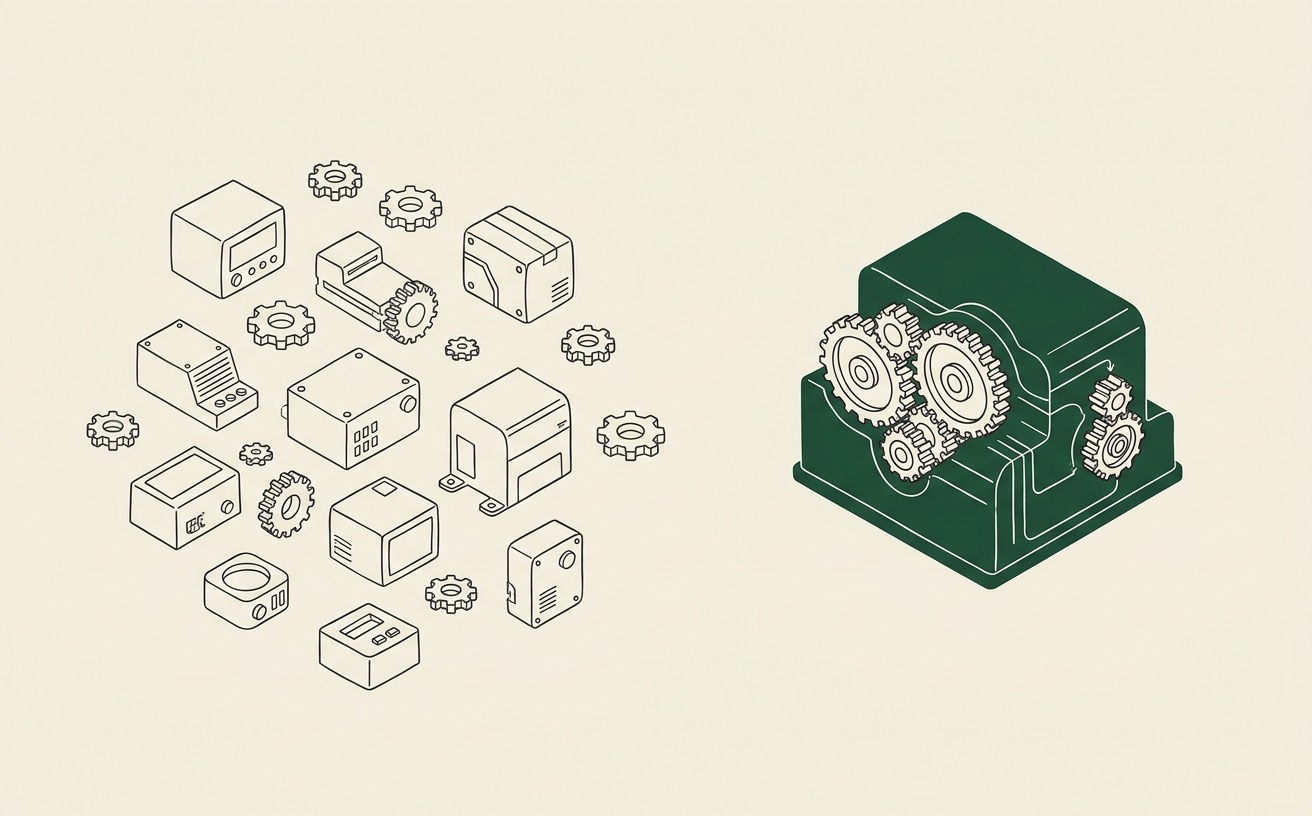
"AI automation agency" is one of the busiest phrases in the market — thousands of searches a month — and if you look at who ranks for it, most of the results are how-to-start-an-agency threads and small shops that opened last quarter. A big chunk of the category is powered by courses that teach people to launch one. That tells you something about the supply side.
It doesn't mean the work is worthless. A good automation shop can wire up a lead responder or a data sync faster than you could hire for it. But the model has a ceiling, and the ceiling is structural: you get automations, not a system. A pile of automations doesn't compound, and it usually isn't yours to keep.
I come at this from the other end. I run five companies — Sena, Precis, Gavel, TrueStandard, and GameTape — with co-founders, AI agents, and zero hired employees, on one operating system I built and have run for two years. This guide is the honest difference between hiring an agency to bolt on automations and building a system the company runs on.
5
AI-native companies I run
0
hired employees
2 yrs
running on one owned system
95%
of AI pilots never reach production
What Is an AI Automation Agency?
An AI automation agency builds point automations for businesses — connecting tools, wiring workflows in platforms like Zapier, Make, or n8n, and standing up chatbots and lead flows. It's service-based, usually project- or retainer-priced, and mostly small and generalist. The work can be useful; the limit is you end up with automations, not a system that compounds.
The core service is straightforward: you have a repetitive task, the agency wires up a bot or a no-code flow to handle it. Inbound leads get an instant reply. A form fills a spreadsheet fills a CRM. A support bot deflects the easy tickets. For a well-defined, isolated task, this is real value delivered quickly.
It's worth being clear-eyed about the supply side, because it shapes what you'll get. The "AI automation agency" boom is fueled by a creator economy that sells $5K–$7K courses on how to start one — which means a meaningful share of the market is generalists a few months into the craft, serving small businesses. There are excellent shops in there. There are also a lot of people who learned the same playbook last quarter.
So the category is real and often affordable, and for narrow automation it can be a good buy. The question isn't whether an agency can automate a task — it's whether a stack of automated tasks adds up to what you need.
AI
The next teardown, without checking back
About one a week from the five companies I run with co-founders, AI agents, and zero hired employees — what I changed, and the part that broke.
One click to unsubscribe.
What It Delivers — and Where It Stops
An agency delivers individual automations that solve discrete tasks. It stops at the seams: the pieces rarely connect into one operating layer, they usually live in the agency's accounts, and when the agency leaves, the automations often leave too.
Picture what you own after a year of agency work: a lead bot here, a data sync there, a reporting flow, a chatbot — a dozen small machines, each doing its one job. Every one might be well built. But look at the seams between them and you'll usually find nothing. They don't share a data layer, they don't know about each other, and no single thing is getting smarter as they run.
Three limits tend to show up:
- The pieces don't compound. Ten disconnected automations are ten tools, not a system. There's no shared context, so the whole is exactly the sum of its parts — and no more.
- You often don't own it. The automations frequently live inside the agency's Zapier, Make, or platform accounts. Stop paying and the flows can go dark. That's renting, not building.
- The hard part is skipped. The unglamorous work — making your data legible, encoding real workflows, keeping agents reliable in production — is where automation becomes an operating system, and it's exactly the part a point-automation model skips.
That last one is the real gap. It's the same reason roughly 95% of AI pilots never reach production: the demo works, the durable system underneath was never built. The data layer is where this is won or lost — I wrote the operator's view of it in AI Integration Services.
Point Automations vs an Owned Operating System
A point automation replaces a task. An operating system replaces the bottleneck. One is a tool you bolt on; the other is a layer the company runs on — data made legible, workflows encoded, agents executing, all compounding. That's the business-model difference underneath the price.
Here's the distinction that matters more than any feature list. An automation is a shortcut for a task you already do. An AI operating system is the layer underneath the whole business: your operational data captured so software can read it, your core workflows encoded as repeatable procedures, and agents running those workflows with a human setting the goal and checking the output. The difference isn't size — it's whether the thing compounds.
This is the model I've run for two years across five companies. Each company delivers what used to need a hired team — a research function, a strategist, a fact-checker, an ops coordinator, a coach — as software that runs on the same operating layer. It works not because any one automation is clever, but because the system has a shared spine: legible data, encoded judgment, and a control loop that feeds results back so it improves. Bolt-on automations can't do that; there's nothing for them to compound into.
If you want the full business-model breakdown — why "a service delivered as software" beats both SaaS and a services agency on unit economics — I laid it out in Service-as-a-Software. And the deliverable itself is spelled out in What an AI Operating System Is.
AI Automation Agency vs Operator: A Comparison
Different purchases for different goals. An agency is the fast, cheap way to automate a task. An operator is the way to make the company AI-native. Here's the straight side-by-side.
| AI automation agency | Operator (The Operator Method) | |
|---|---|---|
| Unit of work | A point automation per task | One operating system for the company |
| Does it compound? | No — disconnected pieces | Yes — shared data + control loop |
| Who owns it | Often the agency's accounts | You — built to hand over |
| Typical builder | Generalist, often course-trained | An operator who runs the same system |
| Best for | One or two isolated tasks | Making the company AI-native |
| You end with | A stack of rented automations | A system you own that compounds |
Neither row is a trap — they're just different buys. The mistake is hiring an agency to make you AI-native, or an operator to fix one broken Zap. Match the tool to the goal. For where an operator sits against the whole field — agencies, fractional CAIOs, enterprise firms — see The Best AI Consulting Firms for Mid-Market.
When an Agency Is Enough — and When You Need an Operator
An agency is enough when the goal is to automate a task. You need an operator when the goal is to make the company itself run on AI. Buy for the goal you have.
An agency is enough when:
- You have one or two well-defined, isolated tasks to automate — a lead responder, a data sync, a simple chatbot.
- You want the cheapest, fastest path to a specific automation and don't yet need a broader system.
- You're testing whether automation helps at all before committing to anything larger.
You need an operator when:
- The goal is to make the company AI-native — an owned operating layer, not a shelf of bots.
- You want the system to compound and to own it outright, not rent flows in someone else's accounts.
- Your bottleneck is a few senior people's capacity, and you need their judgment encoded into a system, not one more standalone automation around the edges.
- You've already got a pile of automations that don't add up to anything, and you want the layer that ties them together.
If you're in the second list, the deliverable you want is your company's AI Operating System, built on a fixed scope and handed to you to own — not a longer list of point automations.
Frequently Asked Questions
What is an AI automation agency?
An AI automation agency builds point automations for businesses — connecting tools, wiring workflows in platforms like Zapier, Make, or n8n, and standing up chatbots and lead flows. It's service-based, usually project- or retainer-priced, and mostly small and generalist. The work can be useful; the limit is you end up with automations, not a system that compounds.
What does an AI automation agency deliver?
Typically individual automations: a workflow that moves data between two tools, an inbound-lead responder, a support chatbot, a report generator. Each solves a discrete task and often lives inside the agency's own accounts. That's fine for isolated wins, but the pieces rarely connect into a single operating layer — and when the agency leaves, the automations often go with them.
What's the difference between an AI automation agency and an operator?
An agency bolts point automations onto your business tool by tool; an operator builds one owned operating system — data, workflows, agents — that compounds. The Operator Method is the second kind: the same system used to run five AI-native companies with zero hired employees for two years, built for your company on a fixed scope and handed over so you own it.
How much does an AI automation agency cost?
It varies widely — often a few thousand dollars a month on retainer, or per-automation project fees. It's usually the cheapest entry point of the AI-services options. The thing to weigh isn't the monthly number but what you own at the end: rented automations in someone else's accounts, or a system your team owns and can build on.
When is an AI automation agency the right choice?
When you have one or two well-defined, isolated tasks to automate and no ambition to build a broader system yet. For that, an agency is fast and cheap. When the goal is to make the company itself AI-native — a compounding operating layer you own — point automations won't get you there, and an operator is the better fit.
Want a system, not a shelf of bots?
I take a few audits a month: a fixed deliverable that maps where your company is carrying weight a stack of agents could lift, and the order to build your own AI Operating System — one owned layer that compounds, with the ROI math to defend it.
Apply for an audit