Service-as-a-Software Is the 2026 Model. I've Run It for Two Years.
There's a phrase going around: service-as-a-software. Work that still ships like a service, but runs on software instead of a team. Most of the writing about it is a 2026 prediction. I'm not predicting it — I've run five companies this way for two years, with co-founders, AI agents, and zero hired employees. This is the business model, told from inside it.
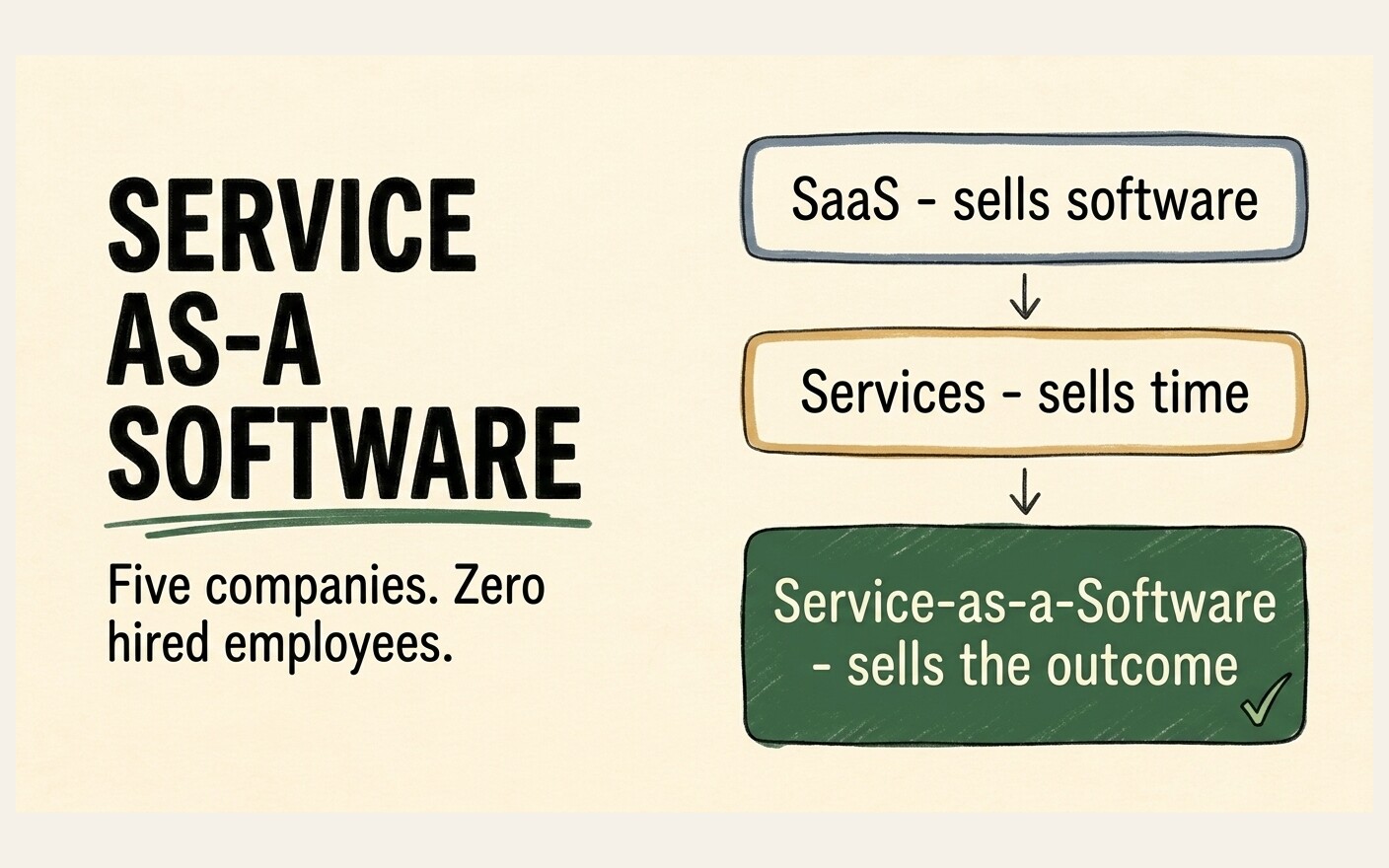
Strip away the noise and there are only three ways to sell work. You can sell software and let people run it. You can sell human time and let software support it. Or you can sell the outcome of a service and let software execute it. That third one is the model everyone started naming in the last eighteen months, and it's the one I want to walk through — because it's the one I actually operate.
I run five companies — Precis, Gavel, TrueStandard, Sena, and GameTape — with co-founders, AI agents, and zero hired employees. Every one of them is a service you'd normally hire a team to deliver, shipped through software instead. So when I describe this model, I'm not forecasting where agencies and services firms are headed. I'm describing the thing I've been running for two years.
This is the business-model version of the teardown: the three ways to sell work, why the old one breaks, the five companies mapped to the services they deliver, the four layers underneath them, and the part operators want — what happens to the unit economics when your cost to deliver stops being a person's time. No prompts. Just the map.
3
ways to sell work
5
services delivered as software
0
hired employees
4
layers it runs on
Three Business Models, One Clean Distinction
The work still gets delivered like a service. The execution runs through software. Your price stops tracking the clock — and that one change is the whole model.
Three ways to sell work, side by side. SaaS sells software — you buy a tool and your people run it, and the vendor's headcount doesn't move when you sign. Services sells human time — you buy hours from an agency, a firm, or a consultant, software just supports the humans doing the work, and the vendor hires to grow. Service-as-a-software sells the outcome of a service — you still get the research report, the qualified meeting, the verified answer, but the work itself is executed by software, not billed by the hour.
SaaS
Sells software
Your people run it
Services
Sells human time
Software supports the humans
Service-as-a-software
Sells the outcome of a service
Software runs the work, a person owns it
That last clause is the entire shift. In a services business, your cost to deliver is a person's time, so your price has to track their time. In a service-as-a-software business, your cost to deliver is mostly tokens and compute, so your price tracks the outcome — and the gap between the two becomes margin that compounds, instead of payroll that compounds.
Most "AI consultants" are still a services business with better tools. They sell hours; the AI just makes the hours faster. That isn't the model. The model is when the deliverable comes out of the software and the human is the editor, the strategist, and the owner of the account — not the line worker. If you want the structural definition of what makes a company AI-native underneath this, that's a companion guide: What It Actually Means to Be AI-Native. This one is about the business model that sits on top of it.
AI
The next teardown, without checking back
About one a week from the five companies I run with co-founders, AI agents, and zero hired employees — what I changed, and the part that broke.
One click to unsubscribe.
Why the Services Model Breaks at Scale
Three problems that compound, and no single fix for all three. Every move that solves one makes another worse. Mid-market operators hit this wall first.
The services model has a wall built into it. Three problems compound, and there's no move that fixes all three at once:
- Margin erodes. Your cost is labor. Labor costs rise every year. Clients push price down. The spread you live on gets squeezed from both sides at once.
- Quality varies with whoever's on the account. A senior delivers senior work; a junior delivers junior work. You can't clone your best person, so your output quality is a coin flip tied to staffing.
- Knowledge walks out the door. Your institutional expertise lives in people's heads and a graveyard of Slack threads. Someone leaves, and a chunk of how-the-work-gets-done leaves with them.
Watch how the fixes cancel out. Hire seniors to fix quality, and margin erodes faster. Hire juniors to protect margin, and quality drops. Document everything to stop knowledge walking out, and you've added overhead nobody maintains. There's no staffing answer that solves the set — because all three problems are rooted in the same place: the unit of delivery is a person.
Mid-market operators feel this first and hardest. You're big enough to have real volume of repeatable work — intake, routing, research, QA, drafting, reconciliation — and too lean to throw thirty people at it. You're running operations designed in 2022 while the cost of executing that same work through software has dropped through the floor. The wall isn't theoretical. It's your next ten hires.
Five Companies, Five Services Delivered as Software
Each company I run productizes a service you'd normally buy from a team of humans, and ships it through software instead. Same outcome. No billable hours.
Here's where I get to skip the hypotheticals. Every company I run is a service-as-a-software. Take the human service a customer would otherwise pay a team to deliver, and deliver it through software:
Precis
what you'd pay a research team for
consensus across thousands of expert sources, as software
Gavel
what you'd pay a strategist for
expert frameworks with real citations and tradeoffs, as software
TrueStandard
what you'd pay a fact-checker for
a verification layer for high-stakes decisions, as software
Sena
what you'd pay an events ops coordinator for
concierge and matchmaking across a conference, as software
GameTape
what you'd pay an executive coach for
ambient observation of how a leader operates, fed back as coaching — continuously, as software
None of these is an AI feature bolted onto a SaaS tool, and none is an agency with better prompts. They're services — the kind you used to hire people to deliver — running through software. That's the category, and naming it next to the human role it replaces is the cleanest way to see it.
A related guide, How I Run 5 Companies with Zero Hired Employees, maps each of these to the internal role I replaced to operate the company. This section is the other side of the same coin: the service each one sells to a customer. Different lens, same five companies.
The Four Layers of a Service-as-a-Software Operation
A service-as-a-software business isn't a pile of ChatGPT tabs. It's a stack of four layers, each doing a specific job, and the model only works when all four are present.
Execution layer — where it's actually real
The skills act in your tools (CRM, outreach, database, pipeline), not just hand you a plan.
Skill library
Repeatable workflows a senior writes once and anyone — or any agent — runs after that.
Context layer
The current state of the work — account, data, history — synced so nobody starts with a catch-up call.
Company OS
Your knowledge as plain text the agents read on every run — SOPs, voice, playbooks, the patterns in your best people's heads.
Layer 1, the Company OS, is your knowledge captured as plain text the agents read every time they run — SOPs, voice and brand, playbooks, the patterns your best people carry in their heads. Not buried in Slack and Notion where it dies; version-controlled and pulled fresh into every session. This is where "knowledge walks out the door" stops being a risk: the knowledge is the asset, and it's written where the software can use it.
Layer 2, the context layer, is the specific, current state of the work — the account, the data, the history, the last conversation — synced automatically so anyone, human or agent, starts with full context instead of a catch-up call. Layer 3, the skill library, is the repeatable workflows, written once by a senior operator and runnable by anyone after that. This is how quality stops being a coin flip: the senior encodes the work once, every run after is senior-quality, and the senior moves from doing the work to reviewing it.
Layer 4, the execution layer, is the part most people skip and the part that separates the real thing from a fancy SOP. Your skills have to act — in your CRM, your outreach tool, your database, your pipeline — not just hand you a plan to go execute yourself.
A skill that returns a tidy plan but can't act in your tools is a smarter SOP, not a service-as-a-software workflow. The model is only real at Layer 4.
If you've read Harness Engineering, you'll recognize the machinery underneath these layers — the onboarding docs, the doer/judge split, the verification loops. That guide is about how you build an agent that works. This one is about how those agents add up to a business that sells a service without selling time.
What Changes When You Stop Pricing Human Time
In a services business, the unit of cost is a person, and it scales with revenue. In a service-as-a-software business, the unit of cost is tokens — and tokens get cheaper while salaries don't.
This is the part operators want the math on. In a services business, your unit of cost is a person, and it scales linearly with revenue. The industry rule of thumb for a traditional B2B services firm is on the order of eight people per million in revenue. Grow the top line, grow the payroll, watch the margin stay flat or shrink.
In a service-as-a-software business, the unit of cost is tokens and compute, and it does not scale with revenue the same way. My five companies run on zero hired employees. The thing that goes up when output goes up is the token bill — and tokens get cheaper every quarter while salaries don't. Output per operator climbs while the cost to produce it falls. That spread is the entire reason the model exists.
Three things compound once it's running. Knowledge compounds — every job you ship gets logged and indexed, and the next job queries it, so the system sharpens itself without anyone maintaining it. Capacity compounds — a senior encodes a workflow once, and every future run is senior-quality without the senior in the chair. Margin compounds — cost-to-deliver falls while output rises, so you can cut price, hold price, or both, and the unit economics move in your favor either way.
For a mid-market operator, the honest framing isn't "fire your team." It's this: the goal is to stop hiring the next thirty people into task-defined work that a service-as-a-software layer can absorb. Your people move up to judgment, relationships, and the work that needs a human. The math doesn't require a layoff. It requires you to stop adding headcount to work that no longer needs it — and to redirect the people you have to where they're irreplaceable. For which work to point this at first, the high-frequency, low-judgment functions where it pays off fastest, see Where to Point AI First.
What Are Operators Actually Saying About This?
I don't only operate this — I track the channels where the people building these businesses argue about it. I scanned 22,319 comments across five AI-native channels I cache in-house (the automation-agency operators around Nick Saraev and Nate Herk, the AI Engineer crowd, and YC builders). The model isn't a forecast there either — it's what they're already running and fighting over.
Three signals came up again and again, and each maps onto a section above.
It's already a one-person business model
184 of the comments were about selling this as a service — pricing, clients, running an agency on it. The line that stuck with me came from someone running a one-person shop:
"The value of this is actually insane for a one person agency like mine — it's like I'm hiring an entire team of employees."
That's the thesis from section three, said by an operator who never read it: one person delivering what used to take a team, because the execution runs through software.
The fear isn't layoffs — it's the wrong frame
45 comments wrestled with "AI replacing teams." The most-upvoted reframe matched the math above almost word for word:
"The key shift is less about 'AI replacing teams' and more about redesigning companies so workflows are structured, queryable, and automation-ready from the start."
Redirect, not layoff. And another 122 comments were about what it costs to run — tokens, API bills, "haiku silently charging you in the background" — the unit-economics point from section five, lived in real time.
The market is starving for what's real
The loudest signal by far: 361 comments — more than on cost or tooling — were some version of "is this actually real, or hype?" The top-voted replies were all relief at a straight answer:
"Clarity > Noise. … Everyone's chasing the next shiny framework while ignoring whether it actually moves the needle."
That's exactly why this guide leads with five companies I run instead of a 2026 forecast. The field is past wanting predictions — it wants the thing, running. That's the bar I hold myself to, and the one I'd hold any service-as-a-software build to.
Source
22,319 comments across five AI-native YouTube channels I cache and track in-house (nicksaraev, nateherk, aidotengineer, ycombinator, ycrootaccess). Counts are comments matching each theme; quotes are verbatim and top-voted. The same comment cache decides which guides I write next.
What This Means for You, This Quarter
You don't rebuild the whole business at once. You find one repeatable service your team produces by hand today and stand it up as software, end to end. Then you do the next one.
You don't rebuild everything at once. You find one service — one repeatable, high-volume deliverable your team produces by hand today — and you stand it up as software, end to end, Layer 1 through Layer 4. One closed loop that ships without a person billing hours against it. Then you do the next one.
The constraint, once you've decided to do this, isn't the technology and it isn't budget. It's finding the senior operator who can translate how the work gets done into a workflow software can run. That's the rare skill now — not the model, the translation. It's the work I do.
I build this layer for mid-market operators the same way I built it for my own five companies: audit where you're staffed against work that should run through software, implement one service-as-a-software loop on a fixed scope, then operate and improve it month over month so it compounds instead of decaying. The hardest part of that sequence — getting the loop into production and keeping it alive there — is its own playbook: The Last Mile Is the Offer. Architecture you can inspect, running in companies I operate myself — not slideware.
Frequently Asked Questions
What is service-as-a-software?
A business model where you sell the outcome of a service — a report, a qualified meeting, a verified decision — delivered through software execution instead of billed human time. A person owns strategy and the relationship; software does the work. It sits between SaaS (which sells a tool your people run) and traditional services (which sells human hours).
How is it different from SaaS?
SaaS sells you a tool and your people run it. Service-as-a-software delivers the finished work product. With SaaS you still staff the people to operate it; with service-as-a-software the operating is the product, and the human is the editor and account owner rather than the line worker.
Is this just an agency using AI tools?
No. An agency using AI is still a services business — it sells hours, the AI just makes them faster. Service-as-a-software is when the deliverable comes out of the software and the price stops tracking someone's time. The tell is at the execution layer: a skill that returns a plan but can't act in your tools is a smarter SOP, not service-as-a-software.
Does this mean replacing my whole team with AI?
No. The math is about not hiring the next thirty people into task-defined work a service-as-a-software layer can absorb, and moving the people you already have up to judgment, relationships, and the work that needs a human. It's a redirect of headcount, not a layoff.
How do I know this works and isn't a 2026 prediction?
Because I run five companies on it today — Precis, Gavel, TrueStandard, Sena, and GameTape — with co-founders, AI agents, and zero hired employees. Each is a service you'd normally hire people for, delivered as software. The architecture is inspectable, not theoretical. Getting it built for your company starts with an audit at agrahri.com.
Want one of your services running as software?
I take a few audits a month: a fixed deliverable that finds the one service worth standing up first, with the ROI math to defend it, and the order to build your own AI Operating System.
Apply for an audit