AI Engineer World's Fair 2026: An Operator's Field Notes
I watched all 32 talks worth your time and found one shift underneath them: the model stopped being the hard part. Reliability moved into the layers around it — the Reliability Stack. Here are the real takeaways, grouped by layer, each deep-linked so you can watch only the ones you want.
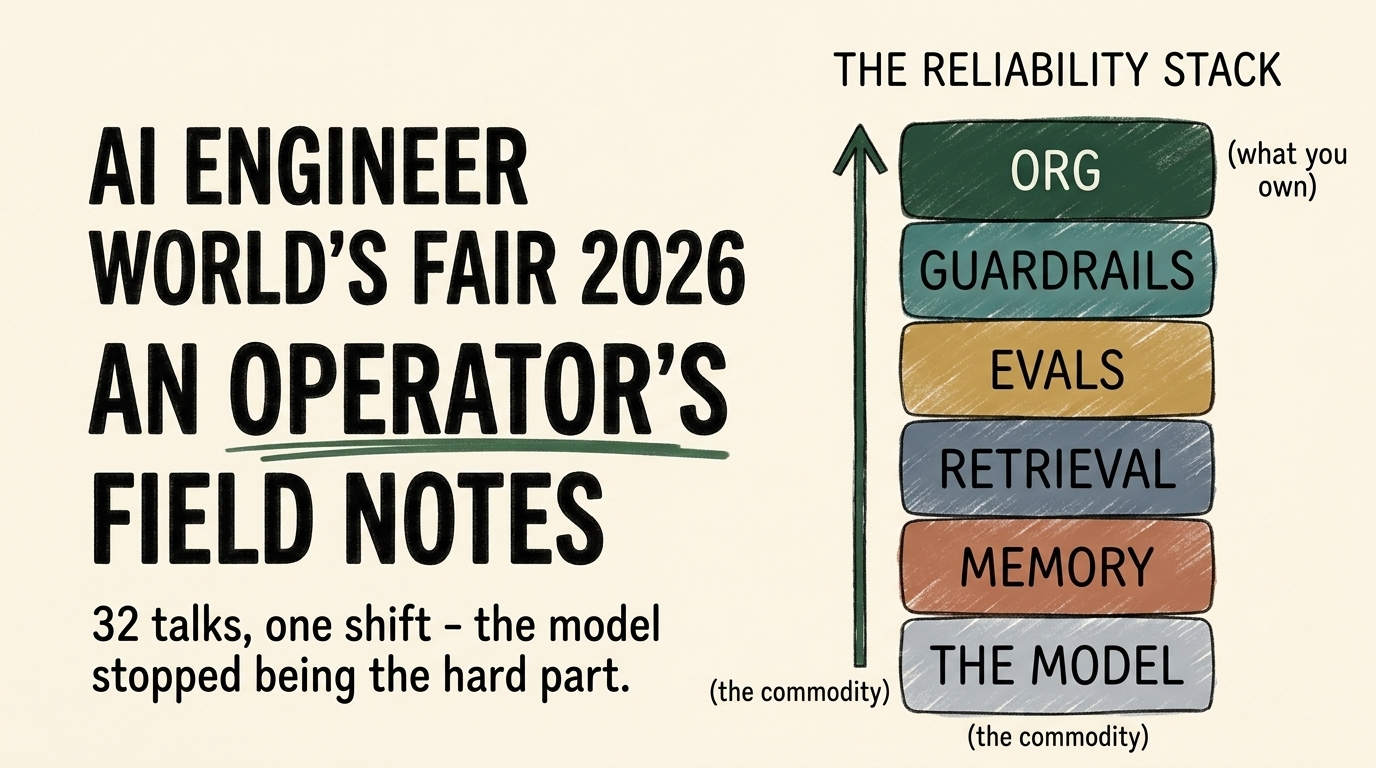
Table of Contents
Most conference recaps are a list of product launches. This isn't that. After AI Engineer World's Fair 2026, I pulled every talk worth an operator's time — 32 of them — into our own cache, generated a full chapter-level summary of each, and read the audience comments underneath. Then I looked for the thing the speakers weren't coordinating on but kept saying anyway.
Here it is: the model stopped being the hard part. Almost nobody on that stage was arguing about which frontier model is smartest. They were arguing about logs, memory, retrieval, evals, tool routing, contracts, and approval gates — the unglamorous engineering that sits around the model and decides whether an agent survives contact with production. I call that wrapper the Reliability Stack, and 2026 is the year it became the whole game.
A note on the dataset, because it's the point of reading this instead of a press release: every takeaway below is drawn from our summary cache of all 32 talks and the comment threads beneath them, and every one deep-links to the exact moment in the source talk. I run five AI-native companies — Sena, Precis, Gavel, TrueStandard, and GameTape — with co-founders, agents, and zero hired employees, on a working version of this stack. So I'll flag where the conference is right, and where the mid-market reality is different. Read the synthesis; click into the talks you want to go deep on.
32
World's Fair 2026 talks distilled
94%
coding tokens cut by a local code index (Tesco)
78→13%
agent accuracy as tools scaled 10→741
0
hired employees running this stack across 5 companies
What Actually Changed at AI Engineer World's Fair 2026?
The conversation moved from "is the model capable?" to "can you operate it reliably?" The interesting work is now the engineering wrapped around the model — memory, retrieval, evals, orchestration, guardrails, and org design. I call that wrapper the Reliability Stack.
A year ago the hallway talk was benchmarks. This year it was failure modes. The speakers who got the room nodding weren't showing off a cleverer prompt — they were showing how they kept an agent alive once real users, real data, and real money were involved. That is a tell. When a field stops debating raw capability and starts debating reliability, it has crossed from research into engineering. The model is now the commodity everyone shares; the durable advantage is the stack you build around it for your company and nobody else's.
Org & delegation
the team redesigned around agents
Orchestration & guardrails
deterministic scaffolding, contracts, approval gates
Evals & replay
prove it works, reproduce the failure
Retrieval & context
the right tokens, not all of them
Memory & state
the durable log the agent actually is
The model
the commodity — everyone gets the upgrade at once
The rest of these field notes walk up that stack, one layer at a time, with the talks that defined each one. Every talk is deep-linked at the moment its point lands, so treat this as a menu: read the synthesis, then go watch the three or four that map to whatever you're building this quarter.
AI
The next teardown, without checking back
About one a week from the five companies I run with co-founders, AI agents, and zero hired employees — what I changed, and the part that broke.
One click to unsubscribe.
Where Does an Agent's Reliability Actually Live?
In its memory, not its model. An agent's real identity is the durable, append-only log of what it has seen and done — and whoever owns that log owns the agent. Most production fragility traces back to state that was treated as an afterthought.
The most quietly radical talk of the week argued that the model and the runtime are disposable — the agent is its log. That reframes reliability as a storage-and-state problem, not a prompting problem. The same theme showed up from the opposite direction: agents that forget across sessions force the human to be the memory, and that's the tax that makes them feel flaky. Here's the layer, talk by talk.
An agent's identity is its append-only log, not the model or runtime. Make the log a first-class citizen and reliability becomes structural instead of an add-on. Whoever owns the log owns the agent.
Ishaan Sehgal, Omnara
► Watch: The Log Is The Agent →Coding agents fail on two axes — space (they see one repo) and time (they forget across sessions) — so the developer becomes the system's memory. A meta-harness that persists session state fixes both.
Victor Savkin, Nx
► Watch: A Genius With Amnesia →Stop treating memory as static facts. Score memories by past-outcome usefulness and treat them as evolving reasoning patterns, or your retrieval keeps surfacing things that never helped.
Sonam Pankaj, StarlightSearch
► Watch: User Signal Dies at the Retrieval Boundary →For a personal research brain, a file-based 'living wiki' with index files beat a vector store — the agent navigates sources and summaries instead of guessing at embeddings.
Paul Iusztin & Louis-François Bouchard
► Watch: Turn 10,994 Notes Into Memory →As context grows, the KV cache eats your RAM. Quantizing embeddings toward a ~3.5-bit sweet spot keeps long-context agents fast without collapsing the index.
Shashi Jagtap, Superagentic AI
► Watch: Turbocharge Retrieval with TurboQuant →What makes this layer real isn't the talks — it's the room arguing about it underneath them. In the comments on "The Log Is The Agent," builders pushed back hard: "can't agree the log IS the agent… why can't we just decouple the log from the agent itself?" and "the author describes a state machine, just a very inefficient one." Another, on the memory talk: "the memory layer stuff really clicked for me, I've been dealing with the same context loss between sessions." That's the signal. The people shipping agents have decided memory is the fight — they're only disagreeing about the implementation.
Why Do Agents Get Dumber as You Add Tools and Context?
Because more context isn't better context. The single clearest number from the whole conference: agent accuracy fell from 78% with 10 tools to 13% with 741. The fix is discipline — feed the model the few right tokens, not everything you have.
This was the most counterintuitive cluster of the week, and the most immediately useful. Stuffing an agent with every tool and every document doesn't make it smarter — it buries the signal and the model gets lost in the middle. Several talks attacked the same problem from different angles: route tools instead of dumping them, index your own code instead of re-sending it, parse documents properly instead of pasting them. The throughline is that retrieval is where most cost and most stupidity hide.
Fat agents that carry every tool definition crater from 78% accuracy at 10 tools to 13% at 741. Treat tools like RAG: embed the descriptions, retrieve the 3-5 relevant ones, and cut tokens by over 98%.
Sohail Shaikh & Ankush Rastogi, Prosodica
► Watch: The 100-Tool Agent Is a Trap →Input tokens are 90% of coding-agent cost. A local code index that retrieves only the needed chunks cut input tokens 94% while holding 90% retrieval accuracy.
Rajkumar Sakthivel, Tesco
► Watch: We Cut 94% of AI Coding Tokens With a Local Code Index →Five concrete token cuts: cache system prompts and tool definitions, route easy tasks to cheap models, summarize big tool results, cap tool loops, and trim conversation history with a sliding window.
Erik Hanchett, AWS
► Watch: Your Agent Is Wasting Tokens and You Don't Know It →RAG quality is a chunking problem before it's a model problem. Structure-first, heading-based chunking gives clean, referenceable data — drag-and-drop ingestion is where hallucinations start.
Abed Matini, Ogilvy
► Watch: Bypassing the Multimodal Tax: Hybrid RAG →When all of the context is relevant and changing, standard vector RAG fails. A distributed Cache-Augmented Generation setup with parallel context buckets retrieves faster.
Luis Romero-Sevilla, Orbis
► Watch: Extended Cache Augmented Generation →Document parsing is a moat you can own cheaply. Open-source Docling parses PDFs, tables, and images on CPUs instead of expensive proprietary GPU parsers — with vision models for diagram captions.
Cedric Clyburn, Red Hat
► Watch: Structuring the Unstructured →Browser agents fail on infrastructure, not intelligence. Compress the page into clean markdown and a smaller, cheaper model gets faster and more reliable. Environment beats model size.
Kushan Raj, ARK
► Watch: Browser Agents Don't Need Better Models. They Need Better Eyes. →If you read one number from this whole guide into a budget meeting, make it the first one: 78% to 13% on tool count alone. It reframes "our agent is unreliable" as "our agent is drowning," and the fix costs engineering time, not a model upgrade. This is the layer where most mid-market money is quietly wasted — paying frontier prices to send the model context it can't even use.
How Do You Prove an Agent Works — and Reproduce It When It Breaks?
Not by chasing determinism — even temperature zero isn't deterministic. You record the input-output boundaries so any production failure can be replayed and turned into a test, and you keep a human expert in the loop because automated metrics score fluency, not truth.
Evals were the layer where the conference sounded most like grown-up software engineering. The recurring message: you will not make an LLM bitwise-reproducible, so stop trying — make the system reproducible instead. Record what went in and what came out at every boundary, and a "good luck reproducing it" outage becomes a regression test. The sharpest version added a warning: don't trust a metric that only measures how fluent the output sounds.
Even with temperature at zero, LLMs aren't deterministic — it's GPU math, batching, and mixture effects. Chase replayability, not determinism: record input-output boundaries so you can freeze and replay any failure.
Tisha Chawla & Susheem Koul, Microsoft
► Watch: Your Agent Failed in Prod. Good Luck Reproducing It. →Before you optimize anything, build a golden dataset with subject-matter experts and real scorers. Then a system can autonomously run evals and update its own prompts and tools against it.
Alfonso Graziano, Nearform
► Watch: Agents Building Agents →Automated metrics and LLM judges score fluency, not fidelity — they can't tell a convincing fabrication from the truth. For anything that matters, a domain expert builds the rubric and the gold set.
Jacob E. Thomas, Results Gen
► Watch: The Miranda Hypothesis: How Hamilton Poisoned Persona Evals →Move past 'just ship it' with a four-phase framework — product requirements, system design, evaluation and monitoring, then optimization — and define a specific, time-bound success metric up front.
Apoorva Joshi, MongoDB
► Watch: AI System Design: From Idea to Production →The operator translation: "replayability" is just a black box for agents. You wouldn't run a finance system you couldn't audit after the fact; an agent is no different. The day you can take yesterday's failure and replay it on demand is the day your agent stops being a science experiment.
What Makes an Agent Safe to Put in Production?
Deterministic scaffolding around the probabilistic core. The agent reasons; the system enforces. Data contracts, idempotency, a control plane that separates proposing an action from executing it, and a human approval gate on anything with a blast radius.
This was the densest layer of the conference — eight talks circling the same conviction from different jobs. You don't make a non-deterministic thing safe by asking it nicely; you make it safe by wrapping it in deterministic structure. The best line of the week came from this layer: trust is a systems-engineering problem, not a prompt-engineering one. The talks below are the blueprint for that structure.
Build systems, not code. Design workflows with explicit start/stop/retry/escalation, set strict data contracts, make actions idempotent so retries don't double-act, and wall risky actions behind human approval.
Angie Jones, Agentic AI Foundation
► Watch: Build Systems, Not Code →A single tone prompt fails by turn 21. Layer the system and add a deterministic post-generation veto that audits output before it ships. Trust is a systems-engineering problem, not a branding one.
Isadora Martin-Dye, Isadora & Co
► Watch: Stop Writing Tone Instructions. Layer Them. →Decouple the AI's proposal from its execution with a control plane that validates first. Most agent failures — recursive loops, context corruption — are infrastructure failures, not model failures.
Nishant Gupta, Meta Superintelligence Labs
► Watch: Deterministic Infra for Non-Deterministic AI Agents →Agents are 'mismanaged geniuses' — the bottleneck is management and verification, not intelligence. Reliability comes from orchestration, and smaller models run recursively can beat frontier LLMs on long tasks.
Raymond Weitekamp, OpenProse
► Watch: Recursive Coding Agents →Favor composition over inheritance: isolated domain-specific agents coordinated by a primary controller, instead of one agent drowning in inherited context. Specialization scales; god-agents don't.
Justin Schroeder, StandardAgents
► Watch: The Future Is Domain-Specific Agents →Sell the specification, not the implementation. A deterministic simulation environment lets agents design systems against real behaviors — stale reads, concurrency — instead of guessing from an abstract prompt.
Dominik Tornow, Resonate HQ
► Watch: The Prompt is the Platform →Coding agents behave like eager interns; structured markdown specs written before the work are the guardrails that stop them from running off. Spec-driven development is the discipline that makes vibe-coding shippable.
Erik Hanchett, AWS
► Watch: Using Spec-Driven Development for Production Workflows →Let agents work in their native medium. HTML, not PowerPoint or Figma, is how an agent should produce graphics and slides — semantic structure it already understands, decoupled from the final format.
Amol Kapoor, Nori
► Watch: HTML is All You Need (for Agents to Make Graphics) →The audience felt this one. Under "Build Systems, Not Code," the top comment was an engineer's relief: "this needs more likes — I've been explaining these concepts to people I work with and failing." Another distilled the whole layer: "agents can write all the syntax, but the philosophy must always be yours." That's the operator's job in one line — own the system; let the agent fill in the code.
What Does All This Do to Your Org Chart?
It flattens it. The reliable-agent stack lets a small senior core orchestrate the work a department used to do — but only if you make the org itself AI-ready: ranked maturity, AI-friendly repos, and a way to delegate work to agents through the tools people already use.
Once agents are reliable, the constraint stops being talent and starts being delegation. The most concrete org talk came from inside a 3,500-person engineering org turning itself autonomous — not with a mandate, but with a maturity model and a champions program. The lesson for a mid-market operator isn't "copy this"; it's that the rollout is a change-management problem, and the prerequisite is making your codebase and your processes legible to an agent in the first place.
Block moved 3,500 engineers toward autonomy with a five-stage maturity model and an 'AI Champions' program of 50 engineers — then made repos AI-ready (agents.md, guardrail rules) and let people delegate via Slack and Jira. A custom orchestrator coordinates 25,000 repos.
Angie Jones, Agentic AI Foundation
► Watch: Building an Autonomous Engineering Org →The research-to-production gap is an org problem, not a model one. 'Research legibility' — a prototype-taxonomy doc and a monorepo that mirrors the research — is what lets engineers ship what researchers prove.
Vaidas Razgaitis, Higharc
► Watch: Research to Reality: Frontier ML in Production →Automate the development loop itself. An offline loop builds, tests, and improves agents while an online loop monitors and optimizes them in production — so humans stop being the bottleneck on agent throughput.
Benedikt Sanftl, Mutagent
► Watch: The Agentic AI Engineer →This is the same shift I unpack from the operator's seat in what "AI-native" actually means — the org chart becomes the product. The conference shows the enterprise version (25,000 repos, a champions program). The mid-market version is smaller and, honestly, easier: you don't have 3,500 people to convert.
Where Are Agents Already Shipping in Production?
In the unglamorous, high-pain workflows — government software, financial compliance, ETL remediation, customer-facing assistants. The production case studies all share the Reliability Stack: human-in-the-loop, sandboxing, observability, and hard numbers.
The proof that this isn't theory is the case studies — teams who put agents in front of real users and lived to present the metrics. Notice what they have in common: none of them led with the model. They led with the guardrails, the evals, and the operational numbers. That's the Reliability Stack paying off.
OpenGov's OG Assist runs on a custom agent loop (on the Effect framework) with an agent-to-agent protocol, deterministic human approval for mutating tool calls, sandboxed code execution, and rolling summarization for long context.
Gabe De Mesa, OpenGov
► Watch: Agents in Production: How OpenGov Built and Scaled OG Assist →A reinforcement-learning agent cut Mean Time To Recovery for ETL pipeline failures by 99.85% across 36 runs — by separating deterministic anomaly detection from learned policy, behind a safety-override layer.
Anna Marie Benzon
► Watch: Using an RL Agent to Detect and Remediate ETL Failures →Financial-compliance fraud hides in the relationships between documents, not inside any one. A graph-based entity-correlation engine across payroll, tax, and procurement catches what document-by-document checks miss.
Varsha Shah
► Watch: AI-Driven Multi-Document Correlation for Compliance →Agents are escaping the screen. A dual-display physical terminal serves local open-source models over an OpenAI-style API — a glimpse of AI-native hardware, power-regulation headaches and all.
Lech Kalinowski, Callstack
► Watch: OpenClaw in Your Hand: Building a Physical AI Terminal →Voice in, visuals out is the winning interaction shape — but it needs sub-200ms latency to feel human, which means reaching for fast Haiku-class models and aggressive early inference.
Allen Pike, Forestwalk Labs
► Watch: Voice In, Visuals Out: The Agony and the Ecstasy →The 99.85% MTTR number is the one to sit with. It's not a chatbot demo — it's an agent quietly fixing data pipelines behind a safety layer, measured the way an ops team measures anything. That's what a production agent looks like: boring, gated, and accountable.
From the Operator's Desk: What the Conference Gets Right, and What It Misses
It's right that reliability is the work now. It misses that a mid-market company doesn't need a 25,000-repo orchestration to get there — you need one production loop, with memory and an approval gate, that survives a Tuesday.
Here's where I'll trade my seat in the audience for the operator's chair. The Reliability Stack matches what I actually run. Across Sena, Precis, Gavel, TrueStandard, and GameTape — five companies, co-founders and agents, zero hired employees — the thing that took work was never picking a smarter model. It was exactly these layers: a durable log each agent resumes from, retrieval that doesn't drown it, an eval I can replay, and an approval gate before anything irreversible. This guide is an artifact of that stack: an agent skill wrote it from an AGENTS.md, pulling the 32 talk summaries through a cache we own.
What the conference gets right: the model is the commodity. Everyone gets the upgrade on the same day, so it can't be your edge. The edge is the stack, and the stack is shaped to your company. What it misses, or at least under-says, is scale. Block's playbook is a marvel — and almost none of it transfers to a $2M–$50M operator who has eleven people, not 3,500. You don't need a champions program. You need to pick the one workflow that eats your week, give it memory and a gate, and put it in production before you touch the second one.
The single best filter I took from the week is the 78%-to-13% number. It means "our agent is flaky" almost never means "we need a better model." It means the agent is drowning in context, missing a memory, or running without a gate — all stack problems, all fixable with engineering you control. When a vendor's pitch is about the model, you're talking to the wrong layer.
The Monday move: take the one recurring workflow that most reliably eats your week, and write down two things — the durable record it would need to resume itself, and the single approval gate you'd require before trusting it unattended. That's the first brick of your Reliability Stack; the component-level build of one agent's version of it — goal contract, verifiers, control loop — is The 7-Layer Reliable Agent. If you want help pointing it at your actual company — which workflow first, which gate, which two systems to wire — that's the audit. The deeper teardown of how these layers fit a whole company is in what "AI-native" actually means, and where to point AI first is in where to point AI first.
Frequently Asked Questions
What was the main theme of AI Engineer World's Fair 2026?
The shift from "is the model capable?" to "can you operate it reliably?" Across 32 talks the frontier moved out of the model and into the engineering wrapped around it — durable memory, disciplined retrieval, evals and replay, deterministic orchestration and guardrails, and an org redesigned for delegation. This guide calls that wrapper the Reliability Stack. The model is the commodity; the stack is the moat.
What is the Reliability Stack?
The set of layers around a model that decide whether an agent survives production: a durable log the agent can resume from, disciplined retrieval that feeds the right tokens instead of all of them, evals plus replay so you can prove it works and reproduce failures, deterministic orchestration and guardrails around the probabilistic core, and an org redesigned for delegation. It's the through-line of AI Engineer World's Fair 2026 — the part of an agent you build and own.
Do you need a bigger model or better engineering to make agents reliable?
Engineering. Talk after talk showed it: smaller models beat frontier ones when wrapped in better orchestration (Recursive Coding Agents), agent accuracy collapsed from 78% to 13% purely from tool-catalog bloat with no model change (The 100-Tool Agent Is a Trap), and browser agents were fixed by a cleaner page representation rather than a smarter model. Reliability is a systems problem, not a parameter-count problem.
Which AI Engineer World's Fair 2026 talks are worth watching first?
For an operator: "Build Systems, Not Code" by Angie Jones for the mental model, "The 100-Tool Agent Is a Trap" for the clearest numbers, "Your Agent Failed in Prod. Good Luck Reproducing It." for the replay discipline, and "Building an Autonomous Engineering Org" for the rollout playbook. Each is deep-linked at the right timestamp in this guide so you can watch the segment, not the whole hour.
How should a mid-market company apply these lessons?
Don't copy a 25,000-repo orchestration. Pick one recurring workflow, give it durable memory and a deterministic approval gate before it touches anything that matters, add a replay-based eval so you can reproduce failures, and only then widen. Start with one production loop, not a platform. That's the difference between the conference demos and a system that survives a Tuesday.
Want the Reliability Stack wired for your company?
The field notes are the generic case. The audit points the stack at your actual company — which workflow to put in production first, which approval gate it needs, and the order to build your own AI Operating System. I take a few a month.
Apply for an audit