The AI Implementation Roadmap for Mid-Market Companies
A roadmap is only worth the system it ends in. Here are the five phases of AI implementation, how to sequence them, what to build first, and why most roadmaps stall at the handoff from strategist to builder — from an operator who runs five AI-native companies on this exact path, with zero hired employees.
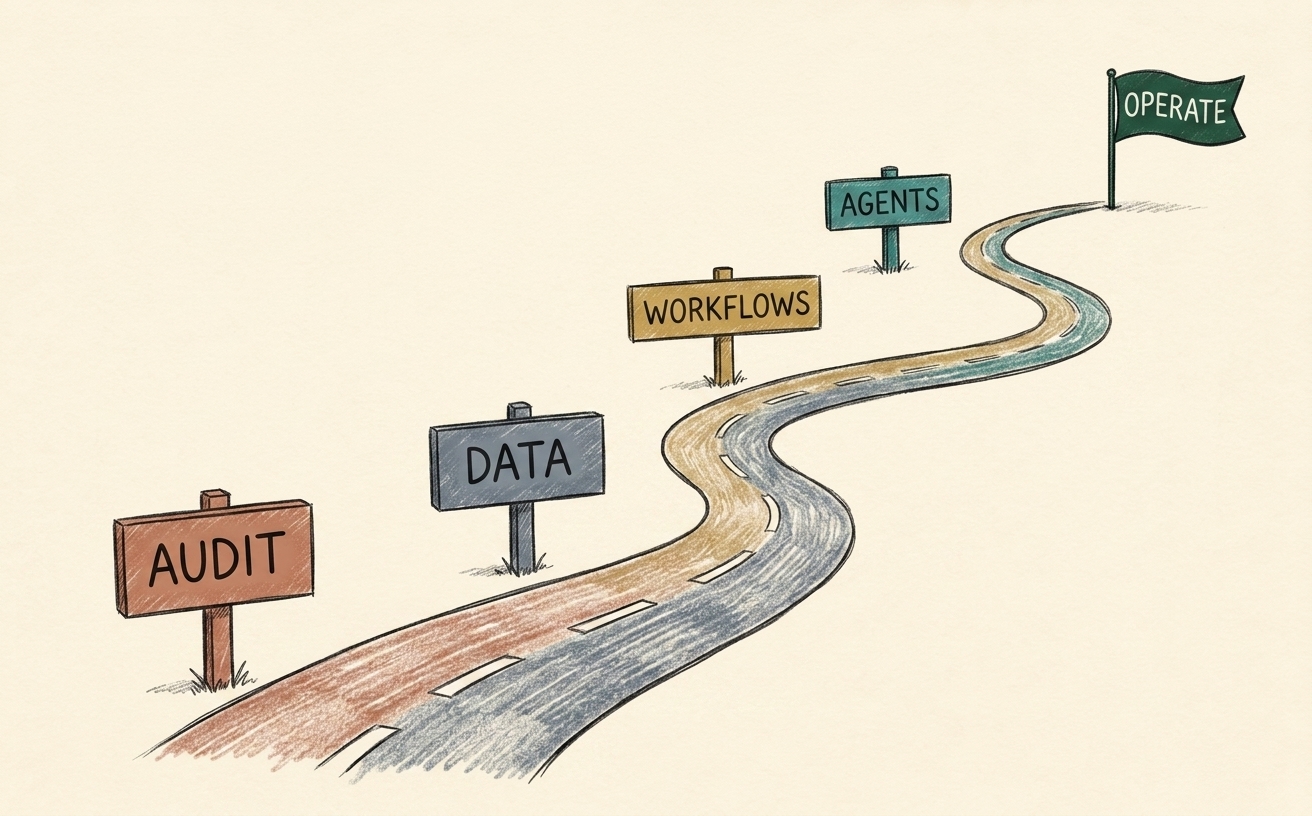
Most AI roadmaps I see are strategy documents. They name the opportunities, rank them, sketch a timeline, and land on someone's desk as a well-argued deck. Then nothing ships. The roadmap wasn't wrong — it just had no one to build it, and a plan that never becomes a running system is worth about what the paper cost.
I come at this from the building end. I run five companies — Sena, Precis, Gavel, TrueStandard, and GameTape — with co-founders, AI agents, and zero hired employees, on one operating system I've run for two years. Every one of them was built on the same path this guide lays out: audit, then data, then workflows, then agents, then operate. Not because it's a clever framework, but because each phase depends on the one before it, and you can't skip ahead without paying for it later.
So this is the roadmap as an operator uses it — the five phases, how to sequence them, what to build first, and the exact place most roadmaps die. The test throughout is simple: a roadmap is only worth the system it ends in.
5
phases, audit to operate
95%
of AI pilots never reach production
5
companies run on this path
0
hired employees
What Is an AI Implementation Roadmap?
An AI implementation roadmap is a sequenced plan that takes a company from where it is to AI running real work — moving through five phases: audit, data, workflows, agents, and operate. A roadmap is only worth the system it ends in, so it has to end in something built and running, not a slide deck.
Two words in that definition are doing the work: sequenced and ends in. Sequenced, because the phases aren't a menu you pick from — they're an order you move through, and each one depends on the last. You can't put an agent on a workflow you haven't encoded, and you can't encode a workflow whose data software can't read. Skip ahead and you build on sand.
Ends in, because the whole point is a running system. A lot of what gets called a roadmap is a strategy deck with a timeline drawn on it — opportunities ranked, a Gantt chart, a budget. That's a fine input. It is not a roadmap, because it stops exactly where the hard part starts: turning the plan into something that runs in production and keeps running.
The version that works ends in an owned operating layer — data made legible, workflows encoded, agents executing, a loop keeping it honest. That deliverable has a name; I spelled it out in What an AI Operating System Is. The roadmap is just the ordered path to get there.
AI
The next teardown, without checking back
About one a week from the five companies I run with co-founders, AI agents, and zero hired employees — what I changed, and the part that broke.
One click to unsubscribe.
The Five Phases: Audit → Data → Workflows → Agents → Operate
The five phases of AI implementation run in order: audit what to build, make the data legible, encode the workflows, put agents on them, then operate with a control loop. Each phase depends on the one before it. Skip a phase and the later ones fail — which is where most projects break.
This is the spine of the whole roadmap. Here's what each phase involves, in the order you do them:
- Audit. Find the work worth automating. Look across the company for tasks that are high-frequency, high-value, and legible, and map where your senior people's time is going. The output isn't a wish list — it's a ranked, ROI-defensible shortlist and the order to build.
- Data. Make the chosen work's data legible to software. Information scattered across inboxes, documents, and someone's head is exactly where pilots stall. Before an agent can act, the data it needs has to be captured somewhere software can read. This is the unglamorous phase, and it's where the real work starts.
- Workflows. Encode the actual procedure. Take how the work gets done — the judgment, the steps, the exceptions people handle without thinking — and write it down as a repeatable workflow. Not a flowchart for humans to follow; an encoded procedure a system can run.
- Agents. Put software workers on the encoded workflow. An agent runs the steps; a human sets the goal and checks the output. This is where a demo becomes production, and where reliability — not model capability — decides whether it survives. Most agents that die in production die on reliability, not intelligence.
- Operate. Run it with a control loop. Results feed back, the workflow improves instead of decaying, and the pieces start to compound. This is the phase that turns a project into an operating layer — your company's AI Operating System — and it's the one point automations never reach.
Notice that four of the five phases have nothing to do with the model. Audit is judgment, data is plumbing, workflows are encoding, operate is a feedback loop. The AI itself shows up in one phase. That ratio is the whole reason implementations succeed or fail on the unglamorous parts, not the clever ones.
How to Sequence It: What to Build First
Build first where frequency, value, and fit line up: a task that happens often, costs real money or time, and has legible enough data to encode. Don't start with the hardest or flashiest problem. Start with the high-frequency, high-value, legible work, ship one win, then expand from proof.
The audit gives you a list. The real question is which item on it you build first, and the answer is not "the biggest." It's the intersection of three things: frequency (how often the task runs), value (what it costs in money or senior time), and fit (whether its data is legible enough to encode without a six-month cleanup first). Score every candidate on all three.
Then start where all three are high at once. A task that happens daily, eats a senior person's afternoon, and already lives in reasonably structured data beats a once-a-quarter, high-stakes decision buried in judgment and scattered files — even though the second one feels more impressive to automate. You want an early, undeniable win, because the entire roadmap runs on the proof that first win generates. Momentum is the scarce resource, not ideas.
This is also where a real strategy phase earns its keep — if it's honest about what's buildable rather than what sounds exciting in a boardroom. The operator's version of strategy is ruthless about fit, because the strategist is the one who'll have to build it. I wrote up that view in AI Strategy Consulting.
Why Most Roadmaps Stall
Most roadmaps stall at the handoff from strategist to builder. The plan is sound, but no one builds it — the strategist delivers a deck and leaves, and there's no operator to turn it into a running system. That gap is why roughly 95% of AI pilots never reach production.
Here's where roadmaps go to die. A strategist — internal or hired — produces a strong plan and hands it over. The deck is good. And then it sits, because a plan is not a system, and no one in the building has both the time and the specific skill to turn phase one into something that runs. The strategist's job ended at the handoff, and that handoff is a cliff.
This is the single biggest reason roughly 95% of AI pilots never reach production. It's not that the ideas were bad or the models weren't capable. It's that the roadmap assumed a builder who never showed up — or assumed the strategist and the builder were the same person when they weren't. The distance between "here's the plan" and "here's the running system" is the entire game, and most roadmaps quietly skip it.
The fix is structural, not motivational. The person who plans it should be the person who builds and runs it, or should hand it to someone who will and stay on the hook for the outcome. That's the operator model: plan, build, run, own — one throat to choke, no cliff at the handoff. I laid out what that covers in AI Implementation Services.
Your First 90 Days
A realistic first 90 days ends with one workflow in production, not a finished transformation. Weeks 1–3: audit and pick the first workflow. Weeks 4–8: make its data legible and encode it. Weeks 9–12: put an agent on it and add the control loop. One real win beats ten stalled pilots.
A realistic first quarter doesn't end with a transformed company. It ends with one workflow running in production and a team that now believes the rest is possible. That belief is the actual deliverable of the first 90 days — the running workflow is how you earn it. Here's the shape of it:
- Weeks 1–3 — Audit. Pick the single first workflow using the frequency-value-fit test, and confirm its data is close to legible. Resist the urge to pick three.
- Weeks 4–8 — Data and workflow. The unglamorous middle: make that data readable to software, then encode the workflow as a real, repeatable procedure. This is where most of the calendar goes, and that's normal.
- Weeks 9–12 — Agent and loop. Put an agent on the encoded workflow, wire in the control loop, and get it running with a human checking output. Ship it to production, not to a demo.
Ninety days in, you have one function running on AI, owned by you, with the numbers to justify the next one. That's worth far more than ten pilots that all stalled at the demo. If you're pricing this out, I broke down what implementation costs in AI Implementation Cost, and the data-legibility phase — the part that quietly makes or breaks the timeline — in AI Integration Services.
Frequently Asked Questions
What is an AI implementation roadmap?
An AI implementation roadmap is a sequenced plan that takes a company from where it is to AI running real work. It moves through five phases — audit, data, workflows, agents, and operate — each one depending on the last. A roadmap is only worth the system it ends in, so a good one is measured by whether it produces a running system, not a slide deck.
What are the phases of AI implementation?
There are five, in order: audit (find the work worth automating and check its data), data (make that data legible to software), workflows (encode the real procedure), agents (put software workers on the encoded workflow with a human checking output), and operate (run it with a control loop that feeds results back so it improves). Skipping a phase is where most implementations break.
What's the difference between an AI strategy and an AI implementation roadmap?
A strategy decides what to do and why; a roadmap sequences how and when it gets built. Strategy without a roadmap is a deck; a roadmap without a builder stalls at the handoff. The two only pay off when the same operator carries them through to a system running in production, rather than handing over a plan and walking away.
What should a company build first with AI?
Build first where frequency, value, and fit line up — a task that happens often, costs real money or senior time, and has data legible enough to encode. Don't start with the hardest or flashiest problem. Ship one high-frequency, high-value workflow into production, prove it, then expand from that win.
How long does AI implementation take?
A realistic first 90 days ends with one workflow running in production, not a finished transformation. From there you expand one function at a time. Company-wide adoption is measured in quarters, not weeks — but the point of the roadmap is to get a real, owned win into production early rather than chase a big-bang launch.
Want a roadmap that ends in a running system?
I take a few audits a month: a fixed deliverable that maps where your company is carrying weight a stack of agents could lift, sequences the five phases for your business, and gives you the order to build — ending in a running system you own, with the ROI math to defend it, not another deck.
Apply for an audit