Is an AI Automation Agency Worth It? An Honest Answer
Straight answer: an AI automation agency is worth it for one or two isolated tasks. It's a poor fit if your goal is to make the company itself AI-native. Here's what these agencies are, whether they're legit, when they're worth the money, and what you own at the end — from someone who runs five AI-native companies on one owned system, with zero hired employees.
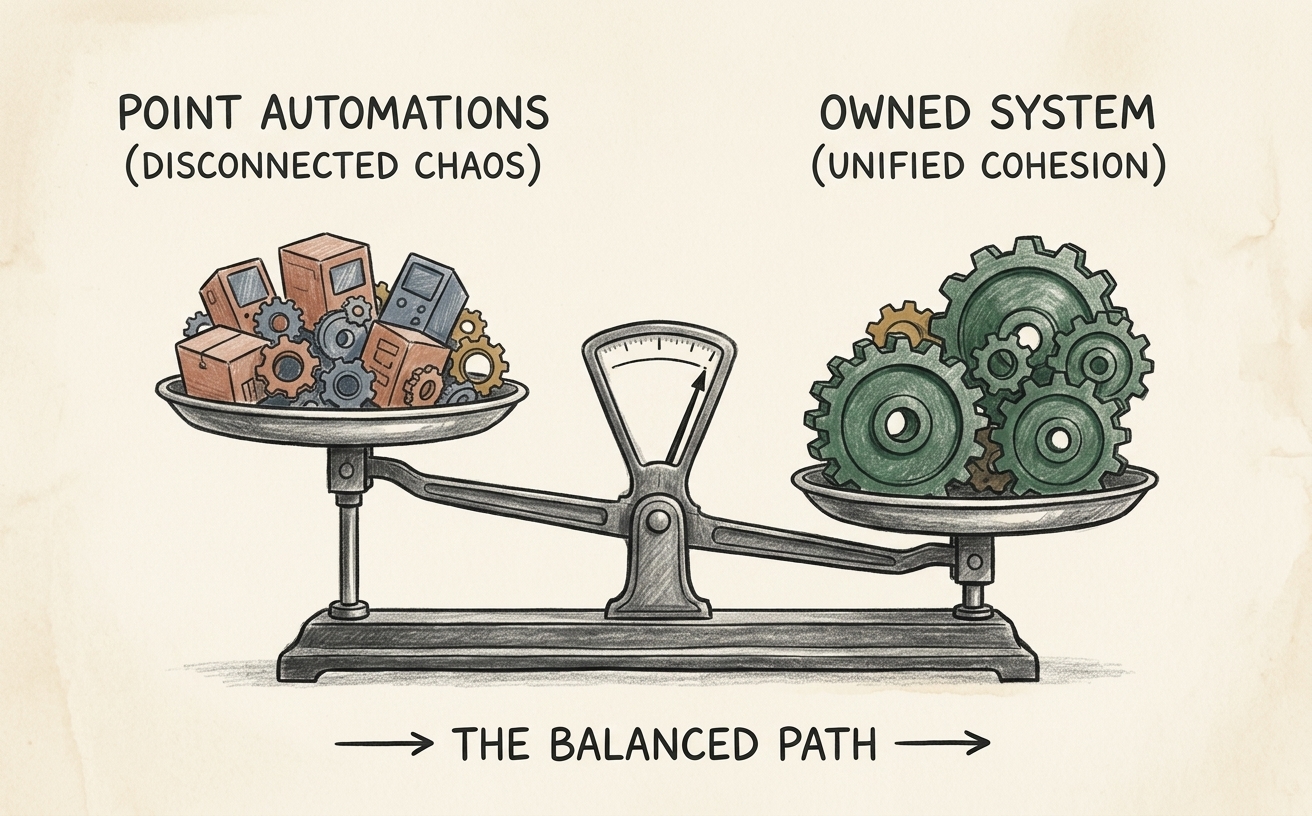
If you're asking whether an AI automation agency is worth it, you have one of two things in mind. Either a specific task you want off your plate, or a sense that the company should be "doing something with AI." Those are different questions. The honest answer depends on which one you're asking. Most advice online skips that fork and tells you to hire.
Here's the short version before the long one. For a narrow task — a lead responder, a data sync, a simple chatbot — an agency is a good buy: fast, cheap, and real. For making the company itself run on AI, it's the wrong tool. The model produces a shelf of disconnected automations, not a system that compounds. Know which one you need before you sign.
I come at this from the operating side. I run five companies — Sena, Precis, Gavel, TrueStandard, and GameTape — with co-founders, AI agents, and zero hired employees. I've run them on one operating system for two years. That's the vantage point here: what an agency is good for, where the money is well spent, and where you'd pay to rent something you should own.
5
AI-native companies I run
0
hired employees
2 yrs
on one owned system
95%
of AI pilots never reach production
What Is an AI Automation Agency?
An AI automation agency is a service shop that builds point automations — wiring tools together in Zapier, Make, or n8n, and standing up chatbots and lead flows. It's service-based, priced per project or retainer, and mostly small and generalist. Useful for a discrete task. The limit: you get automations, not a system.
Before you judge whether one is worth it, be precise about what you'd buy. The core service is narrow: you have a repetitive task, and the agency wires up a bot or a no-code flow to handle it. Inbound leads get an instant reply. A form fills a spreadsheet fills a CRM. A support bot deflects the easy tickets. Each engagement covers one or a handful of these automations, priced per project or on a modest monthly retainer.
That's the whole category. It isn't strategy consulting. It isn't a software product. It isn't a team that runs the thing in production for you. It's build-and-hand-off automation work for small businesses, and for the right task it's quick and effective.
Here's where it gets confusing. "AI automation agency" now covers everything from a skilled shop to someone who took a course last quarter and opened for business this one. So the real questions aren't about the label. Is this specific agency any good? Does the model fit the outcome you want?
AI
The next teardown, without checking back
About one a week from the five companies I run with co-founders, AI agents, and zero hired employees — what I changed, and the part that broke.
One click to unsubscribe.
Is an AI Automation Agency Legit?
Yes — the work is real. A good shop can build a working automation faster than you could hire for it. The catch is the supply side: $5,000–$7,000 courses on starting an agency mean much of the market is generalists a quarter in. Judge a shop by what it has run in production.
"Legit" is fair to worry about. The category earned part of its reputation problem. A creator economy selling $5,000–$7,000 courses on how to start an agency fuels the boom. So a meaningful share of the people selling these services learned the same playbook a few months ago. Their work can still be real. The average skill level sits lower than the marketing suggests.
So ask whether this one is legit, not whether agencies are. A few questions separate a good shop from a re-sold playbook:
- What have you run in production? Not what you can demo — what has been live and reliable for a real client for months. Demos are easy; durable systems are the hard part, and roughly 95% of AI pilots never make it to production.
- Who owns the accounts? If the automations live in the agency's Zapier or Make workspace, you're renting. Ask to own the accounts and credentials from day one.
- Can you show the failure handling? A good builder can tell you what happens when the API is down or the data is malformed. A course graduate usually built for the happy path only.
Answer those three and you'll sort the real operators from the freshly-minted ones. The category is legit. Plenty of individual shops are not.
Is It Worth It? When Yes, When No
Worth it for one or two isolated tasks — a lead responder, a data sync, a chatbot — where an agency is the fastest, cheapest path. Not worth it when the goal is a compounding, owned operating layer. No number of point automations adds up to a system the company runs on.
The "worth it" question only resolves once you're honest about the goal. Split it two ways.
An agency is worth it when:
- You have one or two well-defined, isolated tasks to automate — a lead responder, a data sync, a simple chatbot — and clear success criteria for each.
- You want the cheapest, fastest path to that specific automation and don't yet need a broader system behind it.
- You're testing whether automation helps at all before committing budget or headcount to something larger.
It's not worth it when:
- Your real goal is to make the company itself AI-native — an owned operating layer, not a shelf of bots.
- Your bottleneck is a few senior people's capacity, and what you need is their judgment encoded into a system, not one more standalone automation around the edges.
- You want the result to compound and to own it outright, rather than renting flows in someone else's accounts.
If you're in the first list, hire a good agency and get the task done. If you're in the second, an agency will spend your money well on the wrong thing. You'll get working automations that never add up to the outcome you wanted. The next two sections cover that gap.
What You Actually Own at the End
Less than you'd think. The automations live inside the agency's Zapier, Make, or platform accounts. Stop paying and the flows can go dark. The pieces don't share a data layer, so none of them compound. You're renting a set of tools, not owning a system.
This part decides whether the money was worth it a year later. The sales conversation skips it. Picture what you hold after a stretch of agency work: a lead bot here, a data sync there, a reporting flow, a chatbot. Small machines, each doing its one job. Every one might be built well. Look at the seams between them and there's nothing. They don't share a data layer. They don't know about each other. Nothing gets smarter as they run.
Two problems follow. First, the pieces don't compound. Ten disconnected automations are ten tools, not a system. The whole is the sum of its parts and no more. Second, you may not own them. The flows live inside the agency's accounts, and they go dark when you stop paying. That's the difference between renting and building. It's easy to miss until the renewal invoice arrives.
The alternative: own one operating layer instead of renting a stack of automations. I wrote the full firm-vs-operator comparison in the AI Automation Agency Alternative. And for why "a service delivered as software" beats both an agency retainer and a SaaS subscription on what you keep, see Service-as-a-Software.
The Bottom Line
The decision rule: buy an agency for a task, an operator for the company. If you need one or two automations, hire an agency. If you need the business itself to run on AI — an owned system that compounds — that's an operator's job, not a longer list of bots.
Put it together and the answer isn't yes or no. It's "for what." An AI automation agency is worth it when you buy a task: a specific automation you want live fast and cheap. It's the wrong buy when you want an outcome — the company running on AI. The model can't deliver that, no matter how many automations you stack up.
The clean rule for a mid-market operator: buy an agency for a task, an operator for the company. Match the purchase to the goal you have. Hire an agency to fix a broken Zap. Hire an operator to make you AI-native. Both are fine buys. The mistake is using one for the other's job.
If the goal is the company itself, what you want is your own AI Operating System — an owned layer that compounds — not a shelf of rented automations. And to see where an operator sits against the whole field, from agencies to fractional CAIOs to enterprise firms, see The Best AI Consulting Firms for Mid-Market.
Frequently Asked Questions
What is an AI automation agency?
An AI automation agency is a service shop that builds point automations — wiring tools together in Zapier, Make, or n8n, and standing up chatbots and lead flows. The model is service-based, usually priced per project or on a monthly retainer. Most are small and generalist. The work helps on a discrete task. The limit: you end up with separate automations, not one system that compounds.
Is an AI automation agency legit?
Yes — the work is real. A good shop can build a working automation faster than you could hire for it. Watch the supply side: $5,000–$7,000 courses on how to start an agency feed much of the category, so a large share of the market is generalists a few months into the craft. There are excellent shops in there, and there are re-sold playbooks. Ask what they have run in production. Ask who owns the accounts the automations live in.
Is an AI automation agency worth it?
It's worth it when you have one or two isolated tasks to automate — a lead responder, a data sync, a simple chatbot. For that, an agency is the fastest, cheapest path. It's also a fine way to test whether automation helps before you commit to more. It's the wrong buy when your goal is to make the company itself AI-native — a compounding operating layer you own. Point automations never add up to that.
How much does an AI automation agency cost?
It varies — often a few thousand dollars a month on retainer, or per-automation project fees. It's usually the cheapest entry point of the AI-services options, which is part of the appeal. Weigh what you own at the end, not the monthly fee: rented automations that live in someone else's accounts, or a system your team owns and keeps building on.
What's the alternative to an AI automation agency?
The alternative is an operator who builds you one owned operating system — data, workflows, and agents — instead of a pile of separate automations. It's the same system I run five AI-native companies on with zero hired employees. I build it for your company on a fixed scope and hand it over, so you own it. The full firm-vs-operator comparison sits in the AI automation agency alternative guide.
Want a system, not a shelf of bots?
I take a few audits a month: a fixed deliverable that maps where your company is carrying weight a stack of agents could lift, and the order to build your own AI Operating System — one owned layer that compounds, with the ROI math to defend it.
Apply for an audit