What Is an AI Consultant? What They Do, the Types, and When You Need One
An AI consultant is someone a company hires to help it use AI. That's the plain answer — but the word covers everything from a strategy advisor who hands you a deck to a builder who ships a working system. Most consultants advise and hand you a plan. So the real question for a mid-market company isn't "what is an AI consultant?" — it's whether you need someone to advise, or someone to build and run the system. Written by an operator who runs five AI-native companies with zero hired employees.
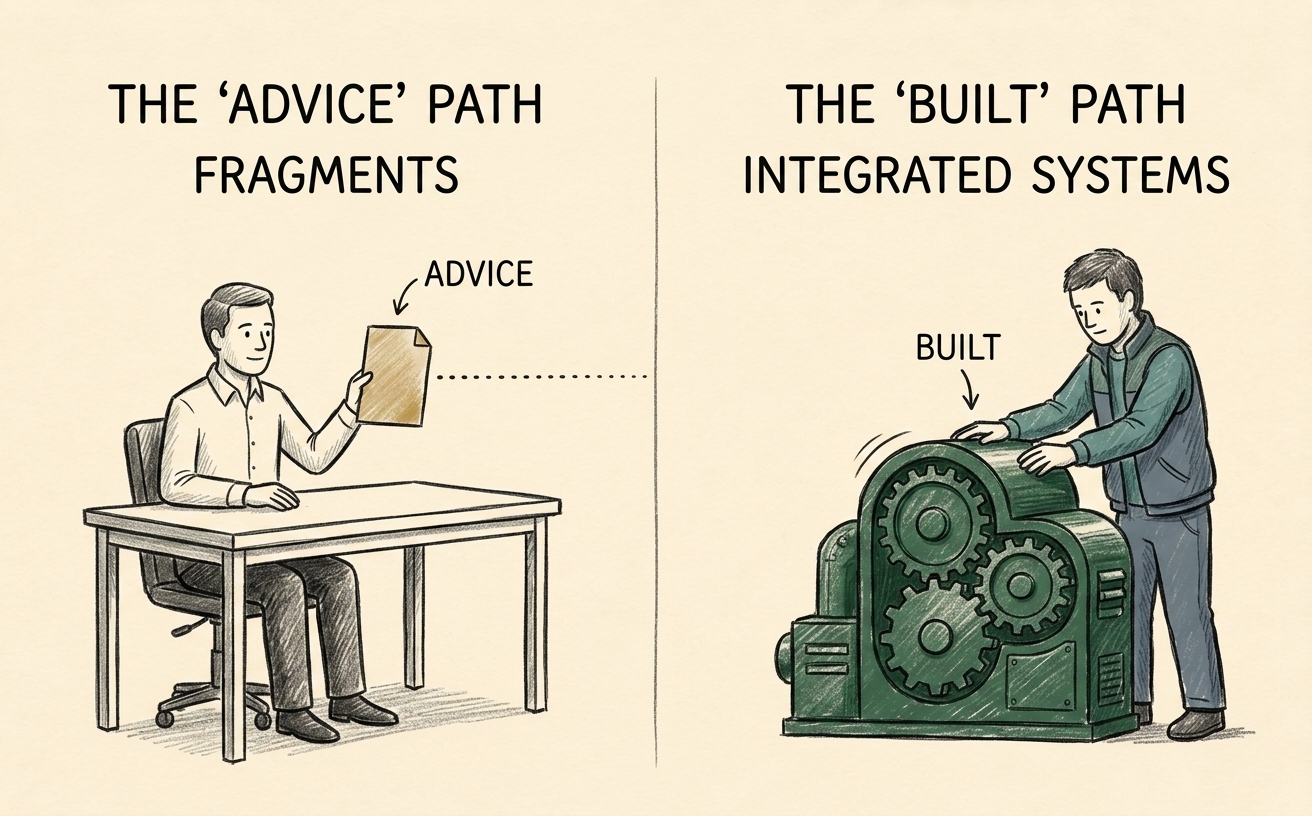
"AI consultant" is one of the vaguest job titles in the market right now. It gets used for a McKinsey team charging north of $500K, for a fractional Chief AI Officer at $150K–$180K a year, and for a generalist who took a $5K course last quarter. All three will call themselves an AI consultant. None of them do the same job. So before you hire one, it's worth being precise about what the role is and what you're buying.
The plain definition: an AI consultant is an advisor a company hires to help it use AI — to figure out where AI can help, pick the tools, plan the projects, and sometimes build them. The catch is in that word "sometimes." Most consultants advise. They assess, they recommend, they hand you a plan. Far fewer build and run the thing. That gap is the whole story of this guide, because it's also where roughly 95% of AI pilots die: not on the strategy, but on the last mile to a working system.
I come at this as an operator, not an advisor. I run five companies — Sena, Precis, Gavel, TrueStandard, and GameTape — with co-founders, AI agents, and zero hired employees, on one operating system I've built and run for two years. I didn't get there by buying a deck. So when I lay out what an AI consultant is, the types, and when you need one, I'm doing it from the build side of the line — the side most of the market never crosses.
5
AI-native companies I run
0
hired employees
4
types of AI consultant
95%
of AI pilots never reach production
What Is an AI Consultant?
An AI consultant is an advisor a company hires to help it use AI: they assess where AI can help, choose the tools and vendors, plan the projects, and sometimes build them. The role spans a wide range — from strategy advisors who hand over a roadmap to hands-on builders who ship working systems. The label is the same; the job underneath it is not.
Strip away the marketing and the role is simple to describe: you have a business, you suspect AI could help somewhere, and you hire someone who knows the space to tell you where and how. That's the shared core across every version of the title. The advisor looks at your operations, points at the places AI could save time or make money, and gives you a way forward.
Where the versions split is on the verb. Some AI consultants stop at recommend — they hand you a strategy and a prioritized list, and the building is your problem. Others go all the way to build — they ship the working thing and, ideally, help you run it. Between those two ends sit specialists who own a slice of the work: the data layer, the chatbot, the integration. The price tags track roughly with how far down that verb they go.
This matters because the word alone tells you almost nothing about what you'll receive. Two firms can both sell "AI consulting" and deliver a deck versus a running system. The rest of this guide is about telling those apart before you sign.
AI
The next teardown, without checking back
About one a week from the five companies I run with co-founders, AI agents, and zero hired employees — what I changed, and the part that broke.
One click to unsubscribe.
What Does an AI Consultant Actually Do?
Day to day, an AI consultant assesses opportunities, selects tools and vendors, writes a roadmap, sometimes builds prototypes, and helps train the team through the change. In practice most stop at the plan — a well-argued case for where AI could help, handed over for someone else to execute.
The day-to-day work of an AI consultant usually moves through a familiar sequence:
- Opportunity assessment. They map your operations and flag where AI could realistically help — the high-frequency, high-value, legible work — and, just as usefully, where it can't yet.
- Tool and vendor selection. There are more AI products than any team can evaluate. A consultant narrows the field to a shortlist that fits your stack and your budget.
- Roadmap. They sequence the opportunities into a plan — what to do first, what to defer, and how the pieces connect.
- Sometimes prototypes or implementation. The more hands-on ones build a proof of concept, or the real thing. This is the part that's often missing.
- Training and change management. They help the team adopt what gets built, because a tool no one uses is a line item, not a result.
Here's the honest part. Most AI consultants are strong on the first three and thin on the fourth. You get a sharp assessment, a sensible shortlist, and a clean roadmap — and then a handoff. The deck is the deliverable. Whether that's a good buy depends on whether you already have someone who can turn the plan into a running system.
If you don't, the plan can sit on a shelf. That's not a knock on the advice; a good roadmap is worth real money. It's a warning about the seam. The gap between a recommendation and a system running in production is exactly where most AI work goes to die — and it's the gap this guide keeps coming back to.
The Four Types of AI Consultant
There are roughly four kinds hiding under the one label: the strategy consultant (advises), the data & AI consultant (fixes the data layer), the conversational AI consultant (builds chatbots and assistants), and the implementation or agentic builder (ships and runs working systems). Knowing which one you're talking to tells you what you'll get.
Not all AI consultants do the same job. It helps to sort them into four types, from most advisory to most hands-on:
1. The strategy consultant. Pure advice. They assess your business, size the opportunity, and hand you a roadmap. No building. This is the classic model — from the big firms down to solo advisors — and it's useful when your bottleneck is deciding what to do. The limit is that a strategy is not a system; someone still has to build it.
2. The data & AI consultant. The specialist in the layer everyone skips. AI is only as good as the data it can see, and in most companies that data is scattered across tools no software can read cleanly. A data & AI consultant makes it legible — cleaning, connecting, and structuring it so AI has something to work with. Unglamorous, and where a lot of projects quietly stall. This is the foundation of any real implementation; I go deeper on it in AI Integration Services.
3. The conversational AI consultant. Focused on chatbots and assistants — support bots, internal Q&A assistants, voice agents. The work is the conversation layer: understanding intent, giving good answers, handing off to a human when it should. Narrower than a general consultant, and the right call when your specific goal is one assistant rather than a broader operating layer.
4. The implementation or agentic builder. The one who ships. They don't stop at a plan — they build the working system and get it running in production, including AI agents that carry out real multi-step work. This is the type most companies are short of, because it's the hardest and it's where the last mile lives. If this is what you need, start with Agentic AI Implementation.
A lot of confusion in the market comes from assuming you're buying type 4 when you're buying type 1. Both are legitimate. But if you hire a strategy consultant expecting a running system, you'll get a good deck and a bill for the building you still have to do.
Consultant vs Operator: Advise vs Build
The real fork isn't between consultants — it's between advising and building. A typical AI consultant tells you what to do and hands over a plan. An operator builds and runs the system themselves. One ends in a handoff; the other ends in production. Here's the straight side-by-side.
Once you've sorted the four types, the choice that decides your outcome is simpler than it looks: do you want someone to advise, or someone to build and run? That's the advise-vs-operate fork, and it's the difference between owning a plan and owning a system.
| Typical AI consultant | Operator (The Operator Method) | |
|---|---|---|
| Deliverable | A strategy and a roadmap | A working AI Operating System |
| Who builds it | Usually someone else, later | The operator, in your company |
| What you own | A plan / a deck | A system you run and keep |
| Ends in | A handoff | Production — agents running real work |
| Best for | Deciding what to do | Getting it built and running |
Neither column is wrong. If your gap is genuinely "we don't know where to start," an advisor earns their fee. But mid-market companies more often have the opposite problem: they roughly know what they want, and they're stuck on getting it built and keeping it running. For them, another strategy deck is not the missing piece. An operator is someone who runs the same kind of system they'd build for you — in my case, five AI-native companies on one owned operating layer for two years — so the plan and the build aren't two separate purchases with a cliff between them.
I've written the mid-market case in full — why the enterprise-consultant model doesn't fit a $2M–$50M company, and what an operator does instead — in The AI Consultant for Mid-Market Companies. And if you want to see the actual deliverable an operator hands over, that's your company's AI Operating System.
When You Need an AI Consultant — and Which Kind
You need an advisor when the hard part is deciding what to do. You need a builder or operator when the hard part is getting it built and keeping it running. Most mid-market companies are in the second group and hire for the first — which is how you end up with a plan and no system.
An advisor-style AI consultant is enough when:
- You don't know where AI fits in your business, and you need a clear read on the opportunities before committing budget.
- You already have a capable technical team that can build — you just need direction, a shortlist, and a sequence.
- The decision, not the execution, is the bottleneck.
You need a builder or operator when:
- You broadly know what you want and you're stuck on making it real — the plan exists, the running system doesn't.
- The goal is to make the company itself AI-native, not to buy one more standalone tool.
- Your bottleneck is a few senior people's capacity, and you need their judgment encoded into a system that runs in production — not a deck about it.
- You want to own the outcome, not rent a set of flows or hold a strategy you can't execute.
Which kind you need also depends on budget and scale. Enterprise AI consulting floors around $500K and is built for the Fortune 500; a fractional Chief AI Officer runs $150K–$180K a year. Neither is sized for a mid-market company that wants one function built and running. For a clear-eyed map of the whole field — big firms, fractional CAIOs, agencies, and operators — see The Best AI Consulting Firms for Mid-Market, and for what a real build costs, AI Implementation Cost.
The short version: if the hard part is figuring out what to do, hire an advisor. If the hard part is getting it built and keeping it running — which, for most mid-market companies, it is — hire someone who builds.
Frequently Asked Questions
What is an AI consultant?
An AI consultant is an advisor a company hires to help it use AI. They assess where AI can help, pick tools and vendors, plan projects, and sometimes build them. The role spans a wide range — from strategy advisors who hand over a roadmap to hands-on builders who ship working systems. The key question for a mid-market company is which end of that range you need: someone to advise, or someone to build and run the system.
What does an AI consultant do?
Day to day, an AI consultant assesses opportunities, selects tools and vendors, writes a roadmap, sometimes builds prototypes, and helps train the team through the change. In practice most stop at the plan — a well-argued case for where AI could help, handed over for someone else to execute. Whether that's enough depends on whether you already have someone who can build.
What is a data and AI consultant?
A data and AI consultant focuses on the layer AI actually runs on: your data. Before AI can do useful work it has to be able to read your operational data, so this kind of consultant cleans up, connects, and structures scattered data into something software can use. It's unglamorous, and it's where a lot of projects quietly stall, because AI is only as good as what it can see.
What is a conversational AI consultant?
A conversational AI consultant specializes in chatbots and assistants — customer-support bots, internal Q&A assistants, voice agents. The focus is the conversation layer: understanding intent, giving good answers, and handing off to a human when needed. It's a narrower specialty than a general AI or implementation consultant, useful when your main goal is a specific assistant rather than a broader operating system.
Do I need an AI consultant or an operator?
If you need someone to help you decide what to do — assess opportunities and write a plan — an advisor-style AI consultant is enough. If you need the system built and running in production, you need a builder, or an operator who runs the same kind of system themselves. I run five AI-native companies with zero hired employees on one owned operating system; that's the operator end of the range, not the advice end.
Want a builder, not another deck?
I take a few audits a month: a fixed deliverable that maps where your company is carrying weight a stack of agents could lift, and the order to build your own AI Operating System — one owned layer that compounds, with the ROI math to defend it.
Apply for an audit