How to Become an AI-Native Company
An AI-native company isn't one that uses AI tools — it's one built to run on them. What AI-native means, how it differs from AI-enabled, and the path to get there, from an operator who runs five AI-native companies with co-founders, agents, and zero hired employees.
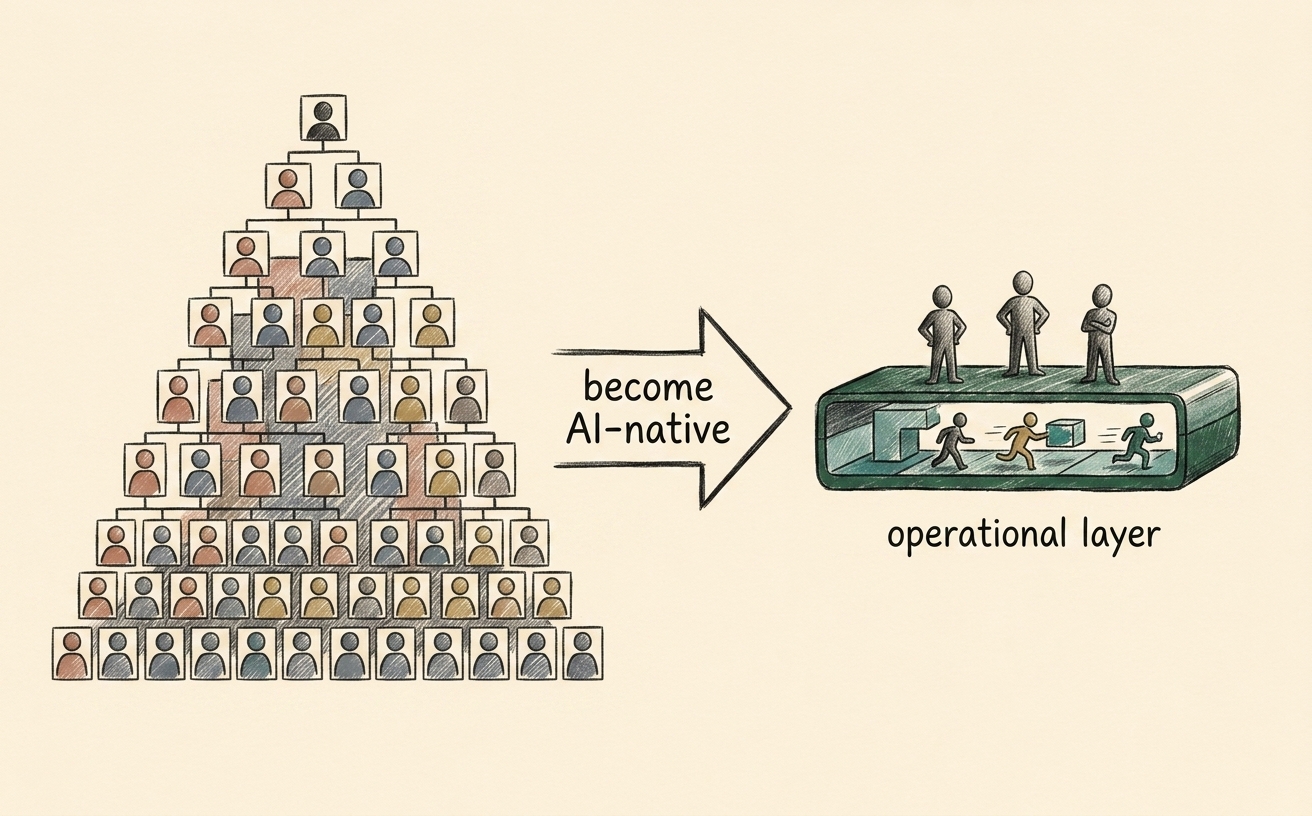
"AI-native" gets used loosely. Most of the time it means a company that has added some AI tools — a copilot here, a chatbot there — while the actual work still runs the way it always did. That's a real thing, but it isn't what I mean by AI-native, and the difference matters if you're deciding where to spend the next year.
An AI-native company is one built so its core work runs on AI by default. The data is legible to software, the workflows are encoded, agents execute them, and humans set the goals and check the output. It's not a traditional company with AI bolted on — the operating layer itself is AI.
I run five companies this way — Sena, Precis, Gavel, TrueStandard, and GameTape — with co-founders, AI agents, and zero hired employees, on one operating system I've run for two years. This guide is what AI-native means, how it differs from AI-enabled, and the concrete path to get there one function at a time.
5
AI-native companies I run
0
hired employees
2 yrs
on one owned system
3
layers: data, workflows, agents
What Is an AI-Native Company?
An AI-native company is built so its core work runs on AI by default: data legible to software, workflows encoded, agents executing them, and humans setting goals and checking output. It isn't a traditional company with AI bolted on — it's a company whose operating layer is AI from the ground up.
The test I use is simple: when the core work happens, what is doing it? In most companies the answer is people, with software helping them. In an AI-native company the answer is the operating layer — data, workflows, and agents — with people setting direction and checking the output. The humans are still essential; they've just moved up a level, from doing the work to running the system that does it.
Concretely, that means three things are true. Your operational data is captured so software can read it, not trapped in inboxes and someone's head. Your recurring workflows are encoded as repeatable procedures instead of tribal knowledge. And agents run those workflows in production, with a human owning the goal and reviewing results. When all three hold for a function, that function is AI-native.
This is how my five companies operate. Each delivers what used to need a hired team — research, strategy, fact-checking, ops coordination, coaching — as software running on one shared operating layer. Nobody was hired to staff those functions; they run on the system. That's the plain meaning of AI-native, and I go deeper on the definition in What AI-Native Actually Means.
AI
The next teardown, without checking back
About one a week from the five companies I run with co-founders, AI agents, and zero hired employees — what I changed, and the part that broke.
One click to unsubscribe.
AI-Native vs AI-Enabled: The Real Difference
AI-enabled means AI tools layered on top of human processes — people still do the work, just faster. AI-native means the operating layer itself is AI: data, workflows, and agents run the work by default. Enabled speeds up your people; native changes what the company is made of.
This is the distinction that decides whether a year of effort compounds or plateaus. AI-enabled is additive: you keep the existing process and give people faster tools. A writer gets a drafting copilot, support gets a suggested-reply box, sales gets a note-taker. Output per person goes up a bit, which is real and worth having. But the shape of the company doesn't change — you still scale it by adding people, and the AI is a helper riding on top.
AI-native is structural. The work itself moves onto the operating layer, so a function's output stops being tied to how many people you put on it. That's a different economic engine, not a faster version of the same one. It's also harder, which is why most "AI transformation" stops at enabled: buying tools is easy, and rebuilding how the work runs is the part that takes real engineering.
Neither is wrong — enabled is a fine place to start. The mistake is thinking a shelf of AI tools has made you AI-native when the underlying work still runs on people. For the full breakdown of the two and where the line sits, see What AI-Native Actually Means.
The Path: Data → Workflows → Agents
The path has three layers, in order: make your data legible to software, encode your workflows as repeatable procedures, then put agents on those workflows with a human checking output. A control loop feeds results back so it compounds. You build it one function at a time, not all at once.
Becoming AI-native isn't a leap; it's an order of operations. The layers have to go in sequence because each one depends on the one below it. Agents can't run a workflow that was never encoded, and a workflow can't run on data the software can't read. Skip the lower layers and you get an impressive demo that dies in production — the same reason roughly 95% of AI pilots never make it there. Here is the order I build in:
- Data — make it legible. Capture the operational data a function needs so software can read it, instead of leaving it scattered across inboxes, docs, and people's heads. This is the unglamorous foundation, and it's where most efforts stall.
- Workflows — encode them. Take the recurring procedure — how the work gets done, including the judgment calls — and write it down as a repeatable, explicit workflow. This turns tribal knowledge into something a system can execute.
- Agents — put them to work. Deploy agents to run the encoded workflow on the legible data, with a human owning the goal and reviewing output. Then close the loop: feed results back so the system improves over time. That control loop is what makes it compound instead of plateau.
That's the whole architecture — three layers plus a control loop that makes it get better as it runs. It's exactly what I mean by an AI Operating System, and I lay out the full deliverable in What an AI Operating System Is.
What Changes When You're AI-Native
Unit economics change first: work that used to need a hired team gets delivered as software, so output stops scaling with headcount. Speed changes too — a function runs at software speed, not meeting speed. The proof I trust most is my own: five companies, zero hired employees, two years.
The first thing that changes is the relationship between output and headcount. In a traditional company, more work means more people; the cost curve rises with the workload. When a function runs on the operating layer, its output is decoupled from headcount — you scale it by improving the system, not by hiring. That's the change I feel most directly running five companies without a hired team: the functions that would normally require staff run as software instead.
Speed changes next. A workflow that used to wait on someone's calendar runs when the trigger fires. The lag between "we should do this" and "it's done" collapses, because the work isn't queued behind a person's day. And because the control loop feeds results back, the system tends to get better the more it runs, rather than staying flat until the next reorg.
I want to be careful not to oversell it: this doesn't remove humans, and it doesn't happen for free. Someone still sets the goals, checks the output, and owns the judgment. What changes is where that human effort goes — into running the system instead of manning the line. For why "a service delivered as software" has better unit economics than either SaaS or a services team, see Service-as-a-Software.
How to Start
You don't rebuild the company overnight. Pick one function, make its data legible, encode the workflow, put an agent on it, and add the control loop. Get that one running in production, then repeat. Becoming AI-native is a sequence of small conversions, not a single relaunch.
The failure mode here is trying to make the whole company AI-native at once. It's too much surface area, the data problem alone is enormous, and you end up with a stalled megaproject. The way that works is to pick one function and take it all the way to production before touching the next. Choose a function that's high-frequency and high-value, where the work is legible enough to encode — that's where the first win is cheapest and most visible.
Then run that one function through the three layers: make its data legible, encode its workflow, put an agent on it with a human checking the output, and add the control loop so it improves. Once it's running in production — not a demo, the real thing carrying real load — you have both a working piece of the operating layer and a template for the next function. You repeat, and the company becomes AI-native one function at a time.
The agent layer is the part that most often fails on the last mile, so it's worth understanding how it's built to survive production — I cover that in Agentic AI Implementation. And if you're a mid-market company ($2M–$50M) weighing whether to advise your way there or have an operator build it, the AI consultant for mid-market guide lays out that choice.
Frequently Asked Questions
What is an AI-native company?
An AI-native company is one built so its core work runs on AI by default, not one that bolts AI onto human processes. Its data is legible to software, its workflows are encoded, agents execute them, and humans set the goals and check the output. I run five of them — Sena, Precis, Gavel, TrueStandard, and GameTape — with co-founders, AI agents, and zero hired employees, on one operating system for two years.
What's the difference between AI-native and AI-enabled?
AI-enabled means tools sitting on top of human processes — a copilot in the inbox, a chatbot on the site — while people still do the underlying work. AI-native means the operating layer itself is AI: data, workflows, and agents run the work by default, with humans setting direction. Enabled makes existing people faster; native changes what the company is made of. Most 'AI transformation' stops at enabled.
How does a company become AI-native?
You don't rebuild the company overnight. You go layer by layer: make one function's data legible to software, encode its workflow as a repeatable procedure, put an agent on it with a human checking output, then add a control loop so results feed back and it improves. That's the data to workflows to agents path. Pick one high-frequency, high-value function, get it running in production, then repeat.
Do you need to be a startup to be AI-native?
No. AI-native is about how the work runs, not how old the company is. A startup can build native from day one, but an established mid-market company ($2M–$50M) can become AI-native one function at a time — the path is the same: legible data, encoded workflows, agents, control loop. The advantage an existing company has is real workflows and real data to encode; the work is converting them, not inventing them.
How long does it take to become AI-native?
There's no single switch, so the honest answer is one function at a time. A first function can be running in production in a matter of weeks, and the company becomes AI-native as you repeat that across functions. It's a compounding path, not a launch date — you're never 'done,' you just keep converting more of the work to run on the operating layer.
Want to make your company AI-native?
I take a few audits a month: a fixed deliverable that maps which of your functions are ready to run on the operating layer, and the order to convert them — data, workflows, agents — into your own AI Operating System, with the ROI math to defend it.
Apply for an audit