The Real Challenges of AI Implementation (and How to Get Past Them)
Most AI projects don't fail on the model — they fail on the unglamorous parts. The four challenges that kill implementations are illegible data, the last mile to production, adoption, and ownership. Here's each one plainly, and how an operator gets past it — from someone who runs five AI-native companies in production with zero hired employees.
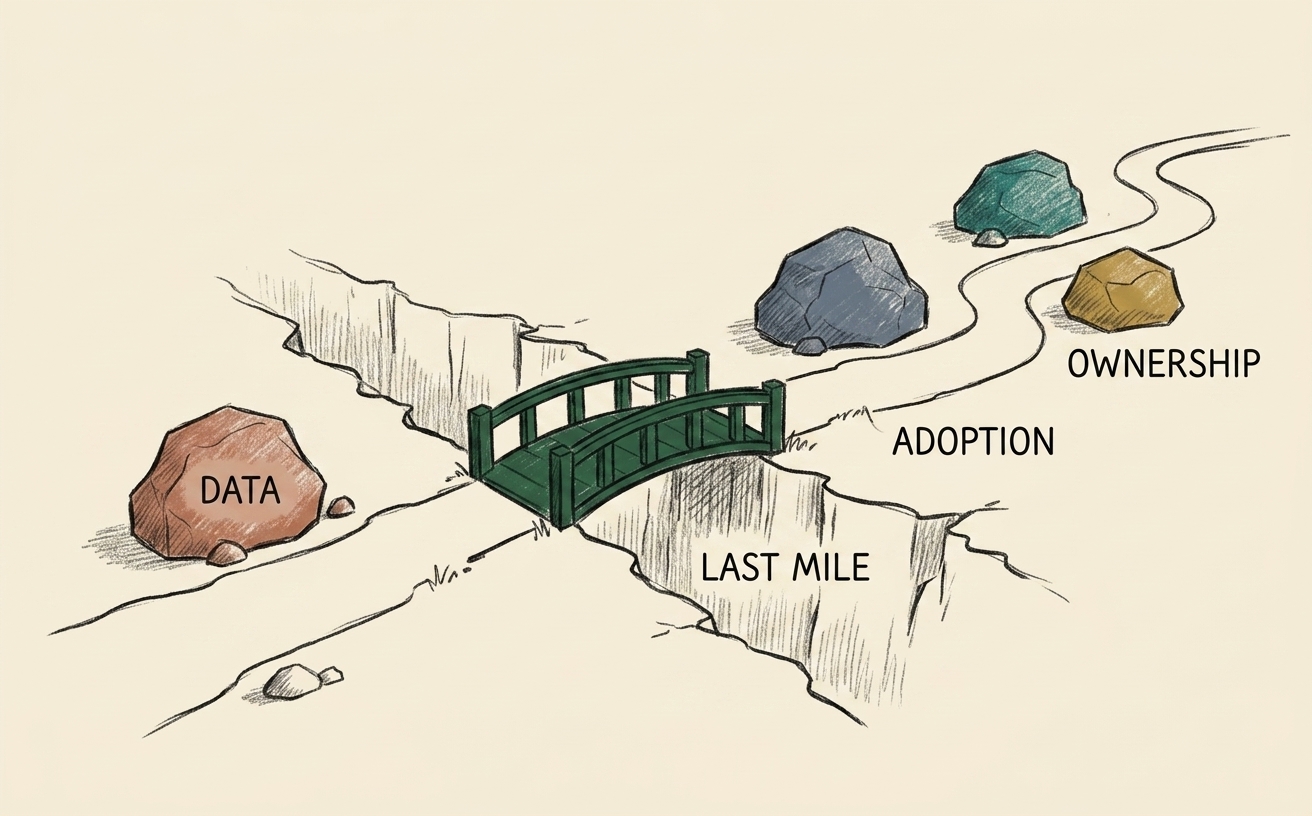
There's a number that hangs over every AI project: roughly 95% of AI pilots never reach production. That statistic gets read as an AI problem, but it isn't. The models are good enough. The reason nineteen out of twenty pilots die is that the hard parts of implementation have almost nothing to do with the model, and almost everything to do with the unglamorous work around it.
I run five companies — Sena, Precis, Gavel, TrueStandard, and GameTape — with co-founders, AI agents, and zero hired employees, on one operating system I've kept running in production for two years. Keeping something live is a different discipline from getting a demo to work once. Every place my systems could have died is a place I had to build past, and the same four failure points show up over and over.
Illegible data. The last mile to production. Adoption. Ownership. None of them is exciting, which is exactly why they get skipped and exactly why they kill projects. This guide walks each one, in the order they tend to bite, and how an operator gets past it.
95%
of AI pilots never reach production
4
challenges that kill most projects
5
companies I keep running in prod
0
hired employees
What Are the Main Challenges of AI Implementation?
Four challenges kill most AI implementations, and none is the model. Data the system can't read. The last mile from a working demo to a production-reliable system. Adoption — people don't use it. Ownership — the automations are rented, not yours. Roughly 95% of pilots never reach production for exactly these reasons.
Ask most teams why an AI project stalled and you'll hear about the model — it wasn't accurate enough, it hallucinated, the use case was too hard. That's rarely the real story. The model is the part vendors have already solved for you. What kills implementations is everything the demo skipped on its way to a meeting.
Sort the failures and they land in four buckets, roughly in the order they bite. First, the data isn't legible — the system can't see what it needs to. Second, the last mile — the distance from a demo that works once to a system that runs reliably every day — was never built. Third, adoption — even a working system fails if the people around it route around it. Fourth, ownership — the pieces live in someone else's accounts, so nothing compounds and nothing is yours.
The rest of this guide takes them one at a time. They're ordered on purpose: you can't solve adoption or ownership until the data and the last mile are handled, and skipping ahead is how projects end up back in that 95%.
AI
The next teardown, without checking back
About one a week from the five companies I run with co-founders, AI agents, and zero hired employees — what I changed, and the part that broke.
One click to unsubscribe.
Challenge 1: Illegible Data
AI is only as good as what it can see. In most companies the operational knowledge is scattered — across tools, spreadsheets, threads, and people's heads — in a form software can't read. That's where pilots quietly stall: not on the model, on the data it was never given clean access to.
This is the first wall, and the one teams most want to skip. Everyone wants to start with the agent, the clever part. But an agent is only ever as good as what it can read, and in a real company the information it needs to do useful work is spread across a CRM, a dozen spreadsheets, a wiki nobody updates, email threads, and — most of it — in the heads of a few senior people who've never had to write it down.
To software, most of that is invisible. The pilot works in the demo because someone hand-fed it a clean example. Point it at the real business and it's reading a fraction of the picture, so it gets the answer wrong, and everyone concludes the AI wasn't ready. The AI was fine. It was working blind.
Getting past this is unglamorous, upfront work: capturing the operational data and the tacit judgment so a system can read it. It's also where a real implementation earns its keep, because once the data is legible every later step gets easier. I wrote the operator's view of this layer in AI Integration Services.
Challenge 2: The Last Mile to Production
The last mile is the distance between a demo that works and a system that runs real work reliably every day. The prototype is the easy part; making it survive messy inputs, edge cases, and production load is the hard part. It's where roughly 95% of pilots die — the demo worked, the durable system was never built.
This is the challenge behind the headline number. Building an AI demo has never been easier — an afternoon and an API key gets you something that impresses in a meeting. But a demo that works once, on a clean input, with someone watching, is a completely different thing from a system that does the same job at 2 a.m. on the ugly inputs nobody anticipated, without a human catching its mistakes.
The gap between those two is the last mile, and it's where the real engineering lives: handling the inputs that don't fit the happy path, catching and recovering from errors, checking the model's own output, staying inside cost and latency budgets, and staying reliable as volume grows. Skip that work and the pilot looks finished when it's barely started — which is precisely why roughly 95% of pilots never make it to production.
Reliability, not capability, is the real bar. The way I make an agent safe to run unattended is a defined reliability stack — seven layers that stand between a model call and a production failure. That's the difference between a demo and something you'd let run your operations, and I broke it down in Agentic AI Implementation.
Challenges 3 & 4: Adoption and Ownership
Two quieter killers. Adoption: even a working system fails if people route around it, so it has to fit how they already work. Ownership: if the automations live in an agency's accounts, you're renting — and when they leave, the work leaves too. A system nobody uses, or nobody owns, isn't implemented.
Adoption. You can clear the data and the last mile and still lose here. A tool people don't trust, or that adds a step to their day, quietly gets routed around — the spreadsheet comes back, the old process reappears, and the shiny system sits unused. Adoption isn't a training problem you solve with a slide deck at the end. It's a design constraint from the start: the system has to fit the way people already work and take work off their plate, not add a chore. If using it is more effort than ignoring it, it will be ignored.
Ownership. The last one is structural and easy to miss until it hurts. A lot of AI work — especially from automation shops — gets built inside the vendor's accounts and tools. The flows live in their Zapier, their platform, their logins. It runs, so you don't notice, until you stop paying or they move on and the work goes dark with them. That's renting, not building, and rented pieces never compound into anything you own.
These two are why a stack of point automations so often ends up as a dead end — nobody adopts it, and nobody owns it. I walked through that trap, and the owned-system alternative, in the AI automation agency alternative.
How Operators Get Past Them
You get past them in order. Fix the data first so the system can see. Build for the last mile with a reliability stack, not a demo. Scope tightly, encode one high-value workflow, and fit how people work so it's adopted. Then hand over ownership, and add a control loop so it improves as it runs.
Each challenge has a direct answer, and the sequence matters as much as the steps. This is the same path I use to keep five companies running, and it maps one-to-one onto the four failure points:
- Fix the data first. Before anything clever, make the operational data and the tacit judgment legible to software. Nothing downstream works if the system can't see — so this comes first, not last.
- Build for the last mile. Treat reliability as the deliverable, not the demo. The seven-layer reliability stack is what stands between a model call and a production failure, and it's the reason an agent can run unattended instead of being babysat.
- Scope tightly and start narrow. A fixed scope with a real finish line beats an open-ended "AI transformation." Encode one high-value, high-frequency workflow end to end rather than boiling the ocean — a real win in production beats ten half-built pilots.
- Design for adoption. Fit the way people already work and take work off their plate, so using the system is the path of least resistance instead of a new chore.
- Hand over ownership, then close the loop. Build it to be handed to you — your accounts, your system — and add a control loop that feeds results back so it compounds instead of going stale.
Underneath, it's one shape: three layers — data made legible, workflows encoded, agents executing — with a control loop that makes it improve as it runs. That's the build I package as your company's AI Operating System, and the phased way I deliver it — legible data first, then reliable agents, on a fixed scope handed over to you — is laid out in AI Implementation Services.
Doing it this way costs more upfront than a quick automation, because the unglamorous parts are the work. It also costs far less than a dead pilot you have to redo, and it's the version that reaches production. If you want the real numbers on what a done-right implementation runs, I broke them down in AI Implementation Cost.
Frequently Asked Questions
What are the biggest challenges of AI implementation?
The biggest challenges aren't the model — they're the unglamorous parts around it. Four kill most projects: illegible data (AI can't read what's scattered across tools, threads, and people's heads), the last mile to production (the demo works, the durable system was never built), adoption (people don't use it), and ownership (the automations are rented, living in someone else's accounts). Roughly 95% of AI pilots never reach production, and these are why.
Why do most AI projects fail?
Most AI projects fail on execution, not capability. The model is rarely the problem; the problem is everything around it — data the system can't read, a production last mile nobody built, users who never adopt it, and no clear owner. Around 95% of pilots never reach production. The demo impresses in a meeting, then dies on the way to real work because the reliable, owned system underneath was skipped.
What is the last-mile problem in AI?
The last mile is the gap between a working demo and a system that runs real work reliably, day after day, without someone babysitting it. A prototype that succeeds in a controlled test is the easy part; making it survive messy inputs, edge cases, and production load is the hard work that takes most of the effort. It's where roughly 95% of AI pilots die — the demo worked, the durable system was never built.
How do you overcome AI implementation challenges?
Attack them in order. Make the data legible first, because nothing works if the system can't see. Then build for the last mile with a reliability stack, not a demo. Scope tightly so there's a real finish line, encode one high-value workflow rather than boiling the ocean, and design for adoption by fitting how people already work. Finally, own it — build the system to be handed over, with a control loop that improves it as it runs.
What's the most common AI implementation mistake?
Mistaking a demo for a system. A prototype that works in a meeting is the easy part; the durable, reliable, owned version that runs in production is the real work, and it's routinely skipped. The related mistake is starting with the model instead of the data — building something clever on top of information the system can't read. Both end the same way: a pilot that never reaches production.
Want past the last mile?
I take a few audits a month: a fixed deliverable that finds where your last AI attempt stalled — data, last mile, adoption, or ownership — and lays out the order to build your own AI Operating System, one owned layer that reaches production and compounds, with the ROI math to defend it.
Apply for an audit