AI Agents for Operations: What They Do and How to Deploy Them
AI agents can run real operational work — not just chat about it — if you build them to survive production. Here's what agents for operations do, the honest difference between AI agent consulting and an operator who runs them, why ops agents fail, and how to deploy them, from someone whose five companies run on agents with zero hired employees.
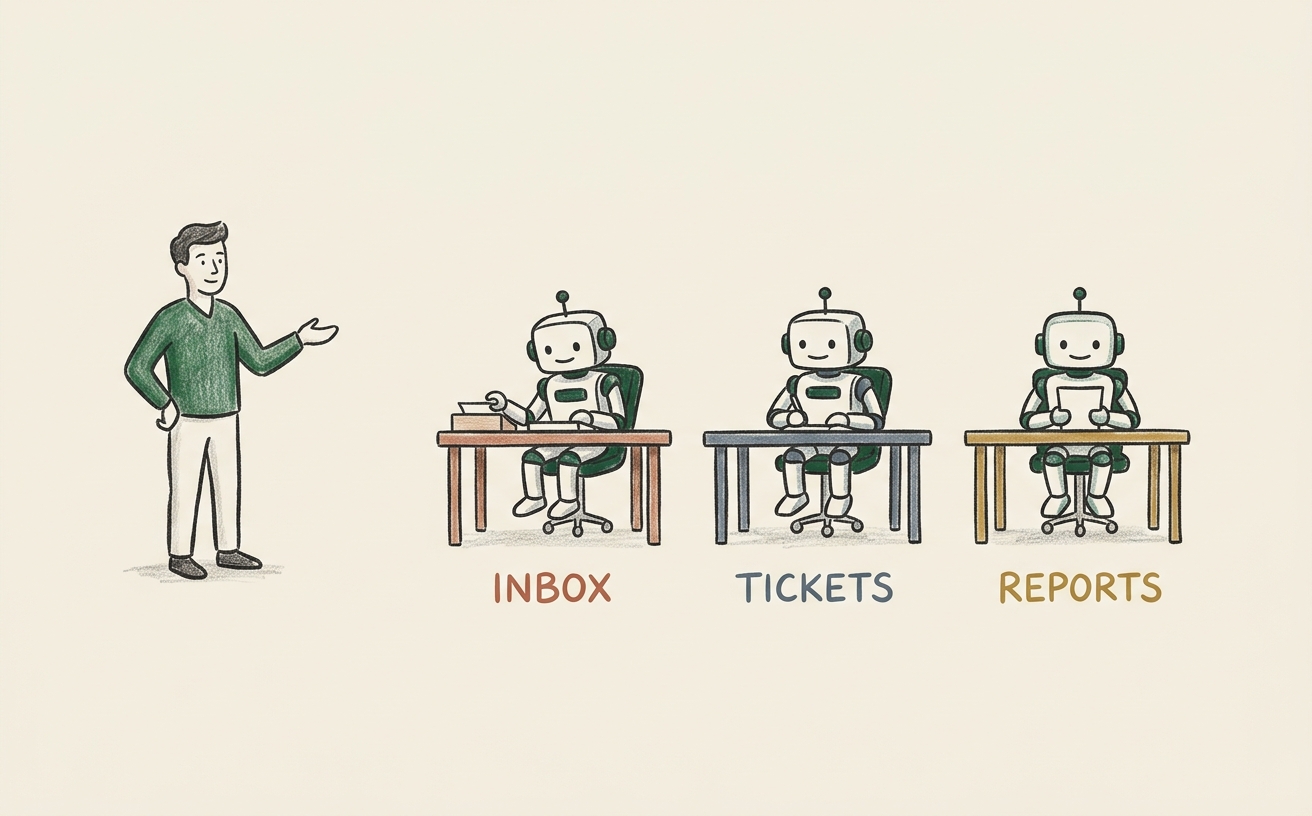
"AI agents for operations" is having its moment, and most of what's written about it is either hype or a demo that never reaches production. I want to give you the operator's version instead, because I don't write about agents theoretically. My companies run on them.
I run five companies — Sena, Precis, Gavel, TrueStandard, and GameTape — with co-founders, AI agents, and zero hired employees, on one operating system I've run for two years. The operational work a normal company staffs with a team happens on agents. So when I say an agent can run operations, I mean I watch it happen every day, including the days it breaks.
This guide covers what agents for operations do, the work they can carry, the honest difference between hiring an AI agent consultant and hiring an operator who runs them, why so many ops agents die in production, and the order to deploy them so yours don't.
5
companies run on agents
0
hired employees
7
layers that make an agent production-safe
95%
of AI pilots never reach production
What Are AI Agents for Operations?
AI agents for operations are software workers that carry out multi-step operational tasks — triage, data entry, follow-ups, reporting — with a human setting the goal and checking the output. Unlike a chatbot, which answers questions, an agent acts: it takes the steps, uses the tools, and gets the work done.
The word "agent" gets stretched to mean almost anything lately, so let me be concrete. A chatbot answers a question and stops. A single automation fires one fixed step when triggered. An agent sits above both: give it a goal, and it decides the steps, calls the tools, handles what comes back, and keeps going until the job is done or it needs a human. That last part — taking action across multiple steps — is what makes it an operational worker rather than a smarter search box.
The human doesn't disappear; the human moves up a level. Instead of doing the task, you set the goal, define what "done" and "correct" look like, and check the output. In the companies I run, that's the actual shape of the work: a co-founder or I set direction, and agents carry the operational load underneath. Nobody is hand-processing tickets or copying data between systems.
So "AI agents for operations" isn't a chatbot with a new label. It's software that does operational work — the running of the business, not the talking about it. The useful question is which operational work it can carry, which is next.
AI
The next teardown, without checking back
About one a week from the five companies I run with co-founders, AI agents, and zero hired employees — what I changed, and the part that broke.
One click to unsubscribe.
What Operational Work Can Agents Actually Run?
In the companies I run, agents handle research, operations coordination, fact-checking, follow-ups, and reporting — each a function that used to need a hire, now delivered as software. The rule of thumb: work that's repeatable, rule-bound, and legible to software is work an agent can carry.
Here's the honest version, grounded in what I actually run rather than a capabilities brochure. Across five companies — Sena, Precis, Gavel, TrueStandard, and GameTape — the operational functions that used to need a hired team run on agents instead. Each one is a job description turned into software.
A few of the operational functions running on agents right now:
- Research. Gathering, reading, and synthesizing source material into something usable, on a schedule, without a person doing the reading.
- Operations coordination. Moving work through its stages — routing, triage, status — the connective tissue that used to eat an ops manager's day.
- Fact-checking and quality control. Checking claims and outputs against sources before anything ships, on every item rather than a sampled few.
- Follow-ups. Chasing the open threads — replies owed, next steps, the things that fall through the cracks when a person is busy.
- Reporting. Turning raw activity into the summary a decision-maker reads, generated rather than assembled by hand.
Notice the framing: each of these is a function, delivered as software, not a person you hire and manage. That's the model — a service your company would otherwise buy or staff, running as code on your own operating layer. I laid out why that beats both SaaS and a services hire on unit economics in Service-as-a-Software. The point for operations is simple: the work gets done at software cost and software speed, with a person setting the goal and owning the result.
AI Agent Consulting vs an Operator Who Runs Them
An AI agent consultant advises on agents and often builds a prototype, then hands you a plan. An operator builds the agents, runs them in production behind a reliability stack, and hands over a system you own. Consulting ends in a recommendation; operating ends in working software.
There's a real market for "AI agent consulting," and some of it is good work. But the word "consulting" hides the fork that matters: does the engagement end with advice, or with agents running your operations? Here's the straight side-by-side.
| AI agent consultant | Operator (The Operator Method) | |
|---|---|---|
| Deliverable | Assessment, recommendations, sometimes a prototype | Working agents running your operations |
| Runs it in production? | Usually not — hands off before the hard part | Yes — that's the whole job |
| Reliability stack | Rarely — out of scope | Seven-layer stack, standard |
| What you own | A plan and a pilot | A system built to hand over |
| Best for | Getting direction and a second opinion | Actually running ops on agents |
Neither is wrong — they're different buys. If you already know you want agents built and running, not just recommended, the thing you're buying is implementation, and I broke down what that involves in Agentic AI Implementation.
Why Ops Agents Fail in Production
Ops agents fail on reliability, not capability. The model is smart enough; the demo works. What's missing is the engineering that keeps an agent correct on the hundredth run, not just the first — error handling, checks, retries, guardrails. I make agents production-safe with a seven-layer reliability stack.
The gap between an agent that demos well and one you can put on real operations is almost never intelligence. It's reliability. A demo runs once, on a clean input, with someone watching. Production is the hundredth run, on a messy input, with no one watching — and that's where most agents quietly fall apart. The failure isn't "the model can't do it." It's "the system around the model was never built."
This is the mechanism behind the number everyone quotes: roughly 95% of AI pilots never reach production. The pilot proves the capability, and then the unglamorous work — error handling, validation, retries, escalation paths, guardrails, monitoring — either gets done or the thing dies at the last mile. Capability is table stakes now. Reliability is the moat, and it's engineering, not prompting.
To make an agent safe enough to run operations, I put it behind a seven-layer reliability stack — the layers that catch, correct, and contain what a single model call gets wrong. I wrote up what those layers are in The Seven-Layer Reliable Agent. And once you're running more than one agent, reliability becomes a coordination problem — how agents hand off, share state, and stay consistent — which I covered in AI Agent Orchestration.
How to Deploy Agents in Your Operations
Deploy in build order, not tool order: make the data legible first, encode the workflow you want run, put an agent on that workflow behind the reliability stack, then add a control loop that feeds results back so it improves. Skip the first steps and the agent has nothing solid to stand on.
If you take one thing from this, take the order. The mistake I see most is starting with the agent — picking a shiny framework, wiring it to some tools, and hoping. That's tool order, and it produces demos that die. Build order is the reverse, and it's how the systems I run were built.
- Make the data legible. An agent can only act on what software can read. Scattered data across inboxes, docs, and tools is where most projects stall, so this comes first. The operator's view of that layer is in AI Integration Services.
- Encode the workflow. Write down the actual procedure — the steps, the decision points, what "good" looks like — before an agent runs it. If you can't describe the workflow, an agent can't run it.
- Put an agent on it, behind the stack. Now the agent has legible data and a defined job. Wrap it in the reliability stack so it holds up on the hundredth run, not just the first.
- Add the control loop. Feed results back — what worked, what didn't, where a human had to step in — so the system improves instead of drifting. This is the part that makes it compound.
Those four steps — legible data, encoded workflow, reliable agent, control loop — are the three layers plus the loop that make up an AI Operating System. Agents for operations aren't a bolt-on; they're the top layer of a system, and they only run when the layers under them are built. Start with one operational function, do the order properly, and you'll have something that holds — and something you own.
Frequently Asked Questions
What are AI agents for operations?
AI agents for operations are software workers that carry out multi-step operational tasks — triage, data entry, follow-ups, reporting, research — with a human setting the goal and checking the output. Unlike a chatbot, which answers questions, an agent acts: it takes the steps and uses the tools to get the work done. In the five companies I run, agents handle whole operational functions that used to require hires.
What is AI agent consulting?
AI agent consulting is advisory work: a consultant assesses where agents could help, recommends tools and use cases, and often builds a prototype or pilot before handing you a plan. It's useful for direction, but it usually stops before the hard part — running agents reliably in production. An operator does the opposite: builds the agents, runs them behind a reliability stack, and hands over a system you own.
What operational work can AI agents handle?
Work that's repeatable, rule-bound, and legible to software. In practice that's a lot: research, operations coordination, fact-checking, follow-ups, reporting, data entry, and triage. In the companies I run, each of those is a function delivered as software rather than a hire. The test isn't whether a task is important — it's whether it's structured enough for an agent to carry with a human checking the output.
Why do AI agents fail in production?
Reliability, not capability. The model is usually smart enough and the demo works — but a demo that works once is not a system that works on the hundredth run. What's missing is the engineering: error handling, checks, retries, and guardrails. It's the same reason roughly 95% of AI pilots never reach production. I make agents production-safe with a seven-layer reliability stack.
Do I need an AI agent consultant or an operator?
If you want a recommendation — where agents might help, which tools to consider — a consultant is enough. If you want agents running your operations, you want an operator: someone who builds them, runs them reliably in production, and hands over a system you own. I run five AI-native companies on agents with zero hired employees; the deliverable is working software, not a deck.
Want agents that survive production?
I take a few audits a month: a fixed deliverable that maps which operational functions in your company an agent could carry, what it takes to run them reliably, and the order to build them into an AI Operating System you own — with the ROI math to defend it.
Apply for an audit